BAMIYAN, Afghanistan: Sitting in his modest home beneath snow-dusted hills in Afghanistan’s Bamiyan province, Nimatullah Rahesh expressed relief to have found somewhere to “live peacefully” after months of uncertainty.
Rahesh is one of millions of Afghans pushed out of Iran and Pakistan, but despite being given a brand new home in his native country, he and many of his recently returned compatriots are lacking even basic services.
“We no longer have the end-of-month stress about the rent,” he said after getting his house, which was financed by the UN refugee agency on land provided by the Taliban authorities.
Originally from a poor and mountainous district of Bamiyan, Rahesh worked for five years in construction in Iran, where his wife Marzia was a seamstress.
“The Iranians forced us to leave” in 2024 by “refusing to admit our son to school and asking us to pay an impossible sum to extend our documents,” he said.
More than five million Afghans have returned home since September 2023, according to the International Organization for Migration (IOM), as neighboring Iran and Pakistan stepped up deportations.
The Rahesh family is among 30 to be given a 50-square-meter (540-square-foot) home in Bamiyan, with each household in the nascent community participating in the construction and being paid by UNHCR for their work.
The families, most of whom had lived in Iran, own the building and the land.
“That was crucial for us, because property rights give these people security,” said the UNHCR’s Amaia Lezertua.
Waiting for water
Despite the homes lacking running water and being far from shops, schools or hospitals, new resident Arefa Ibrahimi said she was happy “because this house is mine, even if all the basic facilities aren’t there.”
Ibrahimi, whose four children huddled around the stove in her spartan living room, is one of 10 single mothers living in the new community.
The 45-year-old said she feared ending up on the street after her husband left her.
She showed AFP journalists her two just-finished rooms and an empty hallway with a counter intended to serve as a kitchen.
“But there’s no bathroom,” she said. These new houses have only basic outdoor toilets, too small to add even a simple shower.
Ajay Singh, the UNHCR project manager, said the home design came from the local authorities, and families could build a bathroom themselves.
There is currently no piped water nor wells in the area, which is dubbed “the dry slope” (Jar-e-Khushk).
Ten liters of drinking water bought when a tanker truck passes every three days costs more than in the capital Kabul, residents said.
Fazil Omar Rahmani, the provincial head of the Ministry of Refugees and Repatriation Affairs, said there were plans to expand the water supply network.
“But for now these families must secure their own supply,” he said.
Two hours on foot
The plots allocated by the government for the new neighborhood lie far from Bamiyan city, which is home to more than 70,000 people.
The city grabbed international attention in 2001, when the Sunni Pashtun Taliban authorities destroyed two large Buddha statues cherished by the predominantly Shia Hazara community in the region.
Since the Taliban government came back to power in 2021, around 7,000 Afghans have returned to Bamiyan according to Rahmani.
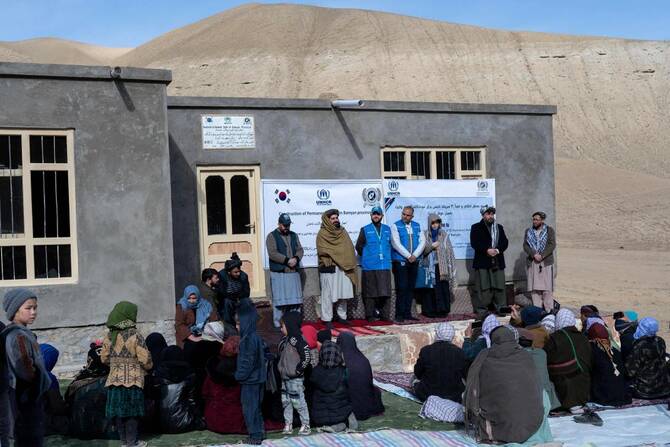
The new project provides housing for 174 of them. At its inauguration, resident Rahesh stood before his new neighbors and addressed their supporters.
“Thank you for the homes, we are grateful, but please don’t forget us for water, a school, clinics, the mobile network,” which is currently nonexistent, he said.
Rahmani, the ministry official, insisted there were plans to build schools and clinics.
“There is a direct order from our supreme leader,” Hibatullah Akhundzada, he said, without specifying when these projects will start.
In the meantime, to get to work at the market, Rahesh must walk for two hours along a rutted dirt road between barren mountains before he can catch a ride.
Only 11 percent of adults found full-time work after returning to Afghanistan, according to an IOM survey.
Ibrahimi, meanwhile, is contending with a four-kilometer (2.5-mile) walk to the nearest school when the winter break ends.
“I will have to wake my children very early, in the cold. I am worried,” she said.


![]()


Afghan returnees in Bamiyan struggle despite new homes
Short Url
https://arab.news/6z5j7
Afghan returnees in Bamiyan struggle despite new homes
- More than five million Afghans have returned home since September 2023, according to the International Organization for Migration

Neglected killer: kala-azar disease surges in Kenya
MANDERA: For nearly a year, repeated misdiagnoses of the deadly kala-azar disease left 60-year-old Harada Hussein Abdirahman’s health deteriorating, as an outbreak in Kenya’s arid regions claimed a record number of lives.
Kala-azar is spread by sandflies and is one of the most dangerous neglected tropical diseases, with a fatality rate of 95 percent if untreated, causing fever, weight loss, and enlargement of the spleen and liver.
Cases of kala-azar, also known as visceral leishmaniasis, have spiked in Kenya, from 1,575 in 2024 to 3,577 in 2025, according to the health ministry.
It is spreading to previously untouched regions and becoming endemic, driven by changing climatic conditions and expanding human settlements, say health officials, with millions potentially at risk of infection.
Abdirahman, a 60-year-old grandmother, was bitten while herding livestock in Mandera county in Kenya’s northeast, a hotspot for the parasite but with only three treatment facilities capable of treating the disease.
She was forced to rely on a local pharmacist who repeatedly misdiagnosed her with malaria and dengue fever for about a year.
“I thought I was dying,” she told AFP. “It is worse than all the diseases they thought I had.”
She was left with hearing problems after the harsh treatment to remove the toxins from her body.
East Africa generally accounts for more than two-thirds of global cases, according to the World Health Organization.
“Climate change is expanding the range of sandflies and increasing the risk of outbreaks in new areas,” said Dr. Cherinet Adera, a researcher at the Drugs for Neglected Diseases Initiative in Nairobi.
- ‘So scared’ -
A surge in cases among migrant workers at a quarry site in Mandera last year led authorities to restrict movement at dusk and dawn when sandflies are most active.
At least two workers died, their colleagues said. Others returned to their villages and their fates are unknown.
“We did not know about the strange disease causing our colleagues to die,” said Evans Omondi, 34, who traveled hundreds of miles from western Kenya to work at the quarry.
“We were so scared,” added Peter Otieno, another worker from western Kenya, recalling how they watched their infected colleagues waste away day by day.
In 2023, the six most-affected African nations adopted a framework in Nairobi to eliminate the disease by 2030.
But there are “very few facilities in the country able to actively diagnose and treat,” kala-azar, Dr. Paul Kibati, tropical disease expert for health NGO Amref, told AFP.
He said more training is needed as mistakes in testing and treatment can be fatal.
The treatment can last up to 30 days and involves daily injections and often blood transfusions, costing as much as 100,000 Kenyan shillings ($775), excluding the cost of drugs, said Kibati, adding there is a need for “facilities to be adequately equipped.”
The sandfly commonly shelters in cracks in poorly plastered mud houses, anthills and soil fissures, multiplying during the rainy season after prolonged drought.
Northeastern Kenya, as well as neighboring regions in Ethiopia and Somalia, have experienced a devastating drought in recent months.
“Kala-azar affects mostly the poorest in our community,” Kibati said, exacerbated by malnutrition and weak immunity.
“We are expecting more cases when the rains start,” Kibati said.
Kala-azar is spread by sandflies and is one of the most dangerous neglected tropical diseases, with a fatality rate of 95 percent if untreated, causing fever, weight loss, and enlargement of the spleen and liver.
Cases of kala-azar, also known as visceral leishmaniasis, have spiked in Kenya, from 1,575 in 2024 to 3,577 in 2025, according to the health ministry.
It is spreading to previously untouched regions and becoming endemic, driven by changing climatic conditions and expanding human settlements, say health officials, with millions potentially at risk of infection.
Abdirahman, a 60-year-old grandmother, was bitten while herding livestock in Mandera county in Kenya’s northeast, a hotspot for the parasite but with only three treatment facilities capable of treating the disease.
She was forced to rely on a local pharmacist who repeatedly misdiagnosed her with malaria and dengue fever for about a year.
“I thought I was dying,” she told AFP. “It is worse than all the diseases they thought I had.”
She was left with hearing problems after the harsh treatment to remove the toxins from her body.
East Africa generally accounts for more than two-thirds of global cases, according to the World Health Organization.
“Climate change is expanding the range of sandflies and increasing the risk of outbreaks in new areas,” said Dr. Cherinet Adera, a researcher at the Drugs for Neglected Diseases Initiative in Nairobi.
- ‘So scared’ -
A surge in cases among migrant workers at a quarry site in Mandera last year led authorities to restrict movement at dusk and dawn when sandflies are most active.
At least two workers died, their colleagues said. Others returned to their villages and their fates are unknown.
“We did not know about the strange disease causing our colleagues to die,” said Evans Omondi, 34, who traveled hundreds of miles from western Kenya to work at the quarry.
“We were so scared,” added Peter Otieno, another worker from western Kenya, recalling how they watched their infected colleagues waste away day by day.
In 2023, the six most-affected African nations adopted a framework in Nairobi to eliminate the disease by 2030.
But there are “very few facilities in the country able to actively diagnose and treat,” kala-azar, Dr. Paul Kibati, tropical disease expert for health NGO Amref, told AFP.
He said more training is needed as mistakes in testing and treatment can be fatal.
The treatment can last up to 30 days and involves daily injections and often blood transfusions, costing as much as 100,000 Kenyan shillings ($775), excluding the cost of drugs, said Kibati, adding there is a need for “facilities to be adequately equipped.”
The sandfly commonly shelters in cracks in poorly plastered mud houses, anthills and soil fissures, multiplying during the rainy season after prolonged drought.
Northeastern Kenya, as well as neighboring regions in Ethiopia and Somalia, have experienced a devastating drought in recent months.
“Kala-azar affects mostly the poorest in our community,” Kibati said, exacerbated by malnutrition and weak immunity.
“We are expecting more cases when the rains start,” Kibati said.
Latest updates




Recommended


© 2026 SAUDI RESEARCH & PUBLISHING COMPANY, All Rights Reserved And subject to Terms of Use Agreement.