NASA begins a practice countdown for its first moonshot with astronauts in more than 50 years

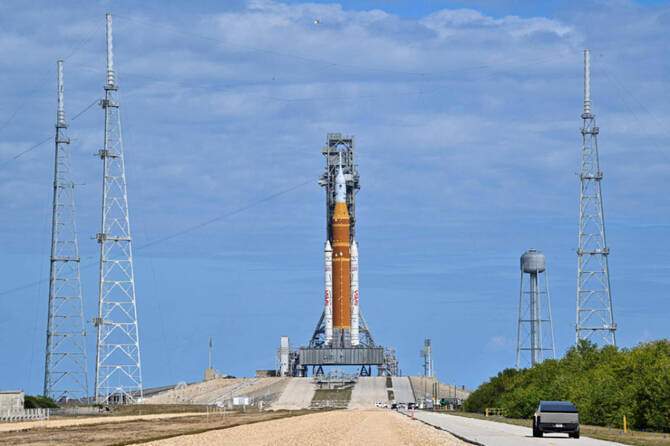
The Space Launch System (SLS) rocket and the Orion spacecraft, integrated for the Artemis II mission, are seen at Launch Pad 39B at the Kennedy Space Center in Cape Canaveral, Florida, on January 30, 2026 ahead of the first crewed mission to the Moon in more than 50 years. (AFP)
Short Url
Updated 01 February 2026
Follow

NASA begins a practice countdown for its first moonshot with astronauts in more than 50 years

  • NASA could try to launch within a week if Monday’s fueling test goes well

CAPE CANAVERAL, Florida: NASA began a two-day practice countdown Saturday leading up to the fueling of its new moon rocket, a crucial test that will determine when four astronauts blast off on a lunar flyby.
Already in quarantine to avoid germs, Commander Reid Wiseman and his crew will be the first people to launch to the moon since 1972. They will monitor the dress rehearsal from their Houston base before flying to Kennedy Space Center once the rocket is cleared for flight.
The 322-foot (98-meter) Space Launch System rocket moved out to the pad two weeks ago. If Monday’s fueling test goes well, NASA could try to launch within a week. Teams will fill the rocket’s tank with more than 700,000 gallons of super-cold fuel, stopping a half-minute short of when the engines would light.
A bitter cold spell delayed the fueling demo, and the launch, by two days. Feb. 8 is now the earliest the rocket could blast off.
Riding in the Orion capsule on top of the rocket, the US and Canadian astronauts will hurtle around the moon and then straight back without stopping until splashdown in the Pacific. The mission will last nearly 10 days.
NASA sent 24 astronauts to the moon during the Apollo program, from 1968 to 1972. Twelve of them walked on the surface.


Chancellor Merz: Germany does not need same fighter jets as France

Updated 2 sec ago
Follow

Chancellor Merz: Germany does not need same fighter jets as France

  • The Future Combat Aircraft System program was launched in 2017
  • Scheme intended to replace France’s Rafale jet and the Eurofighter planes used by Germany and Spain by 2040
BERLIN: Germany does not need the same fighter jets as France, German Chancellor Friedrich Merz said in an interview broadcast Wednesday, signaling that Berlin could abandon a flagship joint defense project.
“The French need, in the next generation of fighter jets, an aircraft capable of carrying nuclear weapons and operating from an aircraft carrier. That’s not what we currently need in the German military,” Merz said on the German podcast Machtwechsel.
The Future Combat Aircraft System (FCAS) program was launched in 2017 to replace France’s Rafale jet and the Eurofighter planes used by Germany and Spain by 2040.
But the scheme, jointly developed by the three countries, stalled last year as France’s Dassault Aviation got into heated disputes with Airbus, which represents German and Spanish interests in the project.
The project has also fallen foul of wider Franco-German disagreements, with Berlin accusing Paris of not making enough effort to boost defense spending.
Merz had previously pledged a decision on FCAS by the end of last year but has postponed making the final call.
France has continued to insist the project is viable.
Merz said on the podcast that France and Germany were now “at odds over the specifications and profiles” of the kind of aircraft they needed.
“The question now is: do we have the strength and the will to build two aircraft for these two different requirement profiles, or only one?” he asked.
If this issue is not resolved, he said Germany would “not be able to continue the project,” adding that there were “other countries in Europe” ready to work with Berlin.