

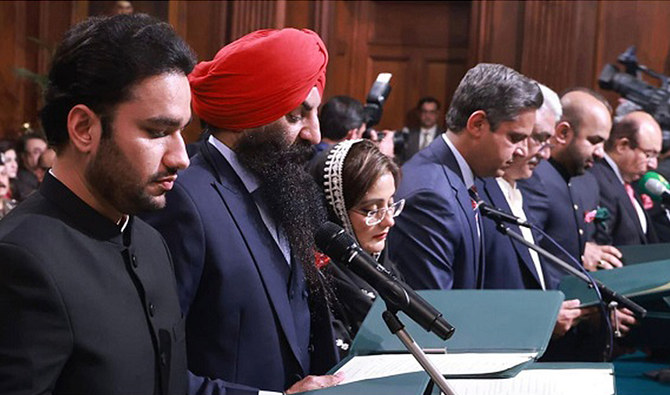
Pakistan appoints first Sikh minister as Ramesh Singh Arora takes oath

Pakistan Muslim League-Nawaz (PML-N) lawmaker Ramesh Singh Arora (2nd L) takes oath as a minister at the Provincial Assembly in Lahore, Pakistan on March 6, 2024.
Short Url
Updated 07 March 2024
Follow

Pakistan appoints first Sikh minister as Ramesh Singh Arora takes oath

  • 48-year-old hails from Narowal’s Kartarpur, is president of Pakistan Sikh Gurdwara Management Committee
  • Singh has been an MP three times before but this is the first time he has been given a ministerial portfolio

ISLAMABAD: Pakistan Muslim League-Nawaz (PML-N) lawmaker Ramesh Singh Arora was given the minorities portfolio in Punjab province this week, making him the first Sikh to be appointed a minister in Pakistan.

Arora, a three-time Member of the Provincial Assembly (MPA) from Narowal, on Wednesday joined the cabinet of recently sworn in Punjab Chief Minister Maryam Nawaf Sharif and was appointed as the provincial minister for minorities. 

Born in the city of Nakana Sahib in 1974, Arora has a postgraduate degree in entrepreneurship and SME Management from the Government College University and before joining politics had worked for the World Bank’s Poverty Reduction Programme in Pakistan. In 2008, he founded the Mojaz Foundation, which works to uplift the underprivileged and poor in Pakistan. He was recently also elected as chief of the Pakistan Sikh Gurudwara Parbandhak Committee (PSGPC).

“For the first time since partition [1947] a Sikh has been inducted into the cabinet of the Punjab province,” Arora said in an interview to the Indian Express. 

“I won’t just work for the safety and well-being of Sikhs but all minorities, including Hindus and Christians living in Pakistan.”

Explaining his plans as a minister for minorities he said:

“I have several plans for the welfare of minorities in Pakistan, especially Punjab. Though the Sikh Marriage Act was passed here, it is yet to be implemented. We will get it implemented. We will also bring a new Interfaith Harmony Policy so that all minorities, including Sikhs, Hindus, Christians and others, feel safe and secure. We will also ensure that the two percent quota for minority students in educational institutions of Pakistan is implemented in letter and spirit.”

Arora said his family had chosen to stay back in Pakistan instead of moving to India after partition.

“I was born in Nankana Sahib but later we moved to Narowal. My grandfather had chosen to stay back in Pakistan during the partition at the insistence of his dear friend,” the minister said. “Just for the sake of friendship, he had chosen to stay back.”

In Feb. 8 elections, Arora was re-elected as an MPA from Narowal, his hometown where Gurdwara Sri Kartarpur Sahib, the final resting place of Sikhism’s founder Guru Nanak, is located. Last year, he was also appointed as the “Ambassador at large” for the Kartarpur Corridor. 

Arora said it was unfortunate that over four years since the launch of the Kartarpur Corridor in November 2019 to facilitate pilgrims from India with visa-free access to the Gurdwara Sri Kartarpur Sahib, “the response has been lukewarm”.

“We will take all possible steps to encourage more people from India to visit Kartarpur via the corridor,” he said. 


Islamabad, Tehran to extend electricity supply agreement for Pakistan’s southwest

Updated 4 sec ago
Follow

Islamabad, Tehran to extend electricity supply agreement for Pakistan’s southwest

  • Tariffs to remain between 7.7–11.45 cents/kWh as Islamabad seeks stability for energy-short border regions
  • Iran currently powers Gwadar and other border towns where Pakistan’s national grid remains limited

ISLAMABAD: Pakistan and Iran have agreed to extend their cross-border electricity supply pact for the southwestern province of Balochistan, maintaining tariffs between 7.7 and 11.45 cents per kilowatt-hour, Pakistan’s energy ministry said on Tuesday.

The deal, first signed in 2002, underpins energy security for parts of southwestern Pakistan where the national grid remains underdeveloped and erratic supply has hampered both industry and residential consumption. Coastal towns like Gwadar and nearby Mand Town in Balochistan have for years relied on imported Iranian power as connectivity with Pakistan’s main transmission network is incomplete and local generation insufficient.

Iran currently exports 100 megawatts of electricity to Gwadar under a March 2023 agreement and could scale up deliveries once additional infrastructure is operational. In May 2023, Prime Minister Shehbaz Sharif and Iranian President Ebrahim Raisi jointly inaugurated the Polan–Gabd transmission line to enable another 100 MW of supply.

Energy ministry spokesperson Zafar Yab Khan confirmed the extension of the deal, saying it had been moved forward between the two governments.

“Yes, it is correct,” he told Arab News, adding that the revised agreement was expected to be placed before Pakistan’s Economic Coordination Committee (ECC).

However, the ECC, Pakistan’s top economic decision-making forum, did not take up the extension in its meeting on Tuesday.

Power trade between Iran and Pakistan has expanded gradually over two decades, with tariffs negotiated periodically to reflect fuel costs and cross-border infrastructure upgrades. In August 2023, the ECC approved amendments to a separate contract extending a 104-MW supply from Iran’s Jakigur district into Pakistan’s Mand town through December 2024.

Gwadar, a key node in the China-Pakistan Economic Corridor (CPEC), is expected to remain dependent on imported electricity until new domestic lines are completed, making continued Iranian supply critical for industries, port operations and basic household demand.