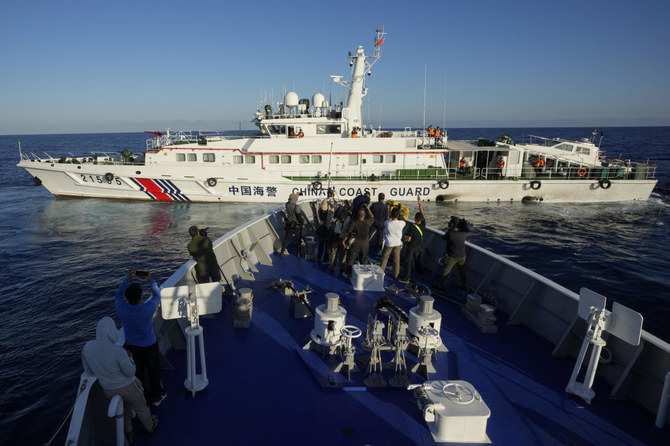
ABOARD BRP SINDANGAN: It was a heart-pounding moment far out in the disputed South China Sea: One of at least five Chinese coast guard ships aggressively approached and sideswiped a Philippine patrol vessel, creating a loud, jarring noise that sent its Filipino crew scrambling to lower rubber fenders to cushion the boat’s hull.
As the high-seas faceoff unfolded Tuesday, two Chinese coast guard ships used water cannons against a smaller supply boat carrying a Filipino admiral and his sailors. The high-pressure spray shattered the boat’s windshield and mildly injured the admiral and four sailors with glass shards and splinters of debris.
“That’s very concerning and very worrisome,” Vice Adm. Alberto Carlos later told reporters, after witnessing firsthand the Chinese actions against the supply boat Unaizah Mae 4, which he was aboard.
As the highest-ranking Filipino military commander overseeing the disputed waters, Carlos joined the trip to ensure that any confrontation would not spiral out of control, the navy said.
It was the latest showdown in one of the world’s most hotly disputed waters that many fear could descend into a larger conflict that puts the United States and China on a collision course.
Tuesday’s hostilities off the Philippine-occupied Second Thomas Shoal lasted about five hours starting after dawn and were witnessed by two Associated Press journalists. The journalists were invited to join the trip aboard the Philippine coast guard ship BRP Sindangan, which was sideswiped by the Chinese coast guard ship in a tense and dangerous moment they caught on camera.
The Philippines adopted a strategy last year of exposing China’s increasingly assertive actions in the disputed sea by embedding journalists on its coast guard patrol ships. Manila said the “transparency campaign” aims to pressure China to abide by international law, including anti-collision regulations.
It has publicly released coast guard videos and photos of dangerous Chinese actions against Philippine forces, including the use by China’s coast guard of a military-grade laser that temporarily blinded Filipino crew in an incident last year that angered Philippine President Ferdinand Marcos Jr.
The campaign has sparked a war of words with Beijing, which has accused the Philippines of hyping up the disputes and allowing itself to be used as a pawn in US efforts to contain China’s rise.
Aboard the BRP Sindangan, the journalists witnessed up close how a mission to deliver food, water and other supplies to a long-marooned warship was partly thwarted by a Chinese blockade of at least 26 ships, including coast guard and suspected militia vessels.
They caught on video and camera how the Chinese ships shadowed, surrounded and blocked the two Philippine coast guard ships and two small supply boats carrying Filipino sailors to the disputed shoal.
Aside from China and the Philippines, Vietnam, Malaysia, Taiwan and Brunei also have overlapping claims in the resource-rich and busy waterway, where a bulk of the world’s commerce and oil transits.
Beijing claims almost the entire sea, a key global trade route. In the last decade, China has turned barren reefs into seven islands that now serve as missile-protected island bases, including three with runways, that have bolstered its capability to fortify its territorial claims and patrols.
In response, Washington has been strengthening an arc of military alliances in the Indo-Pacific, including with the Philippines, Vietnam and other countries at odds with China in the disputed sea.
After China effectively seized another disputed atoll, the Scarborough Shoal off the northwestern Philippines, in 2012, Manila brought its disputes with Beijing to international arbitration and largely won. China, however, rejected the 2016 ruling of the UN-backed tribunal that invalidated its expansive claims on historical grounds and continues to defy the decision.
Filipino officials said the latest confrontation was particularly serious because of the injuries sustained by its navy personnel and damage to their vessel.
“The systematic and consistent manner in which the People’s Republic of China carries out these illegal and irresponsible actions completely negates any of its calls for peaceful dialogue and de-escalation of tensions in the West Philippine Sea,” Jonathan Malaya, a spokesperson for a Philippine government task force dealing with the South China Sea disputes, told a news conference on Wednesday, using the Philippine name for the long-troubled waters.
China blamed the Philippines for the hostilities.
“China has unwavering determination and will in safeguarding its legitimate rights. The Philippines’ attempt of making infringements and provocations will not succeed,” Ministry of Foreign Affairs spokesperson Mao Ning said Wednesday in Beijing.
After the US repeated a warning that it’s obligated to defend the Philippines, its longtime treaty ally, in case of an armed attack, Mao urged Washington “to refrain from using the Philippines as a pawn to destabilize the South China Sea.”
In Washington, US State Department spokesman Matthew Miller said the latest incidents demonstrated China’s “reckless disregard for the safety of Filipinos and also for international law,” and that China was interfering with “lawful Philippine maritime operations.”
Filipino officials said they would continue to assert Philippine rights in the disputed sea.
“We continue to view with great alarm the continuing dangerous maneuvers and dangerous actions,” Marcos told reporters Wednesday in Melbourne, Australia, where he attended a Southeast Asian summit that had the territorial disputes high on its agenda.


![]()

China coast guard flexes its might against the Philippines in disputed waters as journalists look on
Short Url
https://arab.news/2eets
China coast guard flexes its might against the Philippines in disputed waters as journalists look on
- Latest showdown in one of the world’s most hotly disputed waters that many fear could descend into a larger conflict
- The Philippines adopted a strategy last year of exposing Beijing’s increasingly assertive actions in the disputed South China Sea


Latest updates


© 2026 SAUDI RESEARCH & PUBLISHING COMPANY, All Rights Reserved And subject to Terms of Use Agreement.