

Philippine president says tensions in South China Sea have increased

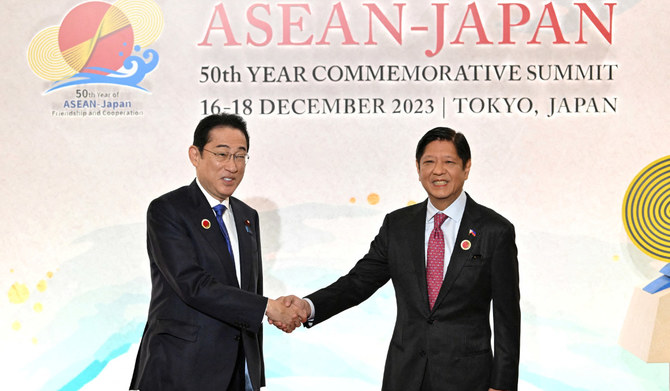
Japan’s Prime Minister Fumio Kishida greets Philippine President Ferdinand Marcos Jr. at the ASEAN-Japan Commemorative Summit Meeting in Tokyo on Sunday. (Reuters)
Short Url
Updated 17 December 2023
Follow

Philippine president says tensions in South China Sea have increased

  • Marcos underscores need to forge strong alliances with like-minded allies

MANILA: Philippine President Ferdinand Marcos Jr. said tensions in the South China Sea have “increased rather than diminished” in recent months, warning that a “more assertive China” posed a “real challenge” to its Asian neighbors.

In an interview with Japanese media on Saturday, Marcos underscored the need to forge strong alliances with like-minded allies, akin to the trilateral cooperation among the Philippines, Japan and the United States.
“I’m afraid we’ll have to be able to say that tensions have increased rather than diminished for the past months or the past years,” Marcos said, according to a press release from his office as he attends a Tokyo summit of Japan and the Association of Southeast Asian Nations.
A week ago, Manila and Beijing traded accusations over a collision of their vessels near a disputed shoal in the South China Sea as tensions over claims in the vital waterway escalate.

FASTFACT

In addition to the Philippines, ASEAN members Vietnam, Indonesia, Malaysia and Brunei claim parts of the South China Sea disputed by China, which claims almost all of the sea, a conduit for more than $3 trillion of annual ship-borne commerce.

In addition to the Philippines, ASEAN members Vietnam, Indonesia, Malaysia and Brunei claim parts of the South China Sea disputed by China, which claims almost all of the sea, a conduit for more than $3 trillion of annual ship-borne commerce.
The Permanent Court of Arbitration in 2016 said China’s claims had no legal basis, a ruling the United States supports but Beijing rejects.
“We have to ... continue to counsel peace and continue communication between the different countries — everyone that is involved,” Marcos said.
The challenge that China posed required “new solutions,” said Marcos, who has vowed to defend his country’s rights in the South China Sea after the collision, which Manila has described as a “serious escalation.”
The Philippines and Japan have started talks on a reciprocal access agreement that would allow the deployment of military forces on each other’s soil, amid growing tensions in the region. Japan also has maritime disputes with China.
“It is not sufficient actually with just Japan and the Philippines to enter into this agreement. We really must get more of these kind of arrangements in place.”


Mali, Burkina say restricting entry for US nationals in reciprocal move

Updated 2 sec ago
Follow

Mali, Burkina say restricting entry for US nationals in reciprocal move

ABIDJAN: Mali and Burkina Faso have announced travel restrictions on American nationals in a tit-for-tat move after the US included both African countries on a no-entry list.
In statements issued separately by both countries’ foreign ministries and seen Wednesday by AFP, they said they were imposing “equivalent measures” on US citizens, after President Donald Trump expanded a travel ban to nearly 40 countries this month, based solely on nationality.
That list included Syrian citizens, as well as Palestinian Authority passport holders, and nationals of some of Africa’s poorest countries including also Niger, Sierra Leone and South Sudan.
The White House said it was banning foreigners who “intend to threaten” Americans.
Burkina Faso’s foreign ministry said in the statement that it was applying “equivalent visa measures” on Americans, while Mali said it was, “with immediate effect,” applying “the same conditions and requirements on American nationals that the American authorities have imposed on Malian citizens entering the United States.”
It voiced its “regret” that the United States had made “such an important decision without the slightest prior consultation.”
The two sub-Saharan countries, both run by military juntas, are members of a confederation that also includes Niger.
Niger has not officially announced any counter-measures to the US travel ban, but the country’s news agency, citing a diplomatic source, said last week that such measures had been decided.
In his December 17 announcement, Trump also imposed partial travel restrictions on citizens of other African countries including the most populous, Nigeria, as well as Ivory Coast and Senegal, which qualified for the football World Cup to be played next year in the United States as well as Canada and Mexico.