GAZA STRIP: Over the last five months, Israel has killed thousands of Hamas fighters, destroyed dozens of their tunnels and wreaked unprecedented destruction on the Gaza Strip.
But it still faces a dilemma that was clear from the start of the war and will ultimately determine its outcome: It can either try to annihilate Hamas, which would mean almost certain death for the estimated 100 hostages still held in Gaza, or it can cut a deal that would allow the militants to claim a historic victory.
Either outcome would be excruciating for Israelis. Either would likely seal an ignominious end for Prime Minister Benjamin Netanyahu’s long political career. And either might be seen as acceptable by Hamas, which valorizes martyrdom.
Netanyahu, at least in public, denies there is any such dilemma. He has vowed to destroy Hamas and recover all the hostages, either through rescue missions or ceasefire agreements, saying victory could come “in a matter of weeks.”
As long as the war rages, he can avoid early elections that polls strongly suggest would remove him from power. But it seems inevitable that at some point a choice will have to be made between the hostages and military victory.
Hamas, meanwhile, appears to be in no hurry to reach a temporary ceasefire ahead of the Muslim holy month of Ramadan, which begins next week, or to delay an expected Israeli operation in Rafah, the southern city where half of Gaza’s population has sought refuge.
Hamas leader Yehya Sinwar, the alleged mastermind of the Oct. 7 attack against Israel, has reason to believe that as long as he holds the hostages, he can eventually end the war on his terms.
SINWAR’S BLOODY GAMBLE
In over two decades spent inside Israeli prisons, Sinwar reportedly learned fluent Hebrew and studied Israeli society, and he identified a chink in the armor of his militarily superior adversary.
He learned that Israel cannot tolerate its people, especially soldiers, being held captive, and will go to extraordinary lengths to bring them home. Sinwar himself was among over 1,000 Palestinian prisoners released in exchange for a single captive soldier in 2011.
For Sinwar, the mass killings on Oct. 7 might have been a horrific sideshow to the main operation, which was to drag large numbers of hostages into a vast labyrinth of tunnels beneath Gaza, where Israel would be unable to rescue them, and where they could serve as human shields for Hamas leaders.
Once that was accomplished, he had a powerful bargaining chip that could be traded for large numbers of Palestinian prisoners, including top leaders serving life sentences, and an end to the Israeli onslaught that Hamas had anticipated.
No amount of 2,000-pound bombs could overcome the strategy’s brutal logic.
Israeli officials say the tunnels stretch for hundreds of kilometers (miles) and some are several stories underground, guarded by blast doors and booby traps. Even if Israel locates Hamas leaders, any operation would mean almost certain death for the hostages that likely surround them.
“The objectives are quite contradictory,” said Amos Harel, a longtime military correspondent for Israel’s Haaretz newspaper. “Of course, you can say it will take a year to defeat Hamas, and we’re moving ahead on that, but the problem is that nobody can ensure that the hostages will remain alive.”
He added that even if Israel somehow kills Sinwar and other top leaders, others would move up the ranks and replace them, as has happened in the past.
“Israel will have a really hard time winning this,” Harel said.
Israel has successfully rescued three hostages since the start of the war, all of whom were aboveground. Israeli troops killed three hostages by mistake, and Hamas says several others were killed in airstrikes or failed rescue operations. More than 100 hostages were released in a ceasefire deal in exchange for Palestinians imprisoned by Israel.
Netanyahu says military pressure will eventually bring about the release of the roughly 100 hostages, and the remains of 30 others, still held by Hamas.
But in candid remarks in January, Gadi Eisenkot, Israel’s former top general and a member of Netanyahu’s War Cabinet, said anyone suggesting the remaining hostages could be freed without a ceasefire deal was spreading “illusions.”
It’s hard to imagine Hamas releasing its most valuable human shields for a temporary ceasefire, only to see Israel resume its attempt to annihilate the group, and Hamas has rejected the idea of its leaders surrendering and going into exile.
For Sinwar, it’s better to stay underground with the hostages and see if his bet pays off.
HOW DOES THIS END?
Netanyahu’s government is under mounting pressure from families of the hostages, who fear time is running out, and the wider public, which views the return of captives as a sacred obligation.
President Joe Biden, Israel’s most important ally, is at risk of losing re-election in November, in part because of Democratic divisions over the war. The humanitarian catastrophe in Gaza has sparked worldwide outrage. The war threatens to ignite other fronts across the Middle East.
There’s a Hamas proposal on the table in which the hostages come back alive.
It calls for the phased release of all of the captives in return for Israel’s gradual withdrawal from Gaza, a long-term ceasefire and reconstruction. Israel would also release hundreds of prisoners, including top Palestinian political leaders and militants convicted of killing civilians.
Hamas would almost certainly remain in control of Gaza and might even hold victory parades. With time, it could recruit new fighters, rebuild tunnels and replenish its arsenals.
It would be an extremely costly victory, with over 30,000 Palestinians killed and the total destruction of much of Gaza. Palestinians would have different opinions on whether it was all worth it.
A rare wartime poll last year found rising support for Hamas, with over 40 percent of Palestinians in the occupied West Bank and Gaza backing the group.
That support would only grow if Hamas succeeds in lifting the longstanding blockade on Gaza, said Tahani Mustafa, senior Palestine analyst at the Crisis Group, an international think tank.
“If this is able to bring some serious concessions that can make life just marginally better, then I think not only will this bolster support for Hamas, but it could also bolster support for armed resistance more broadly.”
Netanyahu has rejected Hamas’ proposal as “delusional,” but there is no sign the militant group is backing away from its core demands.
Israel can keep fighting – for weeks, months or years. The army can kill more fighters and demolish more tunnels, while carefully avoiding areas where it thinks the hostages are held.
But at some point, Netanyahu or his successor will likely have to make one of the most agonizing decisions in the country’s history, or it will be made for them.


The brutal logic of Hamas’ hostage strategy could deny Israel victory in Gaza

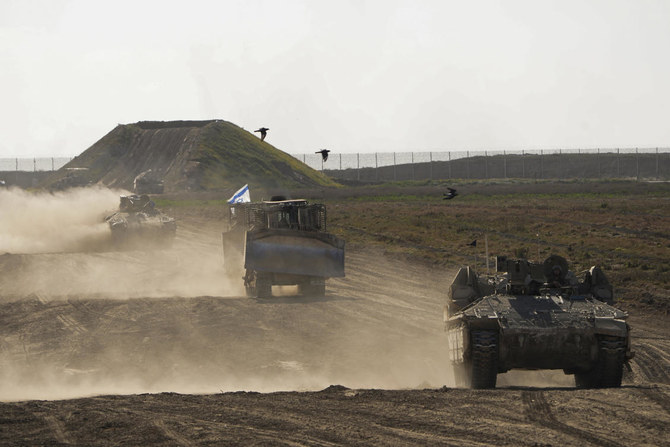

https://arab.news/vp24c
The brutal logic of Hamas’ hostage strategy could deny Israel victory in Gaza

- Netanyahu has vowed to destroy Hamas and recover all the hostages, either through rescue missions or ceasefire agreements
- Hamas, meanwhile, appears to be in no hurry to reach a temporary ceasefire ahead of the Muslim holy month of Ramadan


Ceasefire with Kurdish-led force extended for another 15 days, Syrian army says
- The defense ministry said the extension was in support of an operation by US forces to transfer accused Daesh militants to Iraq
- The Kurdish-led Syrian Democratic Forces confirmed the ceasefire extension
RAQQA, Syria: Hours after the expiration of a four-day truce between the Syrian government and Kurdish-led fighters Saturday, Syria’s defense ministry announced the ceasefire had been extended by another 15 days.
The defense ministry said in a statement that the extension was in support of an operation by US forces to transfer accused Daesh militants who had been held in prisons in northeastern Syria to detention centers in Iraq.
The Kurdish-led Syrian Democratic Forces confirmed the ceasefire extension.
“Our forces affirm their commitment to the agreement and their dedication to respecting it, which contributes to de-escalation, the protection of civilians, and the creation of the necessary conditions for stability,” the group said in a statement.
Over the past three weeks, there have been intense clashes between government forces and the SDF, in which the SDF lost large parts of the area they once controlled.
Earlier in the day, the Kurdish-led force called on the international community to prevent any escalation.
The end of the truce came as government forces have been sending reinforcements to Syria’s northeast.
Syria’s interim government signed an agreement last March with the SDF for it to hand over territory and to eventually merge its fighters with government forces. In early January, a new round of talks failed to make progress over the merger, leading to renewed fighting between the two sides.
A new version of the accord was signed last weekend, and a four-day ceasefire was declared Tuesday. Part of the new deal is that SDF members will have to merge into the army and police forces as individuals.
The SDF said in a statement Saturday that military buildups and logistical movements by government forces have been observed, “clearly indicating an intent to escalate and push the region toward a new confrontation.” The SDF said it will continue to abide by the truce.
On Saturday, state TV said authorities on Saturday released 126 boys under the age of 18 who were held at the Al-Aqtan prison near the northern city of Raqqa that was taken by government forces Friday. The teenagers were taken to the city of Raqqa where they were handed over to their families, the TV station said.
The prison is also home to some of the 9,000 members of the Daesh group who are held in northeastern Syria. Most of them remain held in jails run by the SDF. Government forces have so far taken control of two prisons while the rest are still run by the SDF.
Earlier this week, the US military said that some 7,000 Daesh detainees will be transferred to detention centers in neighboring Iraq.
On Wednesday, the US military said that 150 prisoners have been taken to Iraq.


