

Middle East and the US are leading in AI adoption, says Palantir CEO

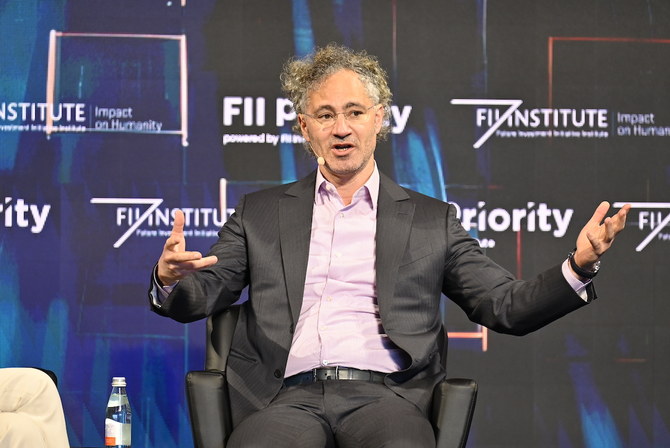
The countries adopting AI are in the US and in the MidEast, Alex Karp, CEO and co-founder of Palantir, tells FII Priority Summit. (Supplied)
Short Url
Updated 23 February 2024
Follow

Middle East and the US are leading in AI adoption, says Palantir CEO

  • It is time to throw out the playbook in order to succeed, says Alex Karp

MIAMI: Alex Karp, CEO of data mining and AI-assisted software firm Palantir, believes “that the world will be shaped through the embodiment of ideas and words in software platforms.

“These platforms are so levered that, in fact, they will shape our life in a way that words used to,” he said at the FII Priority Summit in Miami on Friday.

In order to succeed in today’s world, it is essential to think outside the box and outside any playbook — whether that is in finance, hardware, or any other sector, he said.

“What’s super interesting about the AI revolution is that almost none of the playbook rules make sense,” he added.

The countries adopting AI and utilizing it to its full potential are in the US and in the Middle East, Karp continued.

“In hardware, the value is having a community of people who are all very good, and in software, the value is having the one right person.”

It seems like a small difference but it is not; it is largely the reason attempts to build ecosystems like Silicon Valley have failed, “because the people building them are not software natives,” said Karp.

He continued that it is perhaps why countries like Saudi Arabia and the UAE are “embracing these technologies in a way that I wish other places in West Europe would.”

Armed with a background in social sciences and academia, 20 years ago Karp co-founded Palantir, which received early backing from CIA investment arm In-Q-Tel and does contract work for government agencies like the US Department of Defense, the Federal Bureau of Investigations and the Danish National Police.

Addressing the balance between privacy and ethics, Karp said that the company’s core intel products deal with privacy issues “by exposing authorities and only authorities to the data they’re allowed to see without seeing the other data that they’re not allowed to see.”

He said: “I’m very pro civil liberties but you have to augment both civil liberties and GDP and they’re not in contradiction.”

It is often “people who are allergic to technical issues (that) are actually the adversaries of the enlightenment, because if your enterprise doesn’t work, your country doesn’t work, and nothing can work,” said Karp.

At a time when the world is riddled with war, and these wars are happening “in very complicated electronic suppressed environments,” one cannot use old hardware anymore, said Karp.

“You have to engage in software war and almost all useful hardware things going forward will be software-enabled or controlled.”

Data ownership and privacy are even more critical amid increasing geopolitical tensions, so “your products have to work in an environment where you can understand your supply chain even as it’s disrupted” and even potentially predict disruptions, he continued.

“Treat your company and all of its latent assets as a portfolio under the condition that the portfolio will be very different tomorrow than it is today.”

Karp sees the future of AI as still undecided.

“This is a place where the innovation ramp is so great that the most important thing really is what do you do in the next 18 months.”

For the US, the testing ground for this technology is currently in the military, he added. 

“What will be decided is, can America and its allies get to a point of decisive dominance and then impose regulation on the rest of the world from that perspective of dominance? That would be the best outcome,” concluded Karp.


‘Future cities will be built for visitors, not just residents,’ Saudi tourism minister tells Arab News

Updated 10 November 2025
Follow

‘Future cities will be built for visitors, not just residents,’ Saudi tourism minister tells Arab News

RIYADH: Saudi Arabia is positioning itself at the forefront of the global travel evolution by designing destinations that will target the tourists of the future, the Kingdom’s tourism minister has said.

Ahmed Al-Khateeb added that sustainability would serve as the guiding principle behind Saudi Arabia’s role in tomorrow’s global travel landscape.

Travelers’ habits and the tourism industry’s revenue sources have shifted dramatically in recent years, he told Arab News in an interview.

“People used to travel in groups. Today, they are traveling in smaller groups. Hotels used to make most of their revenues from rooms — now, they are making more from lounges and restaurants.”

And younger generations, empowered by technology, are also redefining how travel is planned and experienced, Al-Khateeb added. “They are driving their own itineraries on the go, which puts pressure on traditional travel companies that once organized large group trips. We are witnessing big shifts in the global travel market.”

Among the world’s fastest-growing tourism markets, China and India are reshaping international travel flows. “China has become the most important source market for outbound travelers, while India is expected to double its number of travelers in the coming years,” the minister said. “This opens a major opportunity for the Middle East — and Saudi Arabia in particular — to emerge as a top destination for international tourists.”

Since 2019, Saudi Arabia has recorded the fastest tourism growth among all G20 nations, said Al-Khateeb. “We have a very strong domestic market and a very strong religious market. Now, we have opened our doors for leisure, business and holiday travelers — whether they seek the Red Sea coast, the southern mountains, our major cities or our beautiful islands.”

Yet the Kingdom’s long-term vision for tourism extends far beyond the present, with destinations being built to serve both visitors and residents sustainably, he added.

“In the 1950s and 1960s, cities were built for residents,” Al-Khateeb said. “Today, in places like Greece, visitors outnumber residents three to one. The cities of the future must be designed for visitors as well — and that’s what we are doing in Saudi Arabia.”

Sustainability has become a non-negotiable element of all tourism development in the Kingdom, he added. “In the last two decades, sustainability has become extremely important. As we build new destinations like the Red Sea, we are fully aligned with sustainability regulations. Whatever we build today is environmentally friendly, ensuring not only environmental, but also social and economic sustainability.”

This principle lies at the heart of Vision 2030’s tourism transformation: “Sustainability is at our forefront whenever we build or operate any new destination,” he added.