

Tech does what we tell it, Dell founder tells Future Investment Initiative Priority summit in Miami

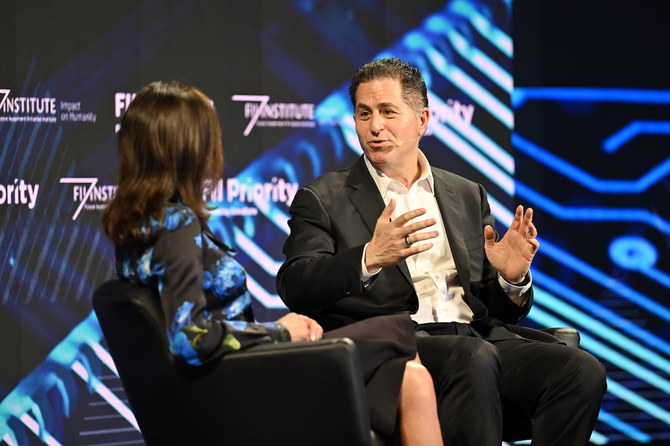
Tech should reflect our humanity, values and beliefs, founder and CEO of Dell told the Future Investment Initiative Priority summit. (Supplied)
Short Url
Updated 23 February 2024
Follow

Tech does what we tell it, Dell founder tells Future Investment Initiative Priority summit in Miami

  • Michael Dell says the potential benefits of AI are too great to ignore but we must ‘have it reflect our humanity, values and beliefs’
  • ‘We have to make sure that the bad people don’t get hold of (the technology) too much, and to the extent they do, we have ways to stop them and to control that,’ he adds.

MIAMI: “Technology doesn’t wake up in the morning and say, ‘I’m going to be good or bad today’… it does what we tell it to do,” Michael Dell, the founder and CEO of tech company Dell told the Future Investment Initiative Priority summit in Miami on Thursday. “And so we have to have it reflect our humanity, values and beliefs.”

Dell, who has been interested in technology since he was 13 years old, talked about the beginnings of his company and its future, especially with artificial intelligence poised to transform the sector.

When he was a teenager, he said, he upgraded computer systems as a hobby and “eventually, in my dorm room 40 years ago, started what became Dell Technologies.”

In the tech industry “all of the successive waves of technology are built on top of the previous ones,” he said, and right now there is “an enormous amount of data.” This evolution has resulted in better connectivity and advancements in computing power, memory, bandwidth and networking. Researchers and developers therefore are now looking at ways to use all this information to go beyond mere computation and calculation, and into the realms of cognition and creativity.

“The game hasn’t even started but it’s clearly a huge opportunity for efficiency and productivity, but also sort of reimagining organizations,” said Dell.

He sees “a tremendous amount of conviction and excitement around building a great future” in Saudi Arabia.

“It’s probably the most exciting region in the world in terms of growth and opportunity, and certainly, when I look at the scale, the ambition and the vision, it’s inspiring and we obviously want to want to be a big part of that,” he added.

That’s why his company is planning expansions in the Kingdom he said will be announced next month.

“Technology has always been about making us safer and healthier and more successful in all human endeavors, and AI is just turbocharging that at an unprecedented scale,” said Dell.

He acknowledged the risks posed by the technology but said it would be almost irresponsible not to utilize it, given its massive benefits.

“We have to make sure that the bad people don’t get hold of (the technology) too much, and to the extent they do, we have ways to stop them and to control that,” he said.

But in the end “it’s software, after all,” Dell added.

“I do think there will be mistakes, problems and challenges. But ultimately, it is going to expand human potential, creativity and capability dramatically.”


Global trade isn’t deglobalizing — it’s reshuffling, Harvard economist says

Updated 09 February 2026
Follow

Global trade isn’t deglobalizing — it’s reshuffling, Harvard economist says

ALULA: Global trade is not retreating into deglobalization despite geopolitical shocks, but is instead undergoing a structural reshuffling led by US-China tensions, according to Harvard University economist Pol Antras. 

Presenting research at the AlUla Emerging Market Economies Conference, Antras said there is no evidence that countries are systematically turning inward. Instead, trade flows are being redirected across markets, creating winners and losers depending on export structure and exposure to Chinese competition. 

This comes as debate intensifies over whether supply-chain disruptions, industrial policy and rising trade barriers signal the end of globalization after decades of expansion. 

Speaking to Arab News on the sidelines of the event, Antras said: “I think the right way to view it is more a reorganization, where things are moving from some countries to others rather than a general trend where countries are becoming more inward looking, in a sense of producers selling more of their stuff domestically than internationally, or consumers buying more domestic products than foreign products.”  

He said a change of that scale has not yet happened, which is important to recognize when navigating the reshuffling — a shift his research shows is driven by Chinese producers redirecting sales away from the US toward other economies. 

He added that countries are affected differently, but highlighted that the Kingdom’s position is relatively positive, stating: “In the case of Saudi Arabia, for instance, its export structure, what it exports, is very different than what China exports, so in that sense it’s better positioned so suffer less negative consequences of recent events.” 

He went on to say that economies likely to be more negatively impacted than the Kingdom would be those with more producers in sectors exposed to Chinese competition. He added that while many countries may feel inclined to follow the United States’ footsteps by implementing their own tariffs, he would advise against such a move.  

Instead, he pointed to supporting producers facing the shock as a better way to protect and prepare economies, describing it as a key step toward building resilience — a view Professor Antras underscored as fundamental. 

Elaborating on the Kingdom’s position amid rising tensions and structural reorganization, he said Saudi Arabia holds a relative advantage in its economic framework. 

“Saudi Arabia should not be too worried about facing increased competitive pressures in selling its exports to other markets, by its nature. On the other hand, there is a benefit of the current situation, which is when Chinese producers find it hard to sell in US market, they naturally pivot to other markets.” 

He said that pivot could benefit importing economies, including Saudi Arabia, by lowering Chinese export prices. The shift could increase the Kingdom’s import volumes from China while easing cost pressures for domestic producers.