‘We go to space for the benefit of the many,’ Sierra Space CEO tells FII Summit

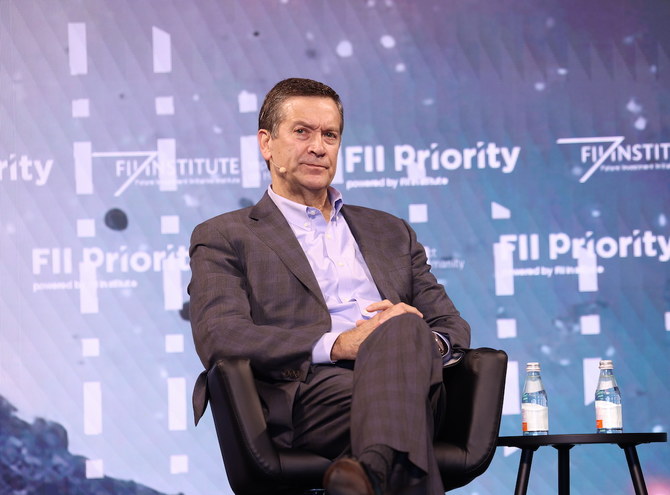
‘The reason we’re building a platform in space is to literally benefit life on Earth,’ said Tom Vice, CEO of Sierra Space at the FII Priority Summit on Friday. (Supplied)
Short Url
Updated 23 February 2024
Follow

‘We go to space for the benefit of the many,’ Sierra Space CEO tells FII Summit

  • Company’s efforts are concentrated in biotech and industrial tech during the transition to commercial-led space

MIAMI: Sierra Space, a commercial space company that has built more than 4,000 space subsystem components and run more than 500 missions, including 14 to Mars, is building technology for “the benefit of the many, not the few,” CEO Tom Vice told the audience at the FII Priority Summit in Miami on Friday.

Addressing the ambitions of countries including the US, China and Russia, and the global space race, Vice said that the days of space being a “sanctuary domain” are over. 

“It is a warfighting domain,” he said. “This is a (time) in which space is a domain just like every other, where adversaries are really very aggressive in terms of holding the US (in) some kind of position where our freedom of action isn’t guaranteed.” 

Therefore, Sierra Space is investing its “time, ingenuity and technology to make sure that we defend space,” Vice said. 

The company is focused on developing technologies to ensure that assets in space are protected in order for the US to carry out its missions both defensively and offensively, he added. 

Vice said that, in comparison to other aerospace and defensive companies, which have a more cautious approach toward defense acquisitions, Sierra Space is “a high-tech, high-speed innovator that’s very focused on bringing capability very quickly.”

The company’s efforts have paid off, said Vice, with Sierra Space receiving $1.3 billion in new satellite constellations in the areas of missile classification, missile detection, missile warning, missile tracking, and fire control.

With NASA’s International Space Station set to be retired by the end of 2030, space exploration is entering a new era.

“We are transitioning to the full commercialization of Low Earth orbit,” Vice said, referring to Earth-centered orbits with an altitude of 2,000 km or less, which NASA classifies as near enough to Earth for convenient transportation, communication, observation, and resupply.

The area is ripe for the creation of an “entire new field of products” in the areas of biotech, industrial tech, and clean energy, Vice claimed, adding that his company is already producing drugs that have an effect on longevity, and is also focused on discovering new sources of clean energy and battery technology, he added. 

The space race isn’t only about asset security, but also economic security, Vice explained.

“The reason why we want to drive the economics is (that) we’re after terrestrial markets, and biotech, and industrial tech. That’s the whole premise of the company,” he said. 

Sierra Space, according to its CEO, is forging relationships with countries across the Middle East, India, Africa, and Latin America, as well as with global companies in the fields of biotech and industrial tech.

Vice believes that “space is an element of diplomacy,” prompting the company to ensure it has “great economic ties, and great country-to-country bilateral and multilateral ties.”

He added: “It’s really important to think about this transition from a government-run International Space Station to a commercial-led International Space Station.”

Vice was part of the team that designed the James Webb Space Telescope, which can “see back in time 13 and a half billion years, and we still have not found life beyond Earth. This is a very special place.”

Sierra Space is not aiming to be “multiplanetary,” Vice stressed. 

“The reason we’re building a platform in space is to literally benefit life on Earth,” he said. “We don’t go to space for the benefit of the few. We go to space for the benefit of the many.”


‘Future cities will be built for visitors, not just residents,’ Saudi tourism minister tells Arab News

Updated 10 November 2025
Follow

‘Future cities will be built for visitors, not just residents,’ Saudi tourism minister tells Arab News

RIYADH: Saudi Arabia is positioning itself at the forefront of the global travel evolution by designing destinations that will target the tourists of the future, the Kingdom’s tourism minister has said.

Ahmed Al-Khateeb added that sustainability would serve as the guiding principle behind Saudi Arabia’s role in tomorrow’s global travel landscape.

Travelers’ habits and the tourism industry’s revenue sources have shifted dramatically in recent years, he told Arab News in an interview.

“People used to travel in groups. Today, they are traveling in smaller groups. Hotels used to make most of their revenues from rooms — now, they are making more from lounges and restaurants.”

And younger generations, empowered by technology, are also redefining how travel is planned and experienced, Al-Khateeb added. “They are driving their own itineraries on the go, which puts pressure on traditional travel companies that once organized large group trips. We are witnessing big shifts in the global travel market.”

Among the world’s fastest-growing tourism markets, China and India are reshaping international travel flows. “China has become the most important source market for outbound travelers, while India is expected to double its number of travelers in the coming years,” the minister said. “This opens a major opportunity for the Middle East — and Saudi Arabia in particular — to emerge as a top destination for international tourists.”

Since 2019, Saudi Arabia has recorded the fastest tourism growth among all G20 nations, said Al-Khateeb. “We have a very strong domestic market and a very strong religious market. Now, we have opened our doors for leisure, business and holiday travelers — whether they seek the Red Sea coast, the southern mountains, our major cities or our beautiful islands.”

Yet the Kingdom’s long-term vision for tourism extends far beyond the present, with destinations being built to serve both visitors and residents sustainably, he added.

“In the 1950s and 1960s, cities were built for residents,” Al-Khateeb said. “Today, in places like Greece, visitors outnumber residents three to one. The cities of the future must be designed for visitors as well — and that’s what we are doing in Saudi Arabia.”

Sustainability has become a non-negotiable element of all tourism development in the Kingdom, he added. “In the last two decades, sustainability has become extremely important. As we build new destinations like the Red Sea, we are fully aligned with sustainability regulations. Whatever we build today is environmentally friendly, ensuring not only environmental, but also social and economic sustainability.”

This principle lies at the heart of Vision 2030’s tourism transformation: “Sustainability is at our forefront whenever we build or operate any new destination,” he added.