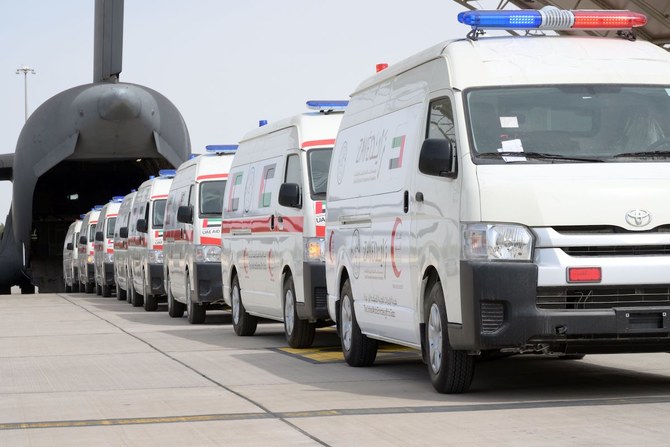
UAE delivers maritime hospital, 10 ambulances for Gaza

1 / 2
The UAE launched a maritime hospital headed for Al-Arish in Egypt, to extend critical medical assistance to Palestinians in Gaza. (WAM)
2 / 2
The Gallant Knight 3 humanitarian operation announced the entry of 10 fully equipped ambulances into the Gaza. (WAM)
Short Url
Updated 08 February 2024
Follow

UAE delivers maritime hospital, 10 ambulances for Gaza

  • The hospital is staffed by a team of 100 professionals

LONDON: The UAE has launched a maritime hospital headed for Al-Arish in Egypt, to extend critical medical assistance to Palestinians in Gaza, Emirates News Agency reported on Thursday.

Departing from Khalifa Port, the hospital is staffed by a team of 100 professionals, encompassing a wide range of specialties such as anesthesia, general surgery, orthopedics and emergency medicine, alongside nurses and paramedics.

The field hospital is equipped to accommodate 100 patients and well-prepared with facilities including operating rooms, an intensive care unit, a radiology department, a laboratory, a pharmacy and medical storage areas. It also features an evacuation helicopter, a medical evacuation boat and ambulances, all furnished with state-of-the-art medical technology.

The hospital is in line with the directives of UAE’s President Sheikh Mohamed bin Zayed Al-Nahyan, aiming to provide support to the Palestinian people in Gaza Strip through the Gallant Knight 3 humanitarian operation. Developed by the Department of Health — Abu Dhabi and AD Ports Group, it serves to bolster the capabilities of the 200-bed UAE field hospital in Gaza.

The hospital, which was launched in December, is staffed by 64 volunteer medical professionals from 17 different nationalities, including 48 men and 16 women, and has successfully conducted more than 555 significant surgeries and provided treatment for more than 4,038 individuals over the past two months.

Meanwhile, a convoy of 84 trucks loaded with humanitarian aid entered the Gaza Strip through the Rafah border crossing in Egypt, Jordan News Agency reported on Thursday.

According to an official source from the Egyptian Red Crescent, 80 trucks were filled with vital goods including food, pharmaceuticals, medical equipment, blankets and tents, addressing the immediate needs of Gaza’s 2.3 million population.

Another four trucks carrying fuel were also delivered. This fuel is set to be distributed by the UN Relief and Works Agency for Palestine Refugees and the Palestine Red Crescent Society, supporting critical energy needs in the occupied Palestinian enclave.

In addition, the Gallant Knight 3 humanitarian operation announced the entry of 10 fully equipped ambulances into the Gaza through the Rafah crossing, Emirates News Agency reported on Wednesday.

The delivery aims to respond to the urgent need for ambulances after Israel’s military damaged most of the vehicles used in the Strip to transport wounded and injured Palestinian residents.

These vehicles will serve the Emirati field hospital and other health facilities, alleviating Palestinian suffering and supporting the Gaza Strip’s health care system, which is facing increasing challenges.

The UAE has sent more than 10,575 tons of humanitarian aid to Gaza via the Gallant Knight 3, using 435 land trucks and shiploads and 154 cargo planes.

The Emirati field hospital has treated nearly 4,000 Palestinian patients.

The UAE has also established six water desalination plants with a daily production capacity of 1.2 million gallons, which will directly benefit Gaza residents.


Aoun reassures Lebanon that risk of war is ‘fading’ in year-end message

Lebanese President Joseph Aoun. (File/AFP)
Updated 31 December 2025
Follow

Aoun reassures Lebanon that risk of war is ‘fading’ in year-end message

  • Israeli military spokesperson said it targeted 380 armed operatives, 950 military sites in Lebanon in past year
  • Beirut’s southern suburb residents pledge to avoid celebratory gunfire on New Year’s Eve

BEIRUT: Lebanese President Joseph Aoun on Wednesday sought to reassure citizens in his year-end address, saying “the overall atmosphere remains positive and the risk of war is fading,” amid widespread concern over a possible Israeli escalation against Hezbollah.

Fear of renewed attacks followed Israeli criticism of a Lebanese Army weapons-confiscation operation that is set to enter its second phase at the start of the 2026. The plan include the expansion from areas north of the Litani River to the Awali River, after the first phase was completed south of the Litani.

President Aoun cautioned that this does not mean “completely eliminating the risk of war,” stressing that “work is underway with various friendly and brotherly countries to completely neutralize the threat of war.”

Addressing Internal Security officials, Aoun said that the “situation is among the best,” noting that this assessment has been echoed by foreign visitors to Lebanon, despite the strain caused by large numbers of Syrian and Palestinian refugees.

He added that security forces were fully carrying out their duties and solving crimes with notable speed, pointing to the successful visit of Pope Leo XIV earlier this year as further evidence of progress.

On Monday, Egyptian Ambassador to Lebanon Alaa Moussa stressed during a Beirut press conference that implementing “international agreements and resolutions, foremost among them the Nov. 27, 2014 agreement and Resolution 1701, constitutes the fundamental approach to sparing Lebanon further security tensions,” speaking of “dire consequences that could result from continued escalation.”

The Egyptian diplomat indicated that “there are no hidden warnings or threats directed at Lebanon, but rather a clear commitment to the agreements signed by the concerned parties, which must be fully implemented by everyone.”

The ambassador stated that his country, under the directives of President Abdel Fattah El-Sisi, is “exerting intensive efforts to reduce tensions in southern Lebanon and the region in general, through active diplomatic contacts led by the Minister of Foreign Affairs Badr Abdelatty with relevant regional and international parties.”

Israeli military spokesman Avichai Adraee published on Wednesday a summary of Israeli attacks on Hezbollah in Lebanon in 2025.

“The Army targeted approximately 380 armed operatives, including Ali Tabatabai (chief of staff), Hassan Kamal (responsible for anti-tank missiles on the southern front), Abbas Hassan Karky (logistics officer in the southern command), and Khodr Saeed Hashem (commander of the naval force in the Radwan Unit),” he said.

“It also attacked approximately 950 military targets, including 210 launch sites and weapons depots, 140 military buildings, and about 60 tunnel entrances,” Adraee added.

In the statement, he accused Hezbollah of committing about 1,920 ceasefire violations and said the military would continue its raids and targeting operations in the new year.

UNIFIL Com. Gen. Diodato Abagnara said in his end-of-the-year message that “UNIFIL will continue to support Lebanon and Israel in implementing their obligations under Resolution 1701, building on the stability achieved in 2025 and strengthening efforts toward a lasting peace.”

As part of the weapons restriction plan, on Tuesday, the Fatah movement — the Palestinian National Security Forces in Lebanon — handed over a new batch of heavy and medium weapons from the Ain Al-Hilweh Palestinian refugee camp to the Lebanese Army in four trucks, away from the media.

This is the second batch of weapons to be handed over from the camp, which is the largest Palestinian refugee camp in Lebanon. It represents the fifth phase of the Palestinian weapons handover process in the camps, four of which were completed between Aug. 21 and Sept. 13, 2025, encompassing nine camps, including Ain Al-Hilweh.

The handover follows and implements an agreement reached between Aoun and Palestinian President Mahmoud Abbas after the latter’s visit to Lebanon in May.

Abbas had announced “the Palestinian Authority’s support for the Lebanese state’s plan to extend its authority over all Lebanese territory, including the Palestinian camps.”

Hamas continues to refuse to hand over its weapons to the Lebanese Army, while Hezbollah maintains its weapons north of the Litani River.

The Lebanese Army implemented “exceptional security measures in various Lebanese regions on New Year’s Eve, with the aim of maintaining security.”

It called on citizens to “cooperate with the security measures taken to maintain public safety and prevent incidents,” warning of the consequences of firing weapons, which will be prosecuted as it poses a threat to public safety.

In another measure, authorities announced that gun licenses and traffic permits will be suspended until Jan. 2, 2026.

In Beirut’s southern suburbs, residents signed a pledge as part of an Internal Security Forces campaign against celebratory gunfire on New Year’s Eve, committing not to fire weapons in public and to report violations with photos or videos.