

54 killed in clashes in area claimed by Sudan, South Sudan: UN

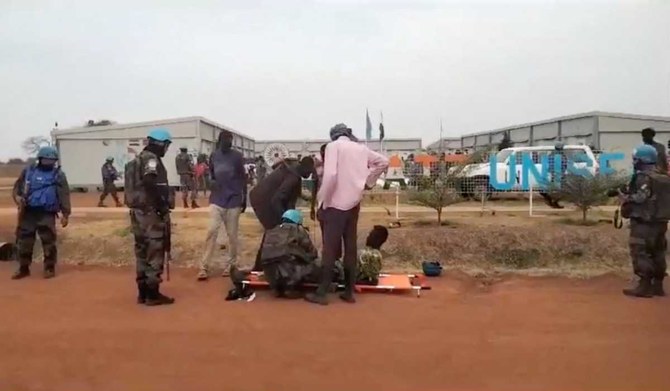
A person receives help as locals gather at a UN peacekeeper camp following deadly attacks, in Dokura, Abyei region, Sudan-South Sudan border area, in this still image obtained from a social media video released January 28, 2024. (REUTERS)
Short Url
Updated 30 January 2024
Follow

54 killed in clashes in area claimed by Sudan, South Sudan: UN

  • UN Secretary General Antonio Guterres condemned the violence and appealed to the governments of both sides to investigate so those responsible could be brought to justice

JUBA: Fighting between rival communities in a disputed region claimed by both Sudan and South Sudan has killed 54 people, including two UN peacekeepers, the United Nations said on Monday, calling for calm.
The clashes in Abyei, a contested oil-rich territory straddling the border of both countries, broke out at the weekend, according to local authorities.
The United Nations Interim Security Force for Abyei (UNISFA) said it “strongly condemns these attacks against civilians and peacekeepers.”
“Currently, according to local authorities, 52 civilians have lost their lives, while 64 others are said to be gravely wounded,” it said.
It said peacekeepers came under fire on Sunday “while transporting affected civilians from a UNISFA base to a hospital.”
A Pakistani peacekeeper was killed, and “four uniformed personnel and one local civilian sustained injury,” it said.
UN Secretary General Antonio Guterres condemned the violence and appealed to the governments of both sides to investigate so those responsible could be brought to justice, said his spokesman Stephane Dujarric, with attacks on peacekeepers potentially constituting a war crime.
A Ghanaian peacekeeper had been killed on Saturday, UNISFA added, calling for an investigation into the violence.
Located between Sudan and South Sudan, Abyei has been a flashpoint since the South gained independence in 2011.
According to authorities in the Abyei Special Administrative Area, armed youths and a local rebel militia carried out a series of “barbaric coordinated attacks,” starting on Saturday morning.

Rou Manyiel Rou, secretary general for the Abyei Special Administrative Area, said on Saturday that the violence was tied to a long-running “conflict between (the) Ngok and Twic” communities.
In a statement published on Monday, Britain, Norway and the United States, the international “Troika” that sponsored South Sudan’s independence, said they were “deeply concerned by the escalation of violence in recent months between communities living in and around” Abyei.
“All leaders who have influence with involved communities and who fail to use it to support peace are demonstrating their disregard for the interests of their people,” the Troika said.
The attacks follow clashes in November last year that killed 32 people, including a UN peacekeeper.
A regional UN envoy expressed concern in November that fighting within Sudan was drawing closer to the country’s border with South Sudan and Abyei.
Hanna Tetteh, the UN special envoy for the Horn of Africa, said Abyei’s proximity to the fighting between Sudan’s rival forces threatened to destabilize the already fragile region and its sometimes volatile local dynamics.
She said the Sudan crisis had also “effectively put on hold” talks between leaders from both countries over Abyei’s long-disputed status.
The 12-year-old UN peacekeeping mission in Abyei currently comprises some 4,000 military and police personnel.


UN rights chief Shocked by ‘unbearable’ Darfur atrocities

Updated 18 January 2026
Follow

UN rights chief Shocked by ‘unbearable’ Darfur atrocities

  • Mediation efforts have failed to produce a ceasefire, even after international outrage intensified last year with reports of mass killings, rape, and abductions during the RSF’s takeover of El-Fasher in Darfur

PORT SUDAN: Nearly three years of war have put the Sudanese people through “hell,” the UN’s rights chief said on Sunday, blasting the vast sums spent on advanced weaponry at the expense of humanitarian aid and the recruitment of child soldiers.
Since April 2023, Sudan has been gripped by a conflict between the army and the paramilitary Rapid Support Forces that has left tens of thousands of people dead and around 11 million displaced.
Speaking in Port Sudan during his first wartime visit, UN Human Rights commissioner Volker Turk said the population had endured “horror and hell,” calling it “despicable” that funds that “should be used to alleviate the suffering of the population” are instead spent on advanced weapons, particularly drones.
More than 21 million people are facing acute food insecurity, and two-thirds of Sudan’s population is in urgent need of humanitarian aid, according to the UN.
In addition to the world’s largest hunger and displacement crisis, Sudan is also facing “the increasing militarization of society by all parties to the conflict, including through the arming of civilians and recruitment and use of children,” Turk added.
He said he had heard testimony of “unbearable” atrocities from survivors of attacks in Darfur, and warned of similar crimes unfolding in the Kordofan region — the current epicenter of the fighting.
Testimony of these atrocities must be heard by “the commanders of this conflict and those who are arming, funding and profiting from this war,” he said.
Mediation efforts have failed to produce a ceasefire, even after international outrage intensified last year with reports of mass killings, rape, and abductions during the RSF’s takeover of El-Fasher in Darfur.
“We must ensure that the perpetrators of these horrific violations face justice regardless of the affiliation,” Turk said on Sunday, adding that repeated attacks on civilian infrastructure could constitute “war crimes.”
He called on both sides to “cease intolerable attacks against civilian objects that are indispensable to the civilian population, including markets, health facilities, schools and shelters.”
Turk again warned on Sunday that crimes similar to those seen in El-Fasher could recur in volatile Kordofan, where the RSF has advanced, besieging and attacking several key cities.
Hundreds of thousands face starvation across the region, where more than 65,000 people have been displaced since October, according to the latest UN figures.