

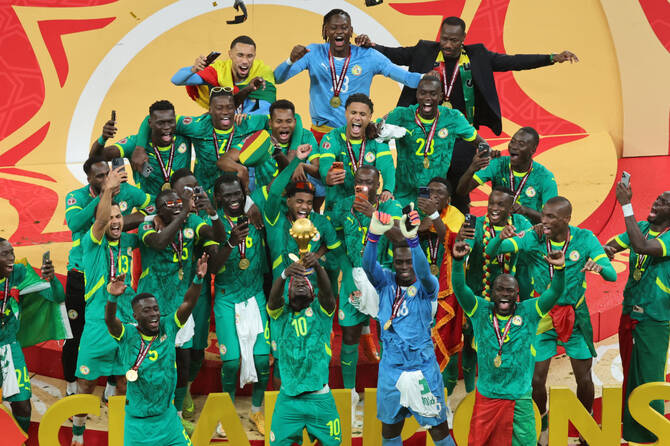

RABAT: Senegal stunned Morocco in Sunday’s Africa Cup of Nations final as Pape Gueye’s goal gave them a 1-0 extra-time win over the hosts at the end of a match marred by disgraceful scenes following a controversial penalty award.
Brahim Diaz could have won the trophy for Morocco when he stepped up to take the spot-kick in the 24th added minute at the end of normal time.
But Senegal goalkeeper Edouard Mendy easily saved the weak attempted chip by the Real Madrid winger, who was clearly distracted by the long delay of almost 20 minutes that followed the penalty award.
Congolese match referee Jean-Jacques Ndala gave the penalty right at the end of the allotted eight added minutes following a VAR check for a challenge on Diaz in the box by Senegal defender El Hadji Malick Diouf.

Senegal's Pape Gueye scores during the Africa Cup of Nations final soccer match between Senegal and Morocco, in Rabat, Morocco, Sunday, Jan. 18, 2026. (AP)
Diaz, the rest of the Moroccan team and their bench vehemently protested to the referee to check the images, but the decision to eventually give the spot-kick was met with fury by Senegal and their fans.
As most of their players walked off the pitch, some Senegal supporters in the small section of away fans at the opposite end of the stadium threw chairs and other objects and attempted to get onto the field of play.
They were eventually contained by a large barrier of police and stewards, and their anger turned to delight and disbelief when the penalty was saved.

Senegal's goalkeeper Edouard Osoque Mendy saves from Morocco's Ismael Saibari during the Africa Cup of Nations final soccer match between Senegal and Morocco in Rabat, Morocco, Sunday, Jan. 18, 2026. (AP)
The Senegal team had initially been riled by the referee’s decision to disallow for a foul a goal they scored in the second added minute when Abdoulaye Seck headed off the post at a corner and Ismaila Sarr nodded in the rebound.
After Diaz’s penalty miss, however, it felt almost inevitable that a galvanized Senegal would go on to score, and they did so in the fourth minute of extra time to stun the home fans in the crowd of 66,526 at the Prince Moulay Abdellah Stadium.
Gueye the hero
Sadio Mane won possession in midfield and found Idrissa Gana Gueye, who released his namesake Pape Gueye.
The Villarreal midfielder held off the backtracking Moroccan captain Achraf Hakimi as he advanced toward the box before beating goalkeeper Yassine Bounou with a superb strike into the top corner.
Morocco were distraught, in particular Diaz who was promptly substituted.
They could still have forced a penalty shoot-out, with Nayef Aguerd heading against the crossbar in the second half of extra time.

Senegal's Sadio Mane holds the trophy aloft after winning the Africa Cup of Nations final soccer match agaisnt Morocco, in Rabat, Morocco, Sunday, Jan. 18, 2026. (AP)
But it was not to be for the hosts, who had been dreaming of winning the title in front of their own fans to end a 50-year wait to become African champions for just the second time.
Senegal could have been more comfortable had Cherif Ndiaye not squandered a glorious chance to make it 2-0 late in the extra period, but they held on.
It is their second Cup of Nations title in the last three editions, after they defeated Egypt on penalties in Yaounde in 2022 to win the trophy for the first time in their history.
They can now look forward to heading to the United States for the World Cup in June, and will hope to persuade star man Mane to play at another AFCON after he declared that the final would be his last ever game at the tournament.
Any investigation into the disgraceful scenes during the game will focus on the conduct of the Senegal team and their fans as well as any shortcomings by Moroccan organizers.

Senegal's Antoine Mendy controls the ball during the Africa Cup of Nations final soccer match between Senegal and Morocco, in Rabat, Morocco, Sunday, Jan. 18, 2026. (AP)
The incidents came at the end of a tense final which had been low on goalmouth action — not exactly surprising given the defensive strength of Africa’s best teams according to the FIFA rankings.
Senegal’s Iliman Ndiaye was denied by Bounou when clean through with the best chance in the first half, while Morocco should have scored just before the hour mark but Ayoub El Kaabi prodded wide from a Bilal El Khannouss cross.
Then came the late drama, with Senegal surviving the penalty award before Gueye became their hero — remarkably that was the first goal scored by the Lions of Teranga in an AFCON final after they had failed to find the net in any of their three previous appearances in the tournament’s deciding game.
It was an agonizing way for Morocco’s campaign to end, and many of their fans had left the stadium before the final whistle on a cold and wet night in Rabat.


