UN says Ghanaian peacekeeper killed in violence in South Sudan

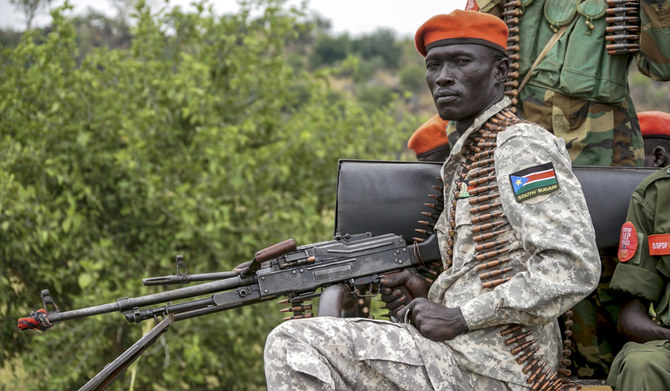
A South Sudanese military police officer sits on a pickup truck while monitoring the area as troops belonging to the South Sudanese Unified Forces take part in a deployment ceremony at the Luri Military Training Centre in Juba on November 15, 2023. (AFP)
Short Url
Updated 29 January 2024
Follow

UN says Ghanaian peacekeeper killed in violence in South Sudan

  • Clashes between different communities are common in South Sudan, which is still reeling from years of a devastating war that pitted the country’s leader, Salva Kiir, against his former deputy, Riek Machar, in a battle between rival tribes

JUBA: A United Nations peacekeeper from Ghana has been killed alongside some civilians after clashes between rival local groups in the Abyei region on South Sudan’s border with Sudan, a UN statement said.
According to the statement by the United Nations Interim Security Force for Abyei (UNISFA), the clashes occurred in three locations in the Abyei area on Saturday.
This led to casualties and the evacuation of civilians to UNISFA bases to provide safety for those caught up in the violence, the statement said.
During the fighting, one UNISFA base came under attack and although the attack was repelled “tragically a Ghanaian peacekeeper was killed during the incident,” the statement said.
The UN mission said it was still verifying the number of people killed, injured and displaced by the violence.
Clashes between different communities are common in South Sudan, which is still reeling from years of a devastating war that pitted the country’s leader, Salva Kiir, against his former deputy, Riek Machar, in a battle between rival tribes.
The UN statement did not say which tribes were involved in Saturday clashes.
The Abyei region, rich in oil resources, experiences frequent bouts of violence. Rival factions of the Dinka ethnic group are locked in a dispute over the location of an administrative boundary. The ownership of Abyei itself is disputed between Sudan and South Sudan, which declared independence from Sudan in 2011.


Syrian army deploys in Deir Ezzor province after Kurdish withdrawal

Updated 2 sec ago
Follow

Syrian army deploys in Deir Ezzor province after Kurdish withdrawal

  • Syria’s army on Monday deployed its forces in parts of the eastern Deir Ezzor province formerly controlled by Kurdish forces following their withdrawal from the area
DEIR EZZOR: Syria’s army on Monday deployed its forces in parts of the eastern Deir Ezzor province formerly controlled by Kurdish forces following their withdrawal from the area.
After two days of rapid gains in Kurdish-controlled territory, Syrian President Ahmed Al-Sharaa announced on Sunday a deal with their leader Mazloum Abdi that includes a ceasefire and the integration of the Kurdish administration and forces into the central state.
The government push captured Arab-majority areas that came under Kurdish control during the fight against the Daesh group.
In Deir Ezzor, an AFP correspondent saw dozens of military vehicles heading to the east of the Euphrates river, which once separated Damascus-controlled areas to the west from the US-backed, Kurdish-led Syrian Democratic Forces to the east.
Lines of cars, trucks and motorcycles formed in front of a small bridge leading to the eastern bank.
Some people were also heading there on foot.
“Our joy over liberation is indescribable,” Mohammed Khalil, a 50-year-old driver in Deir Ezzor, told AFP.
“We hope things will be better than before. There was... no freedom under the SDF.”
Safia Keddo, a 49-year-old teacher, told AFP “the past few years, but today we must turn the page.”
“We want children to return to school without fear, and for electricity, water, and bread to be restored. We’re not asking for a miracle; we just want stability and a normal life.”
The Syrian army said in a statement that it “started the deployment” into the eastern Jazira region “to secure it under the agreement between the Syrian state and the SDF.”
The agreement calls for the immediate handover of the provinces of the Arab-majority Raqqa and Deir Ezzor provinces.
The SDF had announced on Sunday that it was withdrawing from areas under its control in the eastern Deir Ezzor countryside, including the Al-Omar and Tanak oil fields.
Local fighters from tribes in the Arab-majority province sided with Damascus and took control of these areas before the arrival of government forces.
Some Arab tribes were previously allied with the SDF, which included a significant Arab component in its ranks.
The SDF had taken control of part of Deir Ezzor after defeating the Daesh group with the support of an international coalition led by the United States.