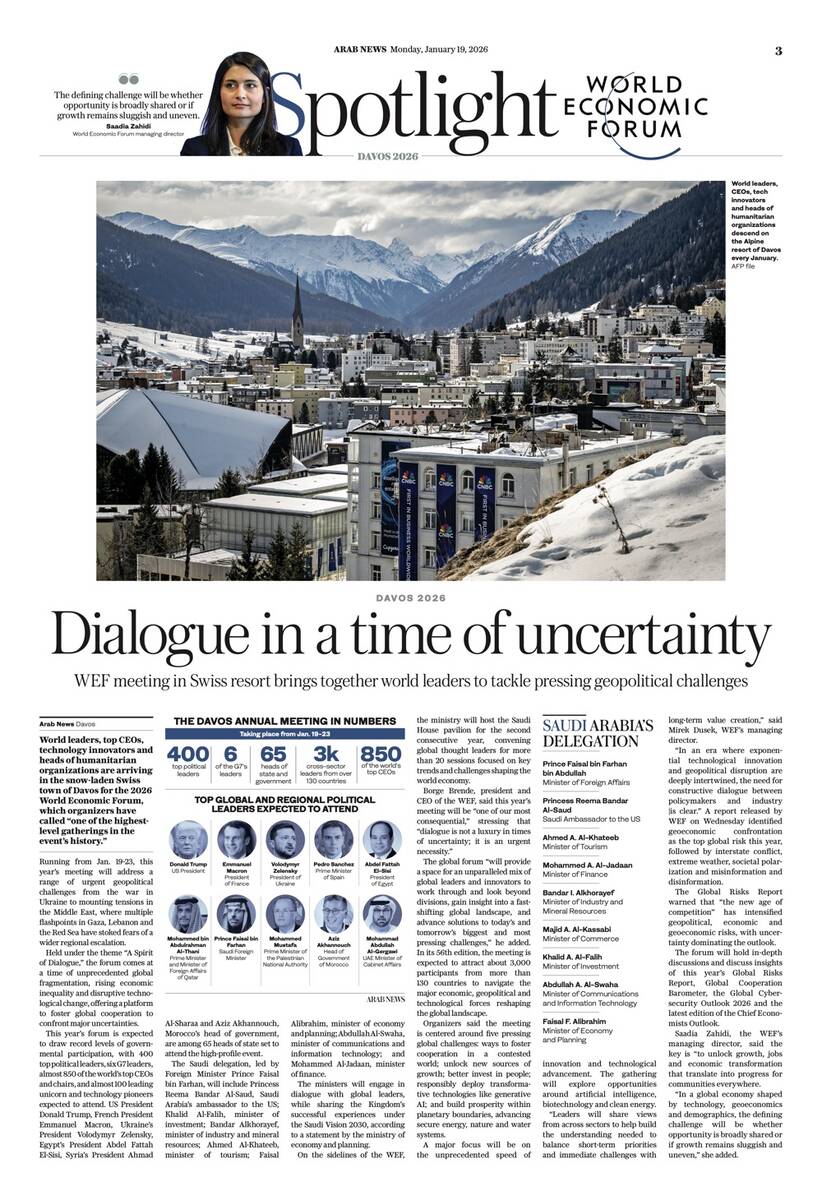
DAVOS: World leaders, top CEOs, technology innovators and heads of humanitarian organizations are arriving in the snow-laden Swiss town of Davos for the 2026 World Economic Forum, which organizers have called “one of the highest-level gatherings in the event’s history.”
Running from Jan. 19-23, this year’s meeting will address a range of urgent geopolitical challenges from the war in Ukraine to mounting tensions in the Middle East, where multiple flashpoints in Gaza, Lebanon and the Red Sea have stoked fears of a wider regional escalation.
Held under the theme “A Spirit of Dialogue,” the forum comes at a time of unprecedented global fragmentation, rising economic inequality and disruptive technological change, offering a platform to foster global cooperation to confront major uncertainties.
This year’s forum is expected to draw record levels of governmental participation, with 400 top political leaders, six G7 leaders, almost 850 of the world’s top CEOs and chairs, and almost 100 leading unicorn and technology pioneers expected to attend.

US President Donald Trump, French President Emmanuel Macron, Ukraine’s President Volodymyr Zelensky, Egypt’s President Abdel Fattah El-Sisi, Syria’s President Ahmad Al-Sharaa and Aziz Akhannouch, Morocco’s head of government, are among 65 heads of state set to attend the high-profile event.
The Saudi delegation, led by Foreign Minister Prince Faisal bin Farhan, will include Princess Reema Bandar Al-Saud, Saudi Arabia’s ambassador to the US; Khalid Al-Falih, minister of investment; Bandar Alkhorayef, minister of industry and mineral resources; Ahmed Al-Khateeb, minister of tourism; Faisal Alibrahim, minister of economy and planning; Abdullah Al-Swaha, minister of communications and information technology; and Mohammed Al-Jadaan, minister of finance.

The ministers will engage in dialogue with global leaders, while sharing the Kingdom’s successful experiences under the Saudi Vision 2030, according to a statement by the ministry of economy and planning.
On the sidelines of the WEF, the ministry will host the Saudi House pavilion for the second consecutive year, convening global thought leaders for more than 20 sessions focused on key trends and challenges shaping the world economy.

Borge Brende, president and CEO of the WEF, said this year’s meeting will be “one of our most consequential,” stressing that “dialogue is not a luxury in times of uncertainty; it is an urgent necessity.”
The global forum “will provide a space for an unparalleled mix of global leaders and innovators to work through and look beyond divisions, gain insight into a fast-shifting global landscape, and advance solutions to today’s and tomorrow’s biggest and most pressing challenges,” he added.
FASTFACTS
* Annual meeting of World Economic Forum is being held in Davos from Jan. 19-23 under the theme “A Spirit of Dialogue.”
* Among those attending are six G7 leaders, almost 850 CEOs and chairs, and about 100 unicorn founders and technology pioneers.
In its 56th edition, the meeting is expected to attract about 3,000 participants from more than 130 countries to navigate the major economic, geopolitical and technological forces reshaping the global landscape.

Organizers said the meeting is centered around five pressing global challenges: Ways to foster cooperation in a contested world, unlock new sources of growth, better invest in people, responsibly deploy transformative technologies like generative AI and build prosperity within planetary boundaries, advancing secure energy, nature and water systems.
A major focus will be on the unprecedented speed of innovation and technological advancement. The gathering will explore opportunities around artificial intelligence, biotechnology and clean energy.

“Leaders will share views from across sectors to help build the understanding needed to balance short-term priorities and immediate challenges with long-term value creation,” said Mirek Dusek, WEF’s managing director.
“In an era where exponential technological innovation and geopolitical disruption are deeply intertwined, the need for constructive dialogue between policymakers and industry is clear.”

A report released by WEF on Wednesday identified geoeconomic confrontation as the top global risk this year, followed by interstate conflict, extreme weather, societal polarization and misinformation and disinformation.
The Global Risks Report warned that “the new age of competition” has intensified geopolitical, economic and geoeconomic risks, with uncertainty dominating the outlook.

The forum will hold in-depth discussions and discuss insights of this year’s Global Risks Report, Global Cooperation Barometer, the Global Cybersecurity Outlook 2026 and the latest edition of the Chief Economists Outlook.
Saadia Zahidi, the WEF’s managing director, said the key is “to unlock growth, jobs and economic transformation that translate into progress for communities everywhere.
“In a global economy shaped by technology, geoeconomics and demographics, the defining challenge will be whether opportunity is broadly shared or if growth remains sluggish and uneven,” she added.