

Saudi Arabia leads IPOs in GCC region: KAMCO Invest

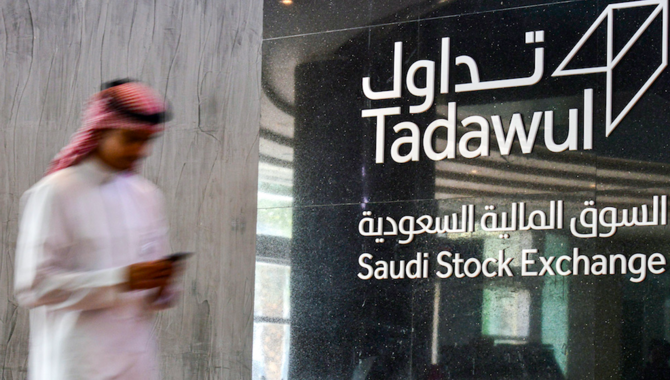
The logo of Saudi Arabia's Stock Exchange in the capital Riyadh. Getty/File Photo
Short Url
Updated 24 January 2024
Follow

Saudi Arabia leads IPOs in GCC region: KAMCO Invest

RIYADH: Saudi Arabia continued to lead initial public offerings in the Gulf Cooperation Councill region in 2023, with 35 out of the 46 IPOs occurring in the Kingdom.

Saudi Arabia’s parallel market, Nomu, witnessed 27 IPOs in 2023, while the Tadawul All Share Index saw eight deals, according to research by KAMCO Invest.  

UAE continued its domination in terms of IPO proceeds, raking in almost 56.3 percent of the issuance proceeds at around $6.07 billion from its eight listings. 

According to the report, proceeds from GCC issuers in 2023 dropped by 54 percent to $10.79 billion from $23.38 billion in 2022. 

“Although issuance numbers were driven by smaller-ticket IPOs, post-listing performance from larger names was largely positive,” said KAMCO Invest. 

It added: “Solid performances from larger stocks were backed by clear signaling and IPO pitches from companies and investment bankers about either growth prospects which drove solid price appreciation or strong dividend yields.” 

The report further noted that the largest IPO from the region was ADNOC Gas, which supplies around 60 percent of the UAE’s natural gas requirements. The company garnered $2.48 billion from the sale of five percent of its business via its primary market issuance.  

ADES Holding Co., the owner and operator of offshore and onshore rigs from Saudi Arabia, recorded the second-largest IPO from the region with issuance proceeds of $1.2 billion before listing on the Tadawul Main Market.

Pure Health from UAE rounded off the top three IPOs from the GCC, raising $990 million. 

Oman’s MSX contributed to the fourth largest IPO in the region with OQ Gas Network, which raised $771 million for 49 percent of its stake. 

Additionally, Qatar witnessed the IPO of managed IT services and solutions provider MEEZA, which raised $232.67 million from its public offering. 

Regarding the prospects for 2024, KAMCO Invest said that issuance proceeds will be dominated by fewer larger issues this year, while several smaller IPOs, such as the Nomu, should debut on the markets. 


First EU–Saudi roundtable on critical raw materials reflects shared policy commitment

Updated 16 January 2026
Follow

First EU–Saudi roundtable on critical raw materials reflects shared policy commitment

RIYADH: The EU–Saudi Arabia Business and Investment Dialogue on Advancing Critical Raw Materials Value Chains, held in Riyadh as part of the Future Minerals Forum, brought together senior policymakers, industry leaders, and investors to advance strategic cooperation across critical raw materials value chains.

Organized under a Team Europe approach by the EU–GCC Cooperation on Green Transition Project, in coordination with the EU Delegation to Saudi Arabia, the European Chamber of Commerce in the Kingdom and in close cooperation with FMF, the dialogue provided a high-level platform to explore European actions under the EU Critical Raw Materials Act and ResourceEU alongside the Kingdom’s aspirations for minerals, industrial, and investment priorities.

This is in line with Saudi Vision 2030 and broader regional ambitions across the GCC, MENA, and Africa.

ResourceEU is the EU’s new strategic action plan, launched in late 2025, to secure a reliable supply of critical raw materials like lithium, rare earths, and cobalt, reducing dependency on single suppliers, such as China, by boosting domestic extraction, processing, recycling, stockpiling, and strategic partnerships with resource-rich nations.

The first ever EU–Saudi roundtable on critical raw materials was opened by the bloc’s Ambassador to the Kingdom, Christophe Farnaud, together with Saudi Deputy Minister for Mining Development Turki Al-Babtain, turning policy alignment into concrete cooperation.

Farnaud underlined the central role of international cooperation in the implementation of the EU’s critical raw materials policy framework.

“As the European Union advances the implementation of its Critical Raw Materials policy, international cooperation is indispensable to building secure, diversified, and sustainable value chains. Saudi Arabia is a key partner in this effort. This dialogue reflects our shared commitment to translate policy alignment into concrete business and investment cooperation that supports the green and digital transitions,” said the ambassador.

Discussions focused on strengthening resilient, diversified, and responsible CRM supply chains that are essential to the green and digital transitions.

Participants explored concrete opportunities for EU–Saudi cooperation across the full value chain, including exploration, mining, and processing and refining, as well as recycling, downstream manufacturing, and the mobilization of private investment and sustainable finance, underpinned by high environmental, social, and governance standards.

From the Saudi side, the dialogue was framed as a key contribution to the Kingdom’s industrial transformation and long-term economic diversification agenda under Vision 2030, with a strong focus on responsible resource development and global market integration.

“Developing globally competitive mineral hubs and sustainable value chains is a central pillar of Saudi Vision 2030 and the Kingdom’s industrial transformation. Our engagement with the European Union through this dialogue to strengthen upstream and downstream integration, attract high-quality investment, and advance responsible mining and processing. Enhanced cooperation with the EU, capitalizing on the demand dynamics of the EU Critical Raw Materials Act, will be key to delivering long-term value for both sides,” said Al-Babtain.

Valere Moutarlier, deputy director-general for European industry decarbonization, and directorate-general for the internal market, industry, entrepreneurship and SMEs at European Commission, said the EU Critical Raw Materials Act and ResourceEU provided a clear framework to strengthen Europe’s resilience while deepening its cooperation with international partners.

“Cooperation with Saudi Arabia is essential to advancing secure, sustainable, and diversified critical raw materials value chains. Dialogues such as this play a key role in translating policy ambitions into concrete industrial and investment cooperation,” she added.