

Pakistan reopens key Torkham border crossing with Afghanistan after over ten-day closure

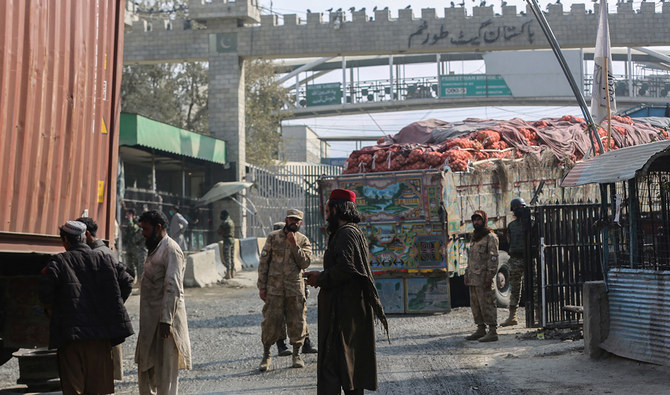
Security personnel stand guard as trucks pass through the zero point Torkham border crossing between Afghanistan and Pakistan, in Nangarhar province on January 23, 2024. (AFP)
Short Url
Updated 23 January 2024
Follow

Pakistan reopens key Torkham border crossing with Afghanistan after over ten-day closure

  • Torkham crossing was closed over Afghan truck drivers not having proper travel permits and visas
  • Pakistan reopens border for a month after which Afghan drivers will need to show passports and visas

PESHAWAR: Pakistan opened a key northwestern border crossing with Afghanistan on Tuesday, police and customs officials said, more than ten days after it was closed over Afghan truck drivers not having proper travel documents.

Truckers have for years been able to pass the border without documents so they generally do not have them but Pakistani officials have recently started asking for passports and visas from Afghan drivers.

The Torkham border crossing has been closed a number of times in recent months, including in September when it was shut for nine days due to clashes between border forces.

“Torkham border has been reopened under a specific arrangement for one month. After one month, the Afghan drivers will require proper traveling documents such as visas and passports,” Naheed Khan, a senior police officer deputed on the border, told Arab News, saying officials had decided to relax document requirements temporarily as a “goodwill” gesture.

The flow of a large number of transit trade vehicles had started on Tuesday morning soon after the border opened, Khan added.

Asghar Ali, a Pakistani customs clearing agent at the border, said the gates of the busy crossing point were reopened at around 9:00 am today, Tuesday, after which movement of vehicles began.

“It is open for a month. After one month, transporters and drivers will be required to carry valid traveling documents while crossing the border,” he said. “Let’s see what happens next.”

Pakistan has deported more than half a million Afghans without valid papers in recent months. The country has long hosted about 1.7 million Afghans, most of whom fled during the 1979-1989 Soviet war. More than half a million fled Afghanistan when the Taliban seized power.

Pakistan says it is concerned that many Pakistani Taliban leaders and fighters have found sanctuary in Afghanistan and have been emboldened to carry out more attacks on security forces in Pakistan. The Afghan Taliban government insists it does not allow the Pakistani Taliban to use its soil to launch attacks in Pakistan.

Pakistan has also blamed a number of recent bombings and attacks on Afghan nationals, saying security concerns were a major reason for its crackdown against illegal migrants. 


Pakistan offloads wheat stocks, boosts provincial supply to stabilize prices

Updated 28 January 2026
Follow

Pakistan offloads wheat stocks, boosts provincial supply to stabilize prices

  • ECC approves sale of 500,000 tons of wheat, allocates 300,000 tons to Punjab
  • Cabinet body also clears utility arrears and approves vaccine and fertilizer funding

KARACHI: Pakistan’s top economic decision-making body on Wednesday approved the disposal of surplus government wheat stocks and a major inter-provincial allocation to stabilize domestic flour prices, as Islamabad seeks to manage food security risks while containing fiscal pressures.

The decisions come as Pakistan grapples with food inflation sensitivity, climate-related supply disruptions and the fiscal burden of carrying large public stocks. Wheat, the country’s staple food, is politically and economically critical because flour prices directly affect household inflation and living costs, and past volatility has triggered public unrest and costly emergency imports.

On Wednesday, the Economic Coordination Committee (ECC) of the Cabinet authorized the sale of 500,000 metric tons of wheat held by the Pakistan Agricultural Storage and Services Corporation (PASSCO), the federal grain procurement agency, through competitive bidding. It also approved the release of 300,000 metric tons to the Punjab government to ensure uninterrupted supplies to flour mills, according to an official statement issued by the Finance Division.

“The disposal of 500,000 metric tons of PASSCO wheat stock through competitive bidding aims at managing surplus stocks, reducing carrying and storage costs, and ensuring price stability in the domestic wheat market while safeguarding food security considerations,” the Finance Division said in a statement following the ECC meeting.

In a related move, the committee approved the provision of PASSCO wheat to Punjab, the country’s most populous province and a key driver of national wheat consumption, to help maintain adequate supplies for flour mills and prevent supply chain disruptions, the statement said.

Beyond food security, the ECC approved a technical supplementary grant - an off-budget allocation used to meet urgent funding needs - of Rs 10.98 billion ($39 million) to clear long-standing liabilities owed by the Pakistan Post Office Department to utility companies, part of broader efforts to address inter-government arrears that have strained public sector finances.

In the health sector, the committee authorized Rs 29.66 billion ($106 million) for the Federal Directorate of Immunization to ensure uninterrupted procurement of vaccines and syringes under the Expanded Program on Immunization, a move aimed at sustaining routine immunization coverage and preventing outbreaks of vaccine-preventable diseases.

The ECC also approved a Rs 23.42 billion ($84 million) subsidy package for imported urea, to be shared equally between the federal and provincial governments, as authorities seek to cushion farmers from rising fertilizer costs and limit spillover effects on food prices.