Why is India’s Ram Mandir in Ayodhya contentious?

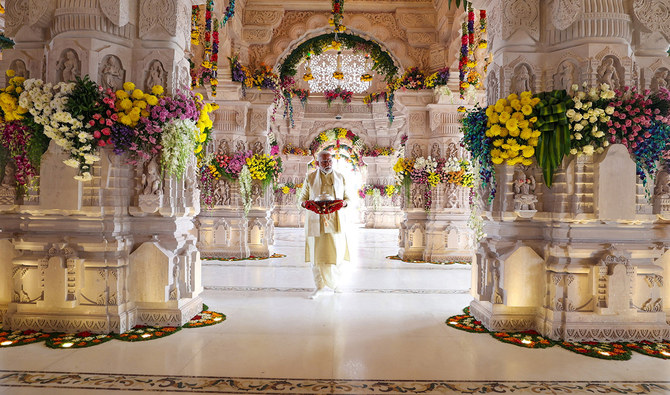
India's Prime Minister Narendra Modi attends the opening of the grand temple of the Hindu god Lord Ram in Ayodhya, India, January 22, 2024. (India's Press Information Bureau/REUTERS)
Short Url
Updated 22 January 2024
Follow

Why is India’s Ram Mandir in Ayodhya contentious?

  • Temple replaces a 16th-century Mughal-era mosque razed by radical Hindu groups in 1992
  • Razed mosque is believed by many Hindus to have been built on the spot where Ram was born

Indian Prime Minister Narendra Modi led the consecration on Monday of a grand temple to the Hindu god-king Ram on a site believed to be his birthplace, in a historic event for the Hindu majority of the world’s most populous nation.
Coming months before Modi seeks a rare third term in general elections due by May, the event delivers on a campaign promise his political party made more than three decades ago, but also calls to mind some of India’s worst sectarian strife.

WHY DOES IT MATTER?
The idol represents Ram as a five-year-old child, as many Hindus consider the temple site to have been the deity’s birthplace and where he spent his childhood.
As the temple replaces a 16th-century Mughal-era mosque razed by radical Hindu groups in 1992, many Indians hail it as a sign of Hindu reawakening from centuries of foreign subjugation, including rule by Muslim dynasties such as the Mughals.
Analysts say Modi’s leadership of the ceremony symbolizes for supporters of his Hindu nationalist party that India is finally ready to end what they call appeasement of minorities and move toward their goal of building a Hindu-first nation.

WHAT ARE THE FEATURES OF THE NEW TEMPLE?
Construction began in 2020, with Modi laying the foundation stone of the temple to one of Hinduism’s principal deities on a 2.7-acre (one-hectare) plot within a complex that sprawls over 70 acres (28 hectares).
Supervised by a panel headed by Modi’s former chief of staff Nripendra Misra, construction cost an estimated 15 billion rupees ($181 million), funded by contributions amounting to more than twice that from 40 million people in India.

WHAT WAS THE RELIGIOUS DISPUTE ABOUT?
The Indian epic, the Ramayana, mentions Ayodhya, a town in the northern state of Uttar Pradesh nearly 700 km (435 miles) east of New Delhi, as the birthplace of Ram, whom Hindus believe to be a physical incarnation of Lord Vishnu.
The razed mosque dating from 1528, during the rule of Babur, India’s first Mughal emperor, is believed by many Hindus to have been built on the spot where Ram was born, following the demolition of an earlier temple there.
In Dec. 1949, authorities seized the mosque after Hindu activists placed idols of Ram inside the disputed structure. Court orders barred removal of the idols, and use as a mosque effectively ceased.
Hindu and Muslim groups filed separate claims over the site and the structure. In 1989, a high court ordered the maintenance of status quo.

HOW WAS THE MOSQUE RAZED?
Hindu and Muslim groups tried unsuccessfully to resolve the dispute through talks, before Modi’s Hindu nationalist Bharatiya Janata Party (BJP) launched a nationwide campaign in 1990 to build the temple.
Lal Krishna Advani, the president of the party at the time, embarked on a cross-country journey on a truck fitted out to resemble an ancient chariot.
It whipped up Hindu fervor, deepening rifts with Muslims but also catapulting the party to national prominence.
The BJP campaign climaxed in a rally in Ayodhya on Dec. 6, 1992, when a mob climbed the mosque and smashed its domes with axes and hammers, levelling the entire structure.
The event triggered sectarian riots in several parts of India, killing about 2,000 people, mostly Muslims.
Muslims are a minority in mainly Hindu India, making up about 14 percent of its 1.42 billion people.
As a foot soldier of the party at the time, Modi helped organize the chariot’s journey, which began in his home state of Gujarat.
He rode to the office of prime minister in 2014 on a Hindu nationalist platform that included the promise to build the temple.
Temple construction began after the Supreme Court permitted it in 2019 on condition that Muslims received another plot for a mosque.


Culture being strangled by Kosovo’s political crisis

Updated 1 sec ago
Follow

Culture being strangled by Kosovo’s political crisis

PRIZREN: Kosovo’s oldest cinema has been dark and silent for years as the famous theater slowly disintegrates under a leaky roof.
Signs warn passers-by in the historic city of Prizren that parts of the Lumbardhi’s crumbling facade could fall while it waits for its long-promised refurbishment.
“The city deserves to have the cinema renovated and preserved. Only junkies gathering there benefit from it now,” nextdoor neighbor butcher Arsim Futko, 62, told AFP.
For seven years, it waited for a European Union-funded revamp, only for the money to be suddenly withdrawn with little explanation.
Now it awaits similar repairs promised by the national government that has since been paralyzed by inconclusive elections in February.
And it is anyone’s guess whether the new government that will come out of Sunday’s snap election will keep the promise.

- ‘Collateral damage’ -

Cinema director Ares Shporta said the cinema has become “collateral damage” in a broader geopolitical game after the EU hit his country with sanctions in 2023.
The delayed repairs “affected our morale, it affected our lives, it affected the trust of the community in us,” Shporta said.
Brussels slapped Kosovo with sanctions over heightened tensions between the government and the ethnic Serb minority that live in parts of the country as Pristina pushed to exert more control over areas still tightly linked to Belgrade.
Cultural institutions have been among the hardest-hit sectors, as international funding dried up and local decisions were stalled by the parliamentary crisis.
According to an analysis by the Kosovo think tank, the GAP Institute for Advanced Studies, sanctions have resulted in around 613 million euros ($719 million) being suspended or paused, with the cultural sector taking a hit of 15-million-euro hit.

- ‘Ground zero’ -

With political stalemate threatening to drag on into another year, there are warnings that further funding from abroad could also be in jeopardy.
Since February’s election when outgoing premier Albin Kurti topped the polls but failed to win a majority, his caretaker government has been deadlocked with opposition lawmakers.
Months of delays, spent mostly without a parliament, meant little legislative work could be done.
Ahead of the snap election on Sunday, the government said that more than 200 million euros ($235 million) will be lost forever due to a failure to ratify international agreements.
Once the top beneficiary of the EU Growth Plan in the Balkans, Europe’s youngest country now trails most of its neighbors, the NGO Group for Legal and Political Studies’ executive director Njomza Arifi told AFP.
“While some of the countries in the region have already received the second tranches, Kosovo still remains at ground zero.”
Although there have been some enthusiastic signs of easing a half of EU sanctions by January, Kurti’s continued push against Serbian institutions and influence in the country’s north continues to draw criticism from both Washington and Brussels.

- ‘On the edge’ -

Across the river from the Lumbardhi, the funding cuts have also been felt at Dokufest, a documentary and short film festival that draws people to the region.
“The festival has had to make staff cuts. Unfortunately, there is a risk of further cuts if things don’t change,” Dokufest artistic director Veton Nurkollari said.
“Fortunately, we don’t depend on just one source because we could end up in a situation where, when the tap is turned off, everything is turned off.”
He said that many in the cultural sector were desperate for the upcoming government to get the sanctions lifted by ratification of the agreements that would allow EU funds to flow again.
“Kosovo is the only one left on the edge and without these funds.”