

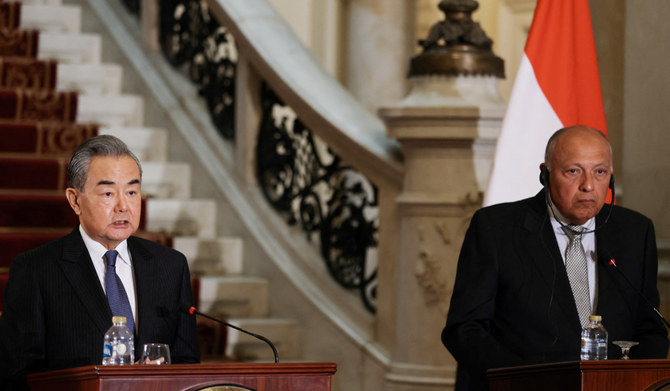

CAIRO: Egyptian people have made great achievements in country-building during the era of President Abdel Fattah El-Sisi, Chinese Foreign Minister Wang Yi said in Cairo on Sunday.
He was speaking at a joint press conference with Egyptian Foreign Minister Sameh Shoukry.
Egypt was the first stop of the Chinese foreign minister’s tour in Africa, followed by Tunisia, Togo, and Cote d’Ivoire.
Ahmed Abu Zeid, spokesman for the Ministry of Foreign Affairs, said that important issues are on the discussion table, including enhancing cooperation in all fields, and exchanging visions on the most important regional issues of common interest.
Shoukry and his Chinese counterpart signed the executive program for the comprehensive strategic partnership for 2024–2028.
Wang said that it has been 10 years since the signing of the strategic partnership between Egypt and China.
Shoukry said that the deteriorating conditions in the Gaza Strip and the threat to navigation in the Red Sea herald the expansion of the conflict in the region.
He said that there must be an immediate ceasefire in Gaza; the issue must be addressed from its roots; and the Palestinian state must be established and officially recognized as a state in the UN, which will stop the Palestinian-Israeli conflict and create ways for stability and security in the region.
The Chinese minister said there must be guarantees to protect navigation in the Red Sea region.
“We express our concern about the expanding conflict in the region,” said Wang.
He said that the two-state solution, which must adhere to the establishment of an independent state of Palestine on the 1967 borders with East Jerusalem as its capital, is the answer to ending the Palestinian-Israeli conflict.
China is calling for the establishment of an international peace conference to discuss the implementation of the two-state solution, he added.
Wang said that the sovereignty of Yemen and the countries bordering the Red Sea must be respected, cautioning against worsening the situation.
The ministers issued a joint statement saying that the two sides exchanged views on the Palestinian issue and Palestinian-Israeli conflict, including the crisis in the Gaza Strip.
They expressed deep concern about the deteriorating humanitarian situation in the enclave, and called on the international community and donors to provide all means of support to the Palestinian National Authority to facilitate its carrying out the tasks entrusted to it to the fullest extent throughout the occupied Palestinian territory.
The two sides stressed the importance of uniting international and regional efforts to immediately stop the attacks on the Gaza Strip, and work to reduce tension and instability in the region.
They also stressed the priority of ensuring the safety and security of navigation in the Red Sea.
The Egyptian and Chinese sides appreciated the efforts made by both sides to calm the situation in the region and contain the repercussions of the humanitarian crisis in the Gaza Strip.
The Egyptian and Chinese sides agreed to continue communication and coordination to find a permanent, comprehensive, and just solution to the Palestinian issue.


