

Judge says Donald Trump won’t give own closing argument at civil fraud trial after disputing rules

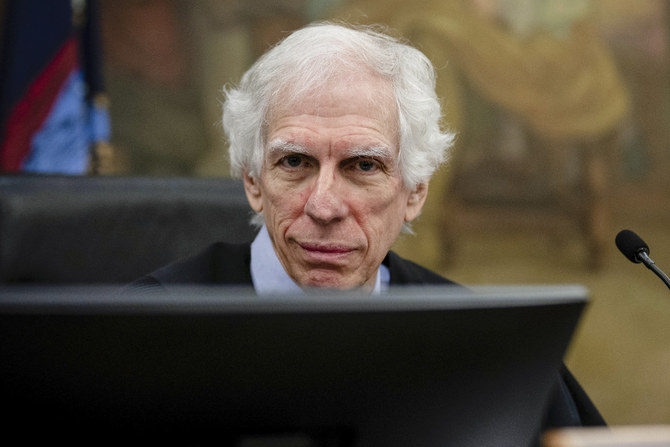
Justice Arthur Engoron. (New York Times via AP, Pool)
Short Url
Updated 11 January 2024
Follow

Judge says Donald Trump won’t give own closing argument at civil fraud trial after disputing rules

  • Engoron rejected the request after Trump's lawyers objected to the judge’s insistence that the former president stick to “relevant” matters and “not deliver a campaign speech”
  • Trump indicated he will still attend Thursday’s court proceeding and reiterated his desire to “personally do the closing argument”

NEW YORK: Donald Trump won’t make his own closing argument after all in his New York civil business fraud trial after his lawyers objected to the judge’s insistence that the former president stick to “relevant” matters and “not deliver a campaign speech.”

Judge Arthur Engoron nixed Trump’s unusual plan on Wednesday, a day ahead of closing arguments.
The judge had initially indicated he was open to the idea, saying he’d let Trump speak if he agreed to abide by rules that apply to attorneys’ closing arguments. Among other things, Engoron wanted the former president and current Republican front-runner to promise he wouldn’t assail his adversaries in the case, the judge or others in the court system.
Trump’s legal team said those limitations unfairly muzzled him. When Engoron didn’t hear from them by a Wednesday deadline, the judge told them he assumed Trump was not agreeing to the restrictions and therefore would not be speaking.
“MEAN & NASTY,” Trump wrote of the judge’s decision on his Truth Social platform. Trump indicated he will still attend Thursday’s court proceeding and reiterated his desire to “personally do the closing argument.”
The trial could cost Trump hundreds of millions of dollars in penalties and strip him of his ability to do business in New York. He’s fighting allegations that his net worth was inflated by billions of dollars on financial statements that helped him secure business loans and insurance.
The former president denies any wrongdoing, and he has lambasted the case as a “hoax” and a political attack on him. The judge is a Democrat, as is New York Attorney General Letitia James, who brought the lawsuit.
The trial came after Engoron decided, in a pretrial ruling, that Trump had engaged in fraud for years. The judge ordered at that point that a receiver take control of some of the ex-president’s properties, but an appeals court has put that order on hold.
The trial concerns remaining claims of conspiracy, insurance fraud and falsifying business records. Engoron will decide the verdict.
It’s extremely uncommon for people who have lawyers to give their own closing arguments. But Trump’s lawyers had signaled privately to the judge last week that the ex-president planned to deliver a summation personally, in addition to arguments from his legal team. James’ office objected, saying that the proposal would effectively amount to testimony without cross-examination.
In an email exchange filed in court Wednesday, Engoron initially approved the request, saying he was “inclined to let everyone have his or her say.”
But he said Trump’s remarks would have to stay within the bounds of “commentary on the relevant, material facts that are in evidence, and application of the relevant law to those facts.”
Trump would not be allowed to introduce new evidence, “comment on irrelevant matters” or “deliver a campaign speech” — or impugn the judge, his staff, the attorney general, her lawyers or the court system, the judge wrote.
Trump attorney Christopher Kise responded that those limitations were “fraught with ambiguities, creating the substantial likelihood for misinterpretation or unintended violation.” Engoron said that they were ”reasonable, normal limits” and would allow for comments on the attorney general’s arguments but not personal attacks.
Kise termed the restrictions “very unfair.”
“You are not allowing President Trump, who has been wrongfully demeaned and belittled by an out of control, politically motivated attorney general, to speak about the things that must be spoken about,” the attorney wrote.
“I won’t debate this yet again. Take it or leave it,” the judge shot back, with an all-caps addition saying he wouldn’t push back an already extended and imminent deadline to resolve the matter. The deadline passed without a response from Trump’s lawyers.
Earlier in the exchange, the judge also denied Kise’s request to postpone closing arguments until Jan. 29 because of the death Tuesday of Trump’s mother-in-law, Amalija Knavs. The judge expressed condolences but said he was sticking to the scheduled date, citing the security and logistics required for Trump’s planned visit to court.
Taking on a role usually performed by an attorney is dicey for any defendant, and summations are a last chance to try to show how the evidence from the trial has or hasn’t met legal requirements for proving the case.
A closing argument isn’t constrained to the question-and-answer format of testimony. But “it’s absolutely not a free-for-all,” said Christine Bartholomew, a University at Buffalo School of Law professor who specializes in civil procedure.
“Unless you’re legally trained … the chance of a misstep is really, really high,” she said, adding that it’s “extra-risky” when a judge has already taken issue with a defendant’s conduct during the case.
Trump ran afoul of Engoron after making a disparaging social media post about the judge’s law clerk on the trial’s second day. The post included a false insinuation about the clerk’s personal life.
Engoron then imposed a limited gag order, barring all participants in the trial from commenting publicly about court staffers. The judge later fined Trump a total of $15,000, saying he’d repeatedly violated the order. Trump’s defense team is appealing it.
During the recent email exchange about Trump’s potential summation, Engoron warned Trump’s lawyers that if the former president violated the gag order, he’d be removed from the courtroom and fined at least $50,000.
Trump testified in November, sparring verbally with the judge and state lawyers as he defended himself and his real estate empire. He later considered but ultimately decided against a second round of testimony, explaining that he had “nothing more to say.”


What Bangladesh’s election means for India, China and Pakistan ties

Bangladesh Nationalist Party supporters gather for a rally ahead of the upcoming national election, in Sylhet on Jan. 22, 2026.
Updated 08 February 2026
Follow

What Bangladesh’s election means for India, China and Pakistan ties

  • Bangladeshis will vote on Feb. 12, almost two years after the 2024 student-led uprising
  • After nearly 2 years of tensions, experts expect a thaw with India under elected government

DHAKA: As Bangladesh prepares to hold its first elections since the 2024 ouster of Sheikh Hasina, its longest-serving prime minister, the outcome will define Dhaka’s relations with the most important regional powers — China, India, and Pakistan.

Nearly 128 million Bangladeshis will head to the polls on Feb. 12 to bring in new leadership after an 18-month rule of the current caretaker administration.

The interim government, led by Nobel laureate Muhammad Yunus, took control following a student-led uprising that ended 15 years in power of Hasina and her Awami League party.

The two main parties out of the 51 competing for power are the Bangladesh Nationalist Party and Jamaat-e-Islami. The Awami League, which for decades has had close ties with India, was excluded from the election ballot over its role in the deadly crackdown on the 2024 student-led protests, in which 1,400 people were killed.

While Bangladesh’s relationship India has deteriorated since the fall of Hasina, who has been in self-exile in New Delhi, the period of diplomatic strain is expected to ease when the new government takes office.

“Whoever comes to power in Bangladesh, due to domestic pressure in the country, relationships with India need a resetting,” Humayun Kabir, former ambassador to the US, told Arab News.

“It’s anticipated that India will also engage with the new government, but they will protect their interests, and we also have to do the same. It’s most likely that the India-Bangladesh relationship will be normalized under the new, elected, government.”

Since 2024, India has suspended key transshipment access that allowed Bangladeshi exports to go via Indian ports and airports. It also put on hold most normal visa services for Bangladeshis, who were among its largest groups of medical tourists.

From Hasina’s heavy pro-India orientation, the interim government has tried to rebalance Bangladesh’s foreign policy toward the two other key regional players — China and Pakistan — who at the same time are India’s main rivals. 

If New Delhi regains its importance, it should not deal a blow to the newly expanded relations with Pakistan, with whom Bangladesh has recently increased exchanges, especially economic, and last month resumed direct flights — after a 14-year gap.

Since the relations have been expanded under the caretaker government, Prof. Delwar Hossain from the International Relations Department at Dhaka University forecast that they would only further improve, no matter who comes to power, and there is no likelihood of a sudden change.

“For Pakistan, any political coalition — whether BNP or Jamaat — will be positive. The BNP has a long history of having good relations with Pakistan during their rule ... Jamaat also has a strong and very positive influence in Pakistan,” he said.

“For Pakistan, the new regime or new government is not the issue. The issue is what the (India) policy of the new government would be and to what extent it would actually support Pakistan’s view.”

Both the BNP and Jamaat have repeatedly said they wanted friendly relations with India, and Hossain expected that they would, at the same time, continue the balanced approach introduced by the caretaker administration.

“India is a reality as a neighbor. At the same time, India is also showing interest in mending relations or adopting a more cooperative approach after the vote, with the government that will be elected ... I think there will be pragmatism from both sides,” he said.

“I don’t see there is a long-term threat to Bangladesh-India relations ... When China and Pakistan were trying to create a trilateral cooperative system or some kind of coalition — China, Bangladesh and Pakistan — we have seen that Bangladesh opted out. It seems that Bangladesh is going to continue its policy of maintaining a balance among these great powers.”

Bangladesh’s relations with China have not changed since the ouster of Hasina, whose government signed several economic agreements with Beijing. Yunus’s administration has continued this cooperation, and China was among the very few countries he officially visited during his term.

During the visit, he secured about $2.1 billion in Chinese investments, loans and grants, including funding for infrastructure like Mongla Port and a special economic zone in Chattogram — Bangladesh’s largest port. China has also eased visa rules for Bangladeshi businesspeople, medical travelers and tourists.

According to Munshi Faiz Ahmed, Bangladesh’s former ambassador to Beijing, China’s importance for Bangladesh cannot be substituted by any other country, especially as over the past few years it has emerged not only as its key investor, but also the largest trade partner.

In the fiscal year 2024-25, Bangladesh’s trade with China was over $21.3 billion, according to National Board of Revenue data. With India, it was about $11.5 billion.

The trade — especially import — dependence on Beijing started long before the regime change. In terms of trade volume, China overtook India already in 2018.

“Even when people thought that we had very close relations with India, our relations with China continued to grow in terms of trade and commerce ... Our trade with China has surpassed India’s, and China is a much bigger investor in Bangladesh’s development projects,” Ahmed said.

“Bangladesh will continue to cooperate with China for a long time to come because what China can provide, no other country can.”