
Gaza Strip, Palestinian Territories: Israel hit targets in south Gaza and across its border with Lebanon, the army said Monday ahead of a visit by the top US diplomat who is seeking to avert a wider war.
Gaza’s health ministry said 73 dead and 99 wounded had arrived at Al-Aqsa hospital in central Gaza’s Deir Al-Balah city over the previous 24 hours.
Three months into its battle with Gaza-based Hamas militants, Israel’s army says its focus has moved from the northern Gaza Strip to “dismantling” militants in the center and south of the Hamas-ruled Palestinian territory.
In the southern city of Khan Yunis, troops and warplanes overnight Sunday-Monday struck 30 militant targets which a military statement described as “significant.” These included underground targets and weapons storage facilities, it said.
A drone also killed 10 militants “preparing to launch rockets toward Israeli territory,” the statement added.
Also overnight, the military said it had hit “numerous Hezbollah targets” in Lebanon.
Israel and Lebanon’s Iran-backed Hezbollah movement, a Hamas ally, have engaged in regular cross-border fire during the war that began an October 7 with Hamas’s unprecedented attack against Israel.
But a strike last week in a Beirut stronghold of Hezbollah has been a major factor contributing to rising fears of spreading conflict. A US Defense Department official has told AFP that Israel carried out the strike that killed Hamas’s deputy leader Saleh Al-Aruri.
The Hamas attack which triggered the war resulted in about 1,140 deaths in Israel, mostly civilians, according to an AFP tally based on official Israeli figures.
The militants, considered a “terrorist” group by the United States and European Union, also took around 250 hostages, 132 of whom remain captive, Israel says. At least 24 are believed to have been killed.
Israel has responded with relentless bombardment and a ground invasion that have killed at least 22,835 people, most of them women and children, according to the Gaza health ministry.
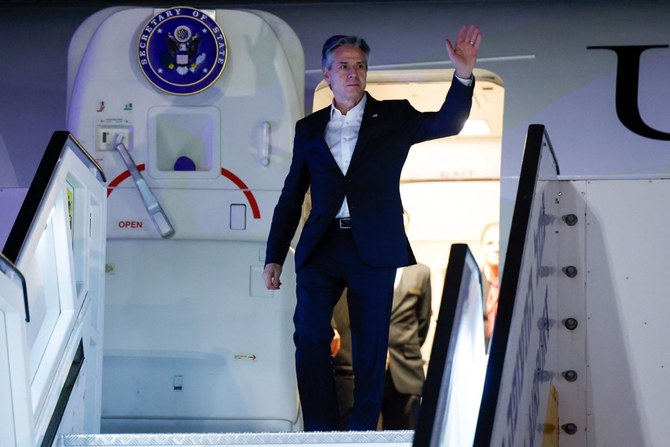
On his fourth regional trip since the war began, Blinken held talks earlier Monday with President of the UAE Sheikh Mohamed bin Zayed Al Nahyan in Abu Dhabi.
Blinken’s visit comes alongside that of other top Western diplomats trying to stop the conflict from spreading and to boost desperately needed aid to Gazans.
In Qatar on Sunday, Blinken warned that the violence could “easily metastasize” into a regional conflict.
Over the weekend Qatari officials also hosted relatives of captives still held in Gaza, said Ruby Chen, father of 19-year-old captive Itay Chen. The release of more hostages “serves the bigger objective, as they see it, which is creating regional stability,” Chen said on returning to Tel Aviv.
Qatar earlier helped mediate a one-week truce that saw dozens of hostages freed in exchange for Palestinian prisoners. Talks with Hamas on a new truce are “ongoing,” the emirate’s prime minister said.
Since October, violence has surged in the Israeli-occupied West Bank, and Yemen’s Iran-backed Houthi rebels have launched more than 100 drone and missile strikes toward targets in the Red Sea, a major global trade route, and Israel.
Washington, Israel’s main ally that provides it with billions of dollars in military aid, has grown increasingly concerned over the war’s civilian death toll.
Most of Gaza’s population has been displaced, according to the United Nations, leaving them in overcrowded shelters or tents in the winter chill.
The World Health Organization has warned of the risk of famine and disease, with only minimal aid entering as people struggle to find water and other necessities.
Washington has said Blinken will press Israel on its compliance with international humanitarian law and ask for “immediate measures” to boost aid to Gaza.
“Our home and my son’s home have been destroyed and we have 20 people martyred in our family. I don’t know where we will go even if I survive,” said Gaza resident Nabil Fathi, 51.
Two journalists working for the Qatar-based Al Jazeera network were killed on Sunday when their car was struck in southern Gaza’s city of Rafah, near the border with Egypt, the broadcaster said.
They were named as Mustafa Thuria, a video stringer who also worked for AFP and other media organizations, and Hamza Wael Dahdouh, the son of Al Jazeera’s Gaza bureau chief who had been wounded in an earlier strike, after his wife and two other children were killed in an Israeli bombardment.
The New York-based Committee to Protect Journalists says at least 79 journalists and media professionals, the vast majority Palestinian, have been killed since the war began.
Al-Aqsa hospital, which received the additional wounded on Monday, is one of Gaza’s few still partly functioning, but on Sunday the UN reported “sickening scenes of people of all ages being treated on blood-streaked floors and in chaotic corridors.”
Israeli military spokesman Daniel Hagari on Saturday said forces had “dismantled” Hamas’s military leadership in northern Gaza, leaving militants there operating only sporadically without leadership.
His comment came weeks after Israel’s Defense Minister Yoav Gallant said in November that Hamas had “lost control” of Gaza, which it has ruled since 2007.
Live AFPTV images on Monday showed black smoke rising over Gaza’s central and southern areas, with explosions sounding.
A military statement said troops had discovered a Hamas underground “weapons production site” in morth Gaza. It also released footage of what it said were operations in the northern district of Shujaiya targeting Islamic Jihad, a militant group fighting alongside Hamas.
Despite the devastation and deprivation in Gaza’s north, members of the minority Greek Orthodox community on Sunday attended Christmas mass inside Gaza City’s richly decorated Church of Saint Porphyrius.