

Indonesians support South Africa’s genocide case against Israel at World Court

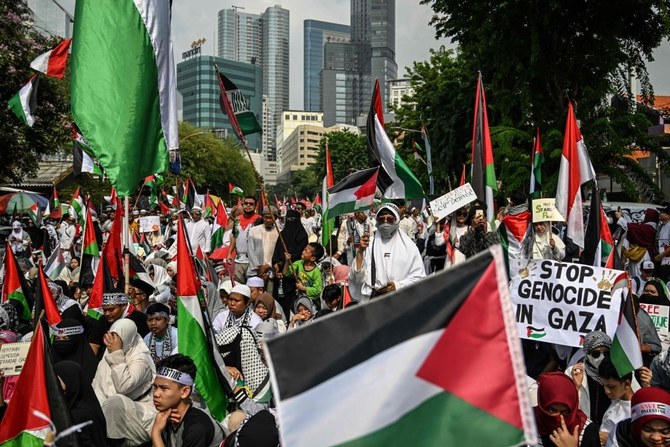
Indonesians in Surabaya, East Java take part in a mass rally in support of Palestinians on Nov. 12, 2023. (AFP)
Short Url
Updated 02 January 2024
Follow

Indonesians support South Africa’s genocide case against Israel at World Court

  • South Africa asked ICJ to issue interim order for Israel to suspend military operations in Gaza
  • Both Indonesia and South Africa have long been vocal supporters of Palestinian independence

JAKARTA: Several Indonesian civil society organizations and activists have come out in support of a case filed by South Africa at the International Court of Justice which accuses Israel of engaging in “genocidal acts” in Gaza. 

In the case launched on Friday at the ICJ, which is also known as the World Court, South Africa stated that Israel has “engaged in, is engaging in and risks further engaging in genocidal acts against the Palestinian people in Gaza,” adding that Tel Aviv’s conduct is in violation of its obligations under the Genocide Convention.

With its submission, South Africa is asking the court to issue an interim order for Israel to immediately suspend its military operations in Gaza. A hearing into that request is likely in the coming days or weeks. While the case may take years if it goes ahead, an interim order could be issued within weeks.

Pretoria can bring the case under the Genocide Convention because both it and Tel Aviv are signatories to it.

South Africans liken their struggle against apartheid with the Palestinian cause. Similarly, Indonesia is also a staunch supporter of Palestine, with its people and government seeing Palestinian statehood as mandated by the nation’s constitution, which calls for the abolition of colonialism.

“We support South Africa’s move to drag Israel to the International Court of Justice,” Dr. Sarbini Murad, chairman of the Medical Emergency Rescue Committee, told Arab News.

MER-C is the Jakarta-based organization that funded the development of the Indonesia Hospital in northern Gaza. The facility was among the first damaged by Israel’s latest bombardments of the besieged strip, which since early October has killed nearly 22,000 people and injured more than 57,000. 

“Israel must be taken to the ICJ because what Israel is doing is genocide. (The) ICJ must act bravely and firmly, without fear even under pressure from Israel through the United States,” Murad said. “We hope that the war will end and peace will come for Palestine.”

Jama’ah Muslimin, a Muslim organization based in West Java, also voiced its support for South Africa, calling the case launch “brilliant and courageous.”

“(Jama’ah Muslimin) calls on other countries, like Indonesia, ASEAN (Association of Southeast Asian Nations) member countries, Arab countries especially, all member states of the OIC (Organization of Islamic Cooperation) and the UN to support and push for the international court to put Israel on trial to stop its crime of genocide in Palestine,” the organization said in a statement.

Though the World Court’s orders are legally binding, they are not always followed as the court has no means of enforcing its decisions.

“Israel has gone beyond the limits of humane reason, and as such we fully support South Africa and hope that the international court will take urgent steps to stop the mass genocide that Israeli forces are doing on the occupied Palestinian territory,” Cecep Jasim, who coordinated a thousands-strong march for Gaza in West Java in late November, told Arab News.

“This is another sliver of hope for us, as concrete steps from other countries in support of Palestine will surely add power to the movement to create freedom and independence for Palestinians.”


EU leaders to reassess US ties despite Trump U-turn on Greenland

Updated 22 January 2026
Follow

EU leaders to reassess US ties despite Trump U-turn on Greenland

  • Diplomats stressed that, although Thursday’s emergency EU talks in Brussels would now lose some of their urgency, the longer-term issue of how to handle the relationship with the US remained

BRUSSELS: EU leaders will rethink their ties with the US at an emergency summit on Thursday after Donald Trump’s threat of tariffs and even military action to ​acquire Greenland badly shook confidence in the transatlantic relationship, diplomats said.
Trump abruptly stepped back on Wednesday from his threat of tariffs on eight European nations, ruled out using force to take Greenland, a semi-autonomous territory of NATO ally Denmark, and suggested a deal was in sight to end the dispute.
German Chancellor Friedrich Merz, welcoming Trump’s U-turn on Greenland, urged Europeans not to be too quick to write off the transatlantic partnership.
But EU governments remain wary of another change of mind by a mercurial president who is increasingly seen as a bully that Europe will have to stand up to, and they are focused on coming up with a longer-term plan on how to deal with the ‌United States under this ‌administration and possibly its successors too.
“Trump crossed the Rubicon. He might do ‌it ⁠again. ​There is no ‌going back to what it was. And leaders will discuss it,” one EU diplomat said, adding that the bloc needed to move away from its heavy reliance on the US in many areas.
“We need to try to keep him (Trump) close while working on becoming more independent from the US It is a process, probably a long one,” the diplomat said.
EU RELIANCE ON US
After decades of relying on the United States for defense within the NATO alliance, the EU lacks the needed intelligence, transport, missile defense and production capabilities to defend itself against a possible Russian attack. This gives the US substantial leverage.
The US ⁠is also Europe’s biggest trading partner, making the EU vulnerable to Trump’s policies of imposing tariffs to reduce Washington’s trade deficit in goods, and, as in ‌the case of Greenland, to achieve other goals.
“We need to discuss where ‍the red lines are, how we deal with this bully ‍across the Atlantic, where our strengths are,” a second EU diplomat said.
“Trump says no tariffs today, but does ‍that mean also no tariffs tomorrow, or will he again quickly change his mind? We need to discuss what to do then,” the second diplomat said.
The EU had been considering a package of retaliatory tariffs on 93 billion euros ($108.74 billion) on US imports or anti-coercive measures if Trump had gone ahead with his own tariffs, while knowing such a step would harm Europe’s economy as well ​as the United States.
WHAT’S THE GREENLAND DEAL?
Several diplomats noted there were still few details of the new plan for Greenland, agreed between Trump and NATO Secretary General Mark Rutte late on ⁠Wednesday on the sidelines of the World Economic Forum in Davos, Switzerland.
“Nothing much changed. We still need to see details of the Greenland deal. We are a bit fed up with all the bullying. And we need to act on a few things: more resiliency, unity, get our things together on internal market, competitiveness. And no more accepting tariff bullying,” a third diplomat said.
Rutte told Reuters in an interview in Davos on Thursday that under the framework deal he reached with Trump the Western allies would have to step up their presence in the Arctic.
He also said talks would continue between Denmark, Greenland and the US on specific issues.
Diplomats stressed that, although Thursday’s emergency EU talks in Brussels would now lose some of their urgency, the longer-term issue of how to handle the relationship with the US remained.
“The approach of a united front in solidarity with Denmark and Greenland while focusing on de-escalation and finding an off-ramp has worked,” a fourth EU diplomat said.
“At the ‌same time it would be good to reflect on the state of the relationship and how we want to shape this going forward, given the experiences of the past week (and year),” he said.