Widespread casualties on day 80 of Lebanon conflict 

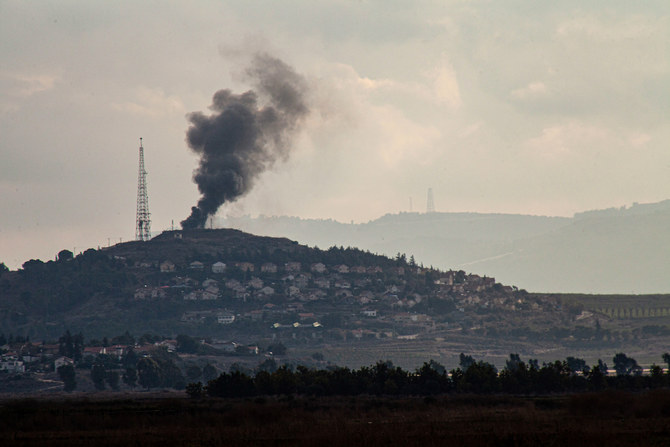
Smoke billows after an attack by Hezbollah on an Israeli military post in Metulla, facing the southern Lebanese border village of Khiam. (File/AFP)
Short Url
Updated 26 December 2023
Follow

Widespread casualties on day 80 of Lebanon conflict 

  • Hezbollah announced that it had targeted several Israeli military outposts, causing direct casualties

BEIRUT: On Tuesday, the 80th day of the conflict in southern Lebanon, hostilities between Hezbollah and the Israeli army caused casualties among Lebanese civilians and the Israeli army, including serious injuries.

Israel also violated Beirut’s airspace. An Israeli drone targeted a spot close to a supermarket on the road leading to the center of Touline village. Two civilians were injured by flying glass from the attack.

Malek Awali, mayor of Touline, told Arab News that he was “surprised by this strike, as the village is 5 km north of the Litani Line, meaning that it is not located within the conflict area,” adding that “the bombed road doesn’t lead to the border region located south the line.”

Awali said that “Touline’s residents didn’t leave the village, which hosts 170 Syrian refugee families and 100 Lebanese families who fled the border region, considering it is a safe village.”

Before the attack on Touline, an Israeli drone carried out two strikes on an open area between the villages of Jibchit and Choukine. The explosions were heard in Nabatieh.

A security source told Arab News that “the Israeli bombing last week and early this week has targeted roads that lead to the border region and that are vital for Hezbollah, namely the Al-Khardali road.”

Following the death of the Iranian military commander Sayyed Reza Mousavi in an Israeli raid in Damascus, people in the southern region feared that Iran and its allies would respond to the incident from Lebanon.

Hezbollah announced that it had targeted several Israeli military outposts, causing direct casualties, including “the Zebdine outpost, using Burkan missiles,” adding that “Israeli enemy soldiers were deployed in the vicinity of the Ramyah outpost.”

The militant group added that it targeted “a monitoring room near the Shomera outpost using appropriate weapons, killing and injuring its members.”

Hezbollah also said that it targeted “a gathering of the enemy’s soldiers in the Dovev outpost using appropriate weapons, killing and injuring them.”

Israeli media said that “an Israeli soldier died due to injuries he received from an anti-tank missile fired from Lebanon last week.”

The Israeli army conducted military actions in southern Lebanon, using airstrikes, artillery shelling and phosphorus bombs.

The attacks were directed at the outskirts of Blida, Mays Al-Jabal, Jabal Balat, Marwahin, and the eastern outskirts of Naqoura.

The Israeli bombing targeted the vicinity of the Zabdin farm in the Shebaa Farms, and the Israeli army carried out two air strikes with missiles, targeting agricultural lands in the town of Mays Al-Jabal in the eastern sector. The Israeli artillery shelling also targeted the outskirts of the town of Rashaya Al-Fakhar.

In the morning, the Israeli army fired toward the valleys and outskirts adjacent to the towns of Aita Al-Shaab, Ramiya, Tallet Al-Mutran, the Hamams area in Sarda, Wata Al-Khyiam, the outskirts of the town of Beit Lev, the outskirts of the town of Aitaroun, and the Al-Tarash area in the town of Mays Al-Jabal. The phosphoric artillery bombardment targeted the Balat Heights.

During the Christmas holidays, MP Melhem Khalaf, from the Forces of Change, toured the southern border villages of Hasbaya, Al-Kfir, Al-Qulayaa, Deir Mimas, Rmeish, Ain Ebel and Bint Jbeil.

He said on Tuesday: “There are 44 border villages experiencing war. There are victims and martyrs, shops are closed, daily life is disrupted, and anxiety, fear and destruction are spread. All the people of these villages are paying the price on our behalf and they are asking: Where do you stand concerning our concerns?”

Hezbollah politicians replied to calls to spare Lebanon from further involvement in the Gaza war. Hezbollah MP Hussein Jashi referred to what he considered “the plea of Western delegations not to expand the confrontation front in Lebanon.”

He said: “We are not concerned with reassuring the enemy and its settlers. Rather, we are present in our land and ready to respond to any attack decisively and without delay.”

Former Hezbollah Minister Mohammed Fneish said: “No one can discourage us from performing our role. Whoever wants to bury his head in the sand should do so, and refrain from bearing responsibility. We are not immune from the repercussions of the conflict and we will not fall into the traps of promises or temptations.”


Sudan’s war robs 8 million children of 500 days’ education

Updated 8 sec ago
Follow

Sudan’s war robs 8 million children of 500 days’ education

  • British NGO Save the Children says many teachers are leaving their jobs due to unpaid salaries

PORT SUDAN: Almost three years of war in Sudan have left more than 8 million children out of education for nearly 500 days, the NGO Save the Children said on Thursday, highlighting one of the world’s longest school closures.

“More than 8 million children — nearly half of the 17 million of school age — have gone approximately 484 days without setting foot in a classroom,” the children’s rights organization said in a statement.

Sudan has been ravaged by a power struggle between the army and the Rapid Support Forces since April 2023.

This is “one of the longest school closures in the world,” the British NGO said.“Many schools are closed, others have been damaged by the conflict, or are being used as shelters” for the more than 7 million displaced people across the country, it added. North Darfur in western Sudan is the country’s hardest-hit state: Only 3 percent of its more than 1,100 schools are still functioning.

In October, the RSF seized the city of El-Fasher, the capital of North Darfur, and the last of Darfur’s five capitals to remain outside their control.

West Darfur, West Kordofan, and South Darfur follow with 27 percent, 15 percent, and 13 percent of their schools operating, respectively, according to the statement.

The NGO added that many teachers in Sudanese schools were leaving their jobs due to unpaid salaries.

“We risk condemning an entire generation to a future defined by conflict,” without urgent investment, said the NGO’s chief executive, Inger Ashing.

The conflict, which has claimed tens of thousands of lives, has triggered the “world’s worst humanitarian crisis,” according to the UN.

On Sunday, UN Human Rights commissioner Volker Turk condemned the increasing number of attacks against “essential civilian infrastructure” in Sudan, including hospitals, markets, and schools.

He also expressed alarm at “the arming of civilians and the recruitment of children.”

The UN has repeatedly expressed concern about the “lost generation” in Sudan.

Even as war rages in the southern Kordofan region, Prime Minister Kamil Idris has announced that the government will return to Khartoum after operating from the Red Sea city of Port Sudan, some 700 km away, for nearly three years.

Main roads have been cleared, and cranes now punctuate the skyline of a capital scarred by the war. Since then, officials have toured reconstruction sites daily, promising a swift return to normal life.

Government headquarters, including the general secretariat and Cabinet offices, have been refurbished. But many ministries remain abandoned, their walls pockmarked by bullets.

More than a third of Khartoum’s 9 million residents fled when the RSF seized the city in 2023. 

Over a million have returned since the army retook the city.

A jungle of weeds fills the courtyard of the Finance Ministry in central Khartoum, where the government says it plans a gradual return after nearly three years of war.

Abandoned cars, shattered glass, and broken furniture lie beneath vines climbing the red-brick facades, built in the British colonial style that shaped the city’s early 20th-century layout.

“The grounds haven’t been cleared of mines,” a guard warns at the ruined complex, located in an area still classified as “red” or highly dangerous by the UN Mine Action Service, or UNMAS.

The central bank is a blackened shell, its windows blown out. Its management announced this week that operations in Khartoum State would resume, according to the official news agency SUNA.

At a ruined crossroads nearby, a tea seller has reclaimed her usual spot beneath a large tree.

Halima Ishaq, 52, fled south when the fighting began in April 2023 and came back just two weeks ago.

“Business is not good. The neighborhood is still empty,” the mother of five said,

Near the city’s ministries, workers clear debris from a gutted bank.

“Everything must be finished in four months,” said the site manager.

Optimism is also on display at the Grand Hotel, which once hosted Queen Elizabeth II.

Management hopes to welcome guests again by mid-February.