BEIRUT: Heavy rainfall in the Zgharta region in northern Lebanon has caused a landslide, killing four Syrian refugee children.
The Lebanese Civil Defense sent out rescue missions to help those trapped in their vehicles or homes, remove mud and rocks from the roads, and release water from flooded areas.
The children were killed after the ceiling of a room made of corrugated iron collapsed on them during heavy rain.
The quantity of rain that fell on Saturday along the Lebanese coasts and inland areas is being blamed for the tragedy.
MP Halima Kaakour nearly drowned while she was swimming in the sea during the stormy weather.
She was rushed to the hospital after swallowing a large amount of water.
The low-pressure system affecting Lebanon will last until early Monday morning before gradually subsiding.
It has brought cold air masses, a temperature drop, heavy rains, scattered snow, and strong winds reaching 90 kph in some areas.
It peaked on Friday night and Saturday, causing rivers to overflow and the sea level to rise and flood the coasts.
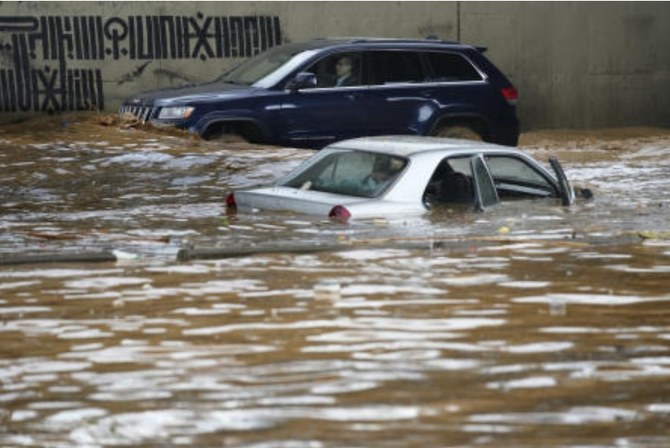
Streets and highways were inundated with unprecedented amounts of water, which the storm drains could not handle.
The flood crisis has emerged as Lebanon grapples with deteriorating infrastructure due to administrative corruption and a need for more maintenance.
The low-pressure system led to the flooding of the area around the Beirut River and the inundation of the Sacred Heart Hospital, with water entering the emergency and radiology departments.
Parking lots were also flooded.
Water surrounded citizens in their cars and school students on buses, seeping into shops, homes, and warehouses. Landslides occurred and sidewalks collapsed, including the famous Raouche Rock Corniche sidewalk.
Water and sand levels rose in the Ramlet Al-Baida area in Beirut.
Due to record-high water levels, people could not get out of their cars in several areas in Beirut’s eastern and western suburbs, especially in the Karantina area, Bourj Hammoud, the airport road, and inside the tunnels.
Civil defense personnel had to rescue people — including children and pregnant women — using cranes or by breaking car windows.
No region in Lebanon was spared from torrents and floods, starting from the Abu Ali River in the north and passing through the Jaj River in Jbeil, Nahr Al-Kalb, the Beirut River, and the Ghadir River.
The waters reached the Burj Al-Barajneh tower and the area of Hay El Sellom in the southern suburbs of Beirut, while the Hazmieh road turned into a swamp.
In the Chouf region, rocks and street walls collapsed, houses and several cars were damaged, and the roads in the city of Tyre in the south turned into swamps.
A Civil Defense source said the water in the Karantina area in Beirut rose to about 10 meters due to the Ministry of Energy’s failure to clean the riverbed.
The Lebanese Civil Defense said its personnel rescued 64 students trapped by the torrents in two buses between Nahr Al-Kalb and Jounieh. Two students were administered first aid.
The Civil Defense personnel carried out relief missions in Broummana in Mount Lebanon, Beit Chabab, Zeghrine, Bologna, and Antelias, removing water from flooded houses and warehouses.
They also rescued two civilians trapped in their vehicles due to mud on the Baskinta road.
Rescue boats were deployed to help trapped people reach safe locations, said the Lebanese Civil Defense.
Heavy rainfalls caused the river’s water levels in Batroun to rise significantly on Saturday, flooding cafes and restaurants.
Social media activists published videos showing water surrounding them while harshly criticizing “the corrupt state.”
Officials in public institutions traded blame over the matter.
During a press conference, caretaker Public Works Minister Ali Hamieh said his ministry was not responsible for isolating and cleaning the river’s course.
Beirut Gov. Marwan Abboud also denied any responsibility for the capital’s floods.


Lebanon floods: 4 refugee children killed, MP almost drowns
https://arab.news/p68w3
Lebanon floods: 4 refugee children killed, MP almost drowns

- Civil Defense personnel carry out rescue missions as heavy rain wreaks havoc in Beirut and other areas
- MP Halima Kaakour nearly drowned while she was swimming in the sea during the stormy weather


Israeli strikes killed eight people in south Lebanon: state media
- Israeli strikes killed eight people in Lebanon on Thursday as Israel renewed its evacuation call for vast areas of the country’s south, long a stronghold of Hezbollah
BEIRUT: Israeli strikes killed eight people in Lebanon on Thursday as Israel renewed its evacuation call for vast areas of the country’s south, long a stronghold of Hezbollah.
The Iran-backed militant group, which dragged Lebanon into the regional war on Monday when it launched an attack on Israel, said it had launched missiles at positions in the Galilee area.
The National News Agency (NNA) reported that the mayor of a village in the Nabatieh region of south Lebanon and his wife were killed in one strike, while in a nearby village another strike killed two children and their parents.
The Lebanese health ministry said two people were killed by a strike on a car near the city of Zahle in the east of the country.
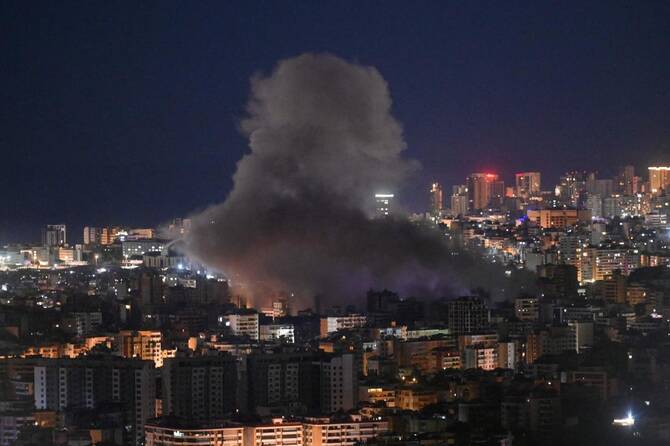
There were new strikes on the southern suburbs of the capital, Hezbollah’s main bastion, early on Thursday, NNA reported, with AFPTV footage showing smoke coming from the area.
It also said a pre-dawn Israeli drone strike hit an apartment in Beddawi, a Palestinian refugee camp near Tripoli in the north of Lebanon, killing senior Hamas official Wassim Atallah Al-Ali and his wife.
Also on Thursday, Israel renewed its warning to residents of hundreds of square kilometers (miles) of southern Lebanon to evacuate because of military action.
Arabic-language spokesman for the Israeli military Avichay Adraee posted on X: “Urgent warning to residents of southern Lebanon: you must immediately continue evacuating to the north of the Litani river.”
The warning included the cities of Tyre and Bint Jbeil.
On Tuesday, Israel’s military said it was creating a buffer zone inside Lebanon to protect Israeli residents.
The following day, it said troops from three divisions, including infantry, armored and engineering units were operating inside Lebanon.


