


BEIRUT: Maronite Patriarch Bechara Al-Rahi reiterated his plea for Lebanon to remain neutral on Monday amid continuing hostilities between Hezbollah and the Israel forces.
In his Christmas sermon, the patriarch spoke about “the families afflicted by the genocidal war on Gaza and our families in southern Lebanon because of the extension of this ill-fated and rejected war to their towns and villages, with the deaths it left behind, the destruction of homes, and the destruction of property.”
Al-Rahi condemned the “brutal genocide taking place in Gaza.”
He said: “We reject its spread to the southern villages. Lebanon is not a land of war but a land of dialogue and peace.”
Al-Rahi said: “The spread of the war to southern Lebanon contradicts Resolution 1701. Lebanon must return to its neutrality as a defender, through diplomacy, of any lost rights.
“The Baabda Declaration in 2012, unanimously approved by the political blocs, affirmed Lebanon’s neutrality with the expression ‘distancing itself’ and adopted it.
“Lebanon’s neutrality has been at the core of Lebanon’s identity since 1860, and it is politically neutral in that it neither fights nor is fought.”
Al-Rahi’s new appeal came as hostilities between Hezbollah and the Israeli army entered a new phase.
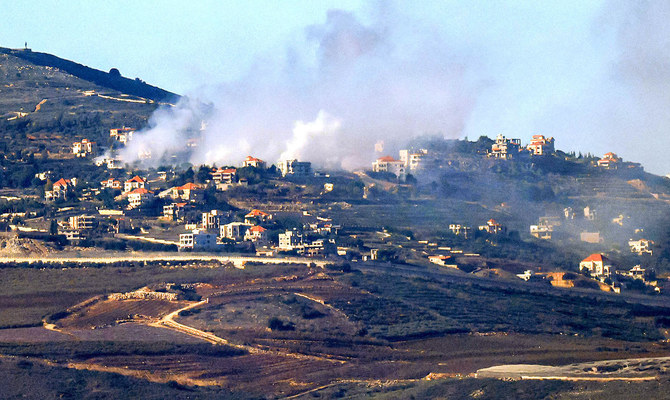
The attacks are now targeting residential houses on both sides of the Blue Line along the border, with some military operations transgressing the rules of engagement.
A security source told Arab News: “Scenes of destruction can be observed in residential neighborhoods in the border areas targeted by Israeli bombing.”
Hezbollah’s attacks are now hitting targets as far as 10 km inside Israel.
Sheikh Naim Kassem, deputy secretary-general, reiterated that the movement’s military operations on the southern front “are to support Gaza, and no one believes that this matter is isolated from protecting Lebanon.”
He said: “We are in one situation; the enemy is one, and this enemy is expansionist. Israel’s strategy is to target one group at a time, aiming to annihilate all.”
On Monday, Hezbollah announced that it had “targeted buildings in the Misgav Am settlement with missile weapons, in response to bombing villages and civilian homes” in southern Lebanon.
On Sunday, Hezbollah announced “targeting a residential building in the Avivim settlement, causing confirmed casualties.”
For the past 79 days, Hezbollah’s hostilities on the southern border have been limited to Israeli military outposts and gatherings of Israeli soldiers.
However, during the past week, the Israeli forces mainly targeted houses belonging to Hezbollah members and cadres in some border villages.
Israel targeted a house in Kfarkila with three shells on Monday, setting it on fire, after targeting a residential home on Sunday in Markaba.
Hezbollah announced the death of the house owner, Wissam Khalil Hammoud, who is one of its members.
Hezbollah also announced on Saturday the death of Ibrahim Salameh from the Aytaroun village after Israeli shelling targeted his house.
Hezbollah said it targeted a deployment of Israeli soldiers in the vicinity of the Metat barracks on Monday.
Since Monday morning, there has been a tense atmosphere in the border villages.
The outskirts of Naqoura, Hanin, and Wadi Hamul were targeted by Israeli artillery shelling.
Hezbollah declared that it initiated missile strikes on the Beit Hilal military base located east of Kiryat Shmona, the Israeli military site of Jal Al-Alam, and a gathering of Israeli soldiers near the Birkat Risha site.
Israeli forces conducted a series of attacks in the areas surrounding Aita Al-Shaab, Tallet Al-Raheb, Kafr Kila, and the Marjayoun Plain.
Additionally, Israeli warplanes targeted the outskirts of Aitaroun and Mays Al-Jabal, launching air-to-surface missiles that caused explosions heard in the Bint Jbeil area.
The Israeli forces used Burkan missiles, phosphorus bombs, and artillery in Monday’s bombardment and installed a surveillance balloon above the towns of Al-Dhahira and Alma Al-Shaab.
According to statistics gathered by journalists in southern Lebanon, the total number of casualties from Israeli airstrikes during the clashes in southern Lebanon over the past 79 days reached 159, including 107 in the south and 14 in Syria.
Among the casualties were 17 civilians in southern Lebanon, including three journalists, one soldier from the Lebanese Army, one from the Amal movement, one from the Syrian Social Nationalist Party, two from the Jamaa Islamiyya, and seven from the Islamic Jihad Movement, as well as nine casualties from the Hamas movement in Lebanon.


