

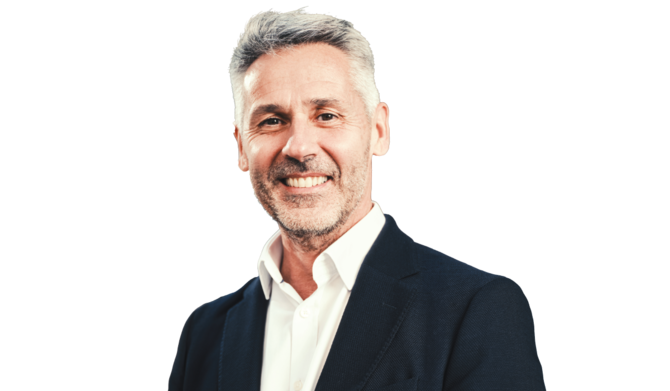

Alberto Bounous is the vice president for development at King Abdullah Financial District, a business and lifestyle destination in Riyadh.
Bounous oversees the development of the district’s new projects across various asset classes from commercial and residential to hospitality and retail with the aim of creating a vibrant neighborhood at the heart of the Kingdom’s capital.
In his current role, Bounous also manages a string of projects within the KAFD central area as well as two large masterplan competitions to design mixed-used development in excess of 2 million square meters in collaboration with the world best studios.
With over 20 years of experience across several continents, Bounous has held senior management positions in real-estate development, and asset and project management in Saudi Arabia as well as India and across South East Asia and West Africa. His experience has armed him with an excellent understanding of global corporate governance while being mindful of local cultural dynamics.
Prior to joining KAFD, Alberto was chief development officer for the AlUla Development Co. — a subsidiary of the Royal Commission for AlUla acquired by the Public Investment Fund. He was tasked with leading real-estate development in the region.
As director of development for the commission, Bounous oversaw a string of cultural and hospitality developments near the UNESCO World Heritage Site, Hegra. His most acclaimed completed projects include the multi-award-winning Maraya Festival Hall, venue of the 2021 GCC Summit, and the Habitas resort, a multi-award-winning luxury hospitality project.
He is the former founder of Roquebruneconsulting, a boutique advisory firm that provided real-estate services to commercial, residential and hospitality companies including the 31Ha Masterplan Jabi Lake lakeshore development in Abuja, Nigeria.
Prior to that, from 2005 to 2013, Bounous was vice president of corporate real estate at Morgan Stanley, where he was responsible for the expansion of the corporate portfolio across the MENA region with a capital expenditure in excess of $100 million per annum. During this time, Bounous was also based in Riyadh when Morgan Stanley established their headquarters in the Kingdom.
Bounous is a qualified architect in the UK and in Italy and a member of the Association of Project Managers. He graduated from the Turin School of Architecture in 1994 and was awarded scholarships to attend postgraduate courses at the Bartlett School of Architecture in London and Universidad de Las Palmas in Spain.
In 2023, he attended Harvard Business School’s real estate management program, focusing on finance and design. A year before that, he was part of the AVIRA leadership executive education program at INSEAD at the Singapore campus.
He attended the University of Cambridge’s Judge Business School program in 2015 and the University of Reading’s program at the school of construction management and engineering in the UK. He also took a postgraduate course at the University of Westminster and attended courses at the Institute of Advanced Architectural Studies in York, UK.


