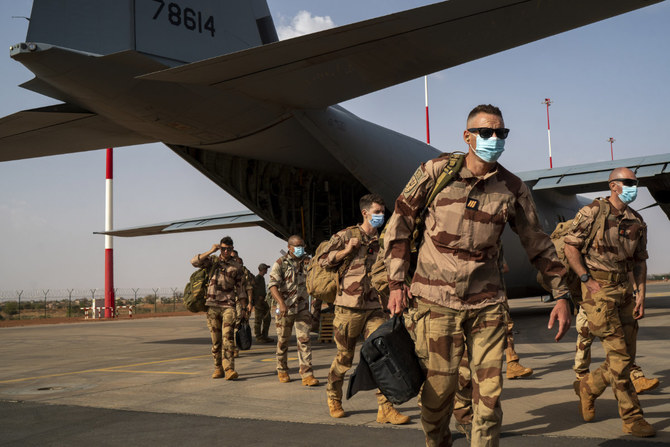
ABUJA, Nigeria: France on Friday completed the withdrawal of its troops after they were asked to leave Niger by the country’s new junta, ending years of on-the-ground military support and raising concerns from analysts about a gap in the fight against jihadi violence across the Sahel region of Africa.
The last French military aircraft and troops departed Niger by the Dec. 22 deadline set by the junta which severed ties with Paris after the coup in July, the French Army General Staff told The Associated Press by email. France already announced this week that it would close its diplomatic mission in Niger for “an indefinite period.”
However, the country would continue to be involved in the Sahel — the vast expanse south of the Sahara Desert which has been a hot spot for violent extremism — although differently, President Emmanuel Macron said Thursday during a visit to a base in Jordan.
“I decided on some important reconfigurations,” Macron said. “We will continue to protect our interests over there but our armies won’t be as present permanently, will be less stationary and also less exposed,” he said.
Niger’s junta described the end of the military cooperation with France as the start of “a new era” for Nigeriens.
“Niger stands tall, and the security of our homeland will no longer depend on a foreign presence,” it said via X, formerly known as Twitter. “We are determined to meet the challenges before us, by consolidating our national military and strategic capabilities.”
But analysts say a vacuum will be created by the troops’ departure. It will “leave Niger and the entire Sahel worse off” in terms of overall counterterrorism efforts as Niger was seen as the last remaining Western partner in the decade-long fight against jihadi groups in the region, said Ryan Cummings, director of Africa-focused security consulting company Signal Risk.
Some 1,500 French troops were training and supporting the local military in Niger, which had been envisioned as the base for counterterrorism operations in the region after anti-French sentiment grew in Mali and Burkina Faso, both run by juntas that have also forced French troops out.
But after deposing Niger’s democratically elected President Mohamed Bazoum, the nation’s junta led by Gen. Abdourahmane Tchiani severed military relations with France and other European countries. Instead, he sought defense cooperation with Russia, whose private mercenary Wagner Group is already active in parts of Africa but faces an uncertain future there following the death of its leader, Yevgeny Prigozhin.
The withdrawal of foreign military missions is already affecting security in Niger, where the number of attacks has surged, according to Oluwole Ojewale with the Dakar-based Institute for Security Studies.
“The country has not demonstrated sufficient military capabilities to fill the vacuum created by the withdrawal. Strategic attacks are being launched by the various armed groups who now roam freely in the ungoverned spaces in the country and incidents have remained on the rise,” said Ojewale.
The junta in Niger has formed a security alliance with the military governments in Mali and Burkina Faso to coordinate counterterrorism operations across the Sahel.
However, much of the immediate impact of the departure of French troops would be felt in western Niger’s Tillabéri region which has been the hot spot for extremism in the country, said Ryan with Signal Risk consulting.
“Violent extremist organizations may utilize the vacuum created to exploit and expand their operations” in the Sahel, he said.


![]()

France completes military withdrawal from Niger, leaving a gap in the terror fight in the Sahel
Short Url
https://arab.news/4c87v
France completes military withdrawal from Niger, leaving a gap in the terror fight in the Sahel


Latest updates


© 2026 SAUDI RESEARCH & PUBLISHING COMPANY, All Rights Reserved And subject to Terms of Use Agreement.