Burkina Faso ends ties with French troops, orders departure

1 / 2
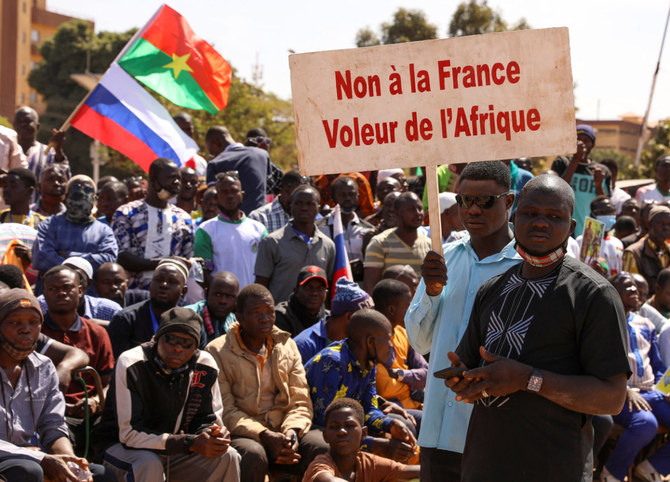
People gather in Ouagadougou on January 20, 2023. to show their support to Burkina Faso's new military leader Ibrahim Traore and demand the departure of the French ambassador. (Reuters)
2 / 2
People gather in Ouagadougou on January 20, 2023. to show their support to Burkina Faso's new military leader Ibrahim Traore and demand the departure of the French ambassador. (Reuters)
Short Url
Updated 22 January 2023
Follow

Burkina Faso ends ties with French troops, orders departure

OUAGADOUGOU: Burkina Faso’s junta government late Saturday ordered hundreds of French troops to depart the West African country within a month, following in the path of neighboring Mali, whose nation is also headed by a coup leader.
National broadcaster RTB made the announcement, citing the official Agence d’Information du Burkina. The news agency said the decision had been made Wednesday to end the presence of France’s military on Burkinabe soil.
Protesters took to the streets of the capital, Ouagadougou, last week to call for the ouster of the French ambassador and the closure of a French military base north of the capital. About 400 French special forces soliders are currently based there, France 24 reported.
The move by Burkina Faso’s regime comes five months after France completed its withdrawal from Mali after nine years fighting Islamic extremists alongside regional troops. Many of those are now based in Niger and Chad instead.
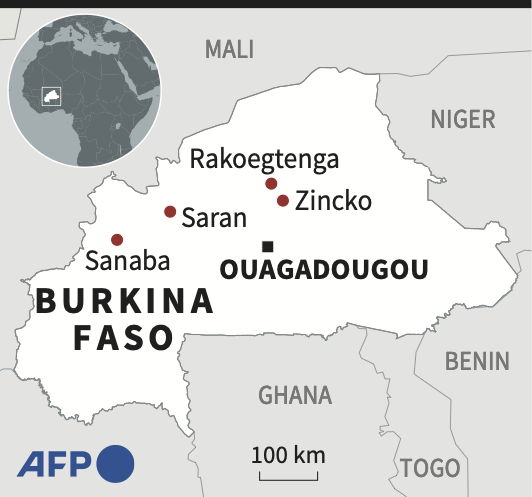
While the number of French troops in Burkina Faso is far smaller than it was in Mali — 400 special forces, compared to more than 2,400 soldiers — Saturday’s announcement adds to the growing concerns that Islamic extremists are capitalizing on the political disarray and using it to expand their reach. Analysts have questioned whether the national militaries of Burkina Faso and Mali are capable of filling in the void.
More than 60 years after Burkina Faso’s independence, French remains an official language and France has maintained strong economic and humanitarian aid ties with its former colony. As the Islamic extremist insurgency has deepened, however, anti-French sentiment has spiked due in part to the unabating violence.
After the second coup there last year, which was led by junior military officer Ibrahim Traore, anti-French protesters began urging the junta to instead strengthen ties with Russia. Mali already has hired Russian mercenaries from the Wagner Group, who have been accused of widespread human rights abuses there and elsewhere.
Saturday’s announcement was welcomed by those who had lost patience with France.
“Despite their presence on Burkinabe soil with huge equipment and their power at the intelligence level, they couldn’t help us defeat terrorism,” said Passamde Sawadogo, a prominent civil society activist and reggae singer. “It therefore was time for us to get rid of them, and that’s what the transition government is doing with a lot of boldness.”


Hegseth says he would have ordered second strike on Caribbean vessel

Updated 4 sec ago
Follow

Hegseth says he would have ordered second strike on Caribbean vessel

  • The Trump administration has framed the attacks as a war with drug cartels, calling them armed groups and saying the drugs being carried to the United States kill Americans

WASHINGTON: US Defense Secretary Pete Hegseth said on Saturday that he backs a September 2 decision to launch a second strike on a suspected drug boat in the Caribbean.
“I fully support that strike,” Hegseth said at the Reagan National Defense Forum in Simi Valley, California. “I would have made the same call myself.”
A video of the attack was shown to members of Congress on Capitol Hill behind closed doors on Thursday, days after reports surfaced that the commander overseeing the operation ordered a second strike to take out two survivors to comply with Hegseth’s direction that everyone should be killed.
Officials from President Donald Trump’s administration have since said that Hegseth did not order the additional strike, and that Admiral Frank Bradley, who led the Joint Special Operations Command at the time, concluded the boat’s wreckage must be neutralized because it might contain cocaine.
Hegseth on Saturday repeated his account of the day, saying that he had seen the first strike on September 2, but then left the room to attend another meeting. He declined to say whether the administration would release the full video, calling the issue “under review.”
The September 2 attack was the first of 22 on vessels in the southern Caribbean and Pacific carried out by the US military as part of what the Trump administration calls a campaign to stem the flow of illegal drugs into the United States.
The strikes have killed 87 people, with one carried out in the eastern Pacific on Thursday.
Accounts of the September 2 strikes have prompted concerns that US forces carried out a war crime.
The video of the attack shown to lawmakers showed two men clinging to wreckage after their vessel was destroyed, according to two sources familiar with the imagery.
They were shirtless, unarmed and carried no visible communications equipment.
The Defense Department’s Law of War Manual forbids attacks on combatants who are incapacitated, unconscious or shipwrecked, as long as they abstain from hostilities and do not attempt to escape. The manual cites firing upon shipwreck survivors as an example of a “clearly illegal” order that should be refused.
The Trump administration has framed the attacks as a war with drug cartels, calling them armed groups and saying the drugs being carried to the United States kill Americans.