WHO says it was told by Israeli military to leave southern Gaza warehouse within 24 hours

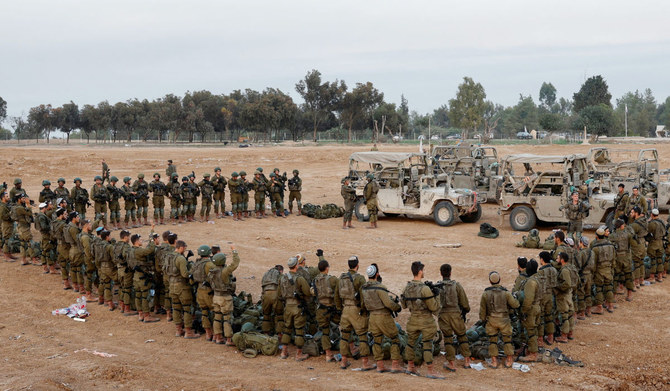
Israeli soldiers stand in order, amid the ongoing conflict between Israel and the Palestinian Islamist group Hamas, near Israel's border with Gaza, in southern Israel, December 4, 2023. (REUTERS)
Short Url
Updated 05 December 2023
Follow

WHO says it was told by Israeli military to leave southern Gaza warehouse within 24 hours

  • Israel killed 15,900 people, mostly women and children, according to the health ministry in Hamas-run Gaza
  • Twelve hospitals still remain operational in the south part of the Gaza Strip, according to the WHO

GENEVA: WHO chief Tedros Adhanom Ghebreyesus said Monday that the Israeli army had told the UN health agency to empty an aid warehouse in southern Gaza before ground operations in the area made it unusable.
“Today, WHO received notification from the Israel Defense Forces that we should remove our supplies from our medical warehouse in southern Gaza within 24 hours, as ground operations will put it beyond use,” Tedros wrote on X, formerly Twitter.
“We appeal to Israel to withdraw the order, and take every possible measure to protect civilians and civilian infrastructure, including hospitals and humanitarian facilities,” he wrote.
Hamas militants from Gaza launched an unprecedented attack on southern Israel on October 7, killing about 1,200 people, mostly civilians, and taking around 240 hostages, according to Israeli officials.
In response, Israel vowed to destroy Hamas and has conducted a relentless air, artillery and naval bombardment alongside a ground offensive, killing around 15,900 people, mostly women and children, according to the health ministry in Hamas-run Gaza.
Israel’s army on Monday sent dozens of tanks into southern Gaza as part of expanded action against Hamas, as communications was cut across the besieged territory.
The number of operational hospitals in Gaza has dropped from 36 to 18 in less than 60 days, according to the WHO, with three providing only basic first aid and others offering partial services.
Twelve hospitals still remain operational in the south part of the Gaza Strip, according to the WHO.
At a press conference earlier on Monday, the WHO regional director for the eastern Mediterranean, Ahmed Al-Mandhari, said the intensification of military ground operations in southern Gaza risked depriving thousands of people of health care.
“We saw what happened in the north of Gaza. This cannot serve as a model for the south,” he said.


Bomb attacks on Thailand petrol stations injure 4: army

Updated 11 January 2026
Follow

Bomb attacks on Thailand petrol stations injure 4: army

  • Authorities did not announce any arrests or say who may be behind the attacks

BANGKOK: Assailants detonated bombs at nearly a dozen petrol stations in Thailand’s south early Sunday, injuring four people, the army said, the latest attacks in the insurgency-hit region.
A low-level conflict since 2004 has killed thousands of people as rebels in the Muslim-majority region bordering Malaysia battle for greater autonomy.
Several bombs exploded within a 40-minute period after midnight on Sunday, igniting 11 petrol stations across Thailand’s southernmost provinces of Narathiwat, Pattani and Yala, an army statement said.
Authorities did not announce any arrests or say who may be behind the attacks.
“It happened almost at the same time. A group of an unknown number of men came and detonated bombs which damaged fuel pumps,” Narathiwat Governor Boonchauy Homyamyen told local media, adding that one police officer was injured in the province.
A firefighter and two petrol station employees were injured in Pattani province, the army said.
All four were admitted to hospitals, none with serious injuries, a Thai army spokesman told AFP.
Thailand’s Prime Minister Anutin Charnvirakul told reporters that security agencies believed the attacks were a “signal” timed with elections for local administrators taking place on Sunday, and “not aimed at insurgency.”
The army’s commander in the south, Narathip Phoynok, told reporters he ordered security measures raised to the “maximum level in all areas” including at road checkpoints and borders.
The nation’s deep south is culturally distinct from the rest of Buddhist-majority Thailand, which took control of the region more than a century ago.
The area is heavily policed by Thai security forces — the usual targets of insurgent attacks.