Boycott campaigns over Gaza war hit Western brands

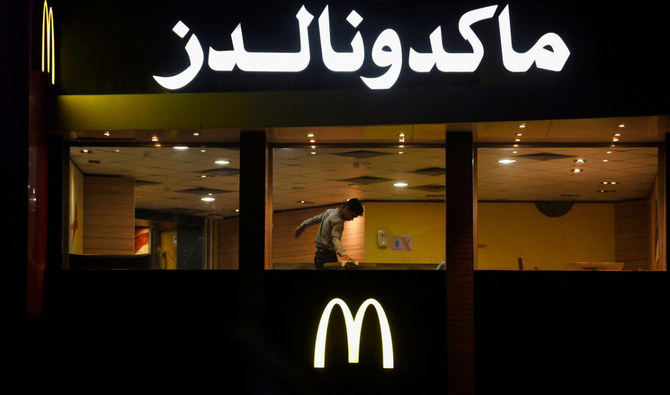
A worker cleans a table in an empty McDonald’s restaurant as a result of the boycott of Western brands in Egypt due to the Israeli bombardment in Gaza, in Cairo, Egypt, November 20, 2023. (Reuters)
Short Url
Updated 23 November 2023
Follow

Boycott campaigns over Gaza war hit Western brands

CAIRO: Midway through a recent evening in Cairo, a worker cleaned tables in an empty McDonald’s restaurant. Branches of other Western fast-food chains in the Egyptian capital also appeared deserted.

All have been hit by a boycott campaign over Israel’s military offensive in the Gaza Strip.

Western brands are feeling the impact in Egypt and Jordan, and there are signs the campaign is spreading in some other Arab countries including Kuwait and Morocco.

Some of companies the campaign is directed at are perceived to have taken pro-Israeli stances, and some are alleged to have financial ties to Israel or investments there.

As the campaign has started to spread, boycott calls circulated on social media have expanded to list dozens of companies and products, prompting shoppers to shift to local alternatives.

In Egypt, where there is little chance of people taking to the streets because of security restrictions, some see the boycott as the best or only way to make their voices heard.

“I feel that even if I know this will not have a massive impact on the war, then this is the least we can do as citizens of different nations so we don’t feel like our hands are covered in blood,” said 31-year-old Cairo resident Reham Hamed, who is boycotting US fast food chains and some cleaning products.

In Jordan, pro-boycott residents sometimes enter McDonald’s and Starbucks branches to encourage scarce customers to take their business elsewhere. 

Videos have circulated of what appear to be Israeli troops washing clothes with well-known detergent brands which viewers are urged to boycott.

“No one is buying these products,” said Ahmad Al-Zaro, a cashier at a large supermarket in the capital Amman where customers were choosing local brands instead.

In Kuwait City, a tour of seven branches of Starbucks, McDonald’s and KFC found them nearly empty. A worker at one Starbucks  said other US brands had also been affected.


Iraq begins closing Al-Hol camp, 19,000 citizens return home

Updated 8 sec ago
Follow

Iraq begins closing Al-Hol camp, 19,000 citizens return home

  • About 3,000 Iraqis still remain in Al-Hol
  • The camp currently houses around 60,000 people of various nationalities, most of them women and children linked to Daesh fighters

DUBAI: Iraq said it has begun dismantling the Al-Hol camp in northeast Syria, repatriating thousands of its citizens as part of efforts to prevent the site from being used to promote extremist ideology, state news agency INA reported on Wednesday.
The Ministry of Migration and Displacement said around 19,000 Iraqis returned from Al-Hol to their former areas of residence and were reintegrated into local communities, with no security incidents recorded.
Karim Al-Nouri, undersecretary at the ministry, said returnees were subjected to screening and vetting before their transfer to the Al-Amal Community Rehabilitation Center in Al-Jada’a, south of Mosul in Iraq.
“The Ministry of Migration and Displacement is not concerned with security aspect,” Al-Nouri said, adding terrorism cases are handled separately by judiciary.
He said senior Daesh militants recently transferred to Iraq were brought from prisons run by the US-backed Syrian Democratic Forces (SDF), and not from Al-Hol camp.
The most recent group of returnees consists of 281 families, marking the 31st batch received by Iraq so far.
Officials described Al-Hol as a potential security threat, saying the camp has been exploited in the past as a recruitment hub for Daesh and a center for spreading extremism.
The camp currently houses around 60,000 people of various nationalities, most of them women and children linked to Daesh fighters.
Iraqi returnees receive psychological, medical and social support at the Al-Amal center, with assistance from international organizations and the Iraqi health ministry, before returning to their communities, according to the ministry. Those found to have committed crimes are referred to courts.
Al-Nouri said about 3,000 Iraqis still remain in Al-Hol. He added Iraqi detainees are also held in other prisons in Syria, with their cases requiring follow-up by the Ministry of Foreign Affairs.