Canadian man who ran over Muslim family convicted of murder

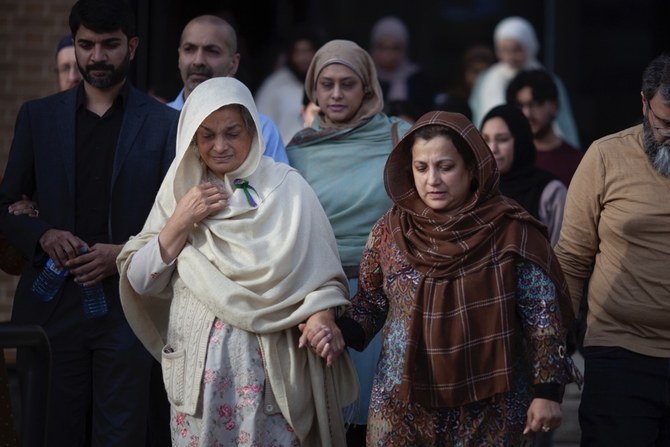
Family and friends of the Afzaal family, including Tabinda Bukhari, front-left, the mother of Madiha Salman, exit the Superior Court of Justice after a verdict in the Nathaniel Veltman murder trial was reached, on Thursday, Nov. 16, 2023, in Windsor, Canada. (The Canadian Press via AP)
Short Url
Updated 17 November 2023
Follow

Canadian man who ran over Muslim family convicted of murder

OTTAWA: A Canadian man who used his truck to run down a Muslim family out for a walk was found guilty Thursday in Canada’s first murder trial in which jurors were asked to consider a terrorism motive related to white supremacy.
Nathaniel Veltman, 22, was convicted of four counts of first degree or premeditated murder, and one count of attempted murder. He faces up to life in prison when sentenced.
He acknowledged striking the Afzaal family with his pick-up truck in June 2021 in London, Ontario, which left three generations of the family dead and a young boy orphaned.
The prosecution argued at trial that he was motivated by white supremacist ideology and sought to intimidate or terrorize Muslims.
The defense said he’d suffered a mental decline — which did not, however, meet the requirements for an insanity plea — and was in “a state of extreme confusion” after consuming hallucinogenic psilocybin mushrooms that weekend.
“Today’s verdict is a monumental step in the fight against hate and Islamophobia,” Imam Abdul Fattah Twakkal said outside the courthouse.
“It sets a precedent against white nationalist terrorism,” he said. “It sends a clear message that such hate has no place in our society.”
But he added, “the evidence that came out of this trial shows us that there is still a lot of work to be done to ensure that the next radicalized young man is not out there.”
Tabinda Bukhari, the mother of one of the adult victims, told reporters: “The enduring grief, trauma and the irreplaceable void left by the loss of multiple generations of one family has pierced us profoundly.”
The verdict, she added, provides “some solace.”
The jury in the almost 10-week trial heard Veltman had penned a “terrorist manifesto,” found on his computer, in which he espoused white nationalism and described his hate for Muslims.
He “dressed like a soldier,” wearing body armor and a helmet, with a “crusader T-shirt” with a red cross, prosecutor Fraser Ball said in closing arguments earlier this week.
“He was hunting for Muslims to kill,” he said.
When Veltman passed the Afzaal family on a London street on that warm Sunday evening, the Crown attorney said, he turned his pick-up truck around and accelerated “pedal to the metal,” jumping the curb as he drove into them.
Bodies flew into the air.
Salman Afzaal, 46, his wife Madiha Salman, 44, their 15-year-old daughter Yumnah and her grandmother Talat Afzaal, 74, were killed. A nine-year-old boy orphaned in the ramming suffered serious but non-life-threatening injuries.
Bits of the victims’ clothing were found embedded in the grill of Veltman’s truck after he surrendered in a nearby parking lot. He told police he’d wanted to “send a strong message” against Muslim immigration.
Ball said that message was “brutal and terrifying: leave this country or you and your loved ones could be next.”
The defense argued that a combination of mental disorders, childhood traumas and drug use left Veltman feeling detached or disconnected from reality.
The attack two years ago “changed Canadian Muslims’ relationship with their country,” said Omar Khamissa, head of the National Council of Canadian Muslims. “For the first time for many of us, we felt unsafe and targeted just for walking down the street.”
Former federal minister Omar Alghabra said on X, formerly Twitter, that this case was “an example of how hateful words could lead to radicalization which could lead to deadly violence.”
Defense lawyer Christopher Hicks said that Veltman was, after the verdict, “in shock, because he knows he’s looking at 25 years in jail without hope of parole.”
A date for a sentencing hearing will be scheduled on December 1.
The slaying was the deadliest anti-Muslim attack in Canada since a shooting at a mosque in Quebec City in 2017 that left six dead. The perpetrator of that shooting was not accused of terrorism.


What Bangladesh’s election means for India, China and Pakistan ties

Bangladesh Nationalist Party supporters gather for a rally ahead of the upcoming national election, in Sylhet on Jan. 22, 2026.
Updated 08 February 2026
Follow

What Bangladesh’s election means for India, China and Pakistan ties

  • Bangladeshis will vote on Feb. 12, almost two years after the 2024 student-led uprising
  • After nearly 2 years of tensions, experts expect a thaw with India under elected government

DHAKA: As Bangladesh prepares to hold its first elections since the 2024 ouster of Sheikh Hasina, its longest-serving prime minister, the outcome will define Dhaka’s relations with the most important regional powers — China, India, and Pakistan.

Nearly 128 million Bangladeshis will head to the polls on Feb. 12 to bring in new leadership after an 18-month rule of the current caretaker administration.

The interim government, led by Nobel laureate Muhammad Yunus, took control following a student-led uprising that ended 15 years in power of Hasina and her Awami League party.

The two main parties out of the 51 competing for power are the Bangladesh Nationalist Party and Jamaat-e-Islami. The Awami League, which for decades has had close ties with India, was excluded from the election ballot over its role in the deadly crackdown on the 2024 student-led protests, in which 1,400 people were killed.

While Bangladesh’s relationship India has deteriorated since the fall of Hasina, who has been in self-exile in New Delhi, the period of diplomatic strain is expected to ease when the new government takes office.

“Whoever comes to power in Bangladesh, due to domestic pressure in the country, relationships with India need a resetting,” Humayun Kabir, former ambassador to the US, told Arab News.

“It’s anticipated that India will also engage with the new government, but they will protect their interests, and we also have to do the same. It’s most likely that the India-Bangladesh relationship will be normalized under the new, elected, government.”

Since 2024, India has suspended key transshipment access that allowed Bangladeshi exports to go via Indian ports and airports. It also put on hold most normal visa services for Bangladeshis, who were among its largest groups of medical tourists.

From Hasina’s heavy pro-India orientation, the interim government has tried to rebalance Bangladesh’s foreign policy toward the two other key regional players — China and Pakistan — who at the same time are India’s main rivals. 

If New Delhi regains its importance, it should not deal a blow to the newly expanded relations with Pakistan, with whom Bangladesh has recently increased exchanges, especially economic, and last month resumed direct flights — after a 14-year gap.

Since the relations have been expanded under the caretaker government, Prof. Delwar Hossain from the International Relations Department at Dhaka University forecast that they would only further improve, no matter who comes to power, and there is no likelihood of a sudden change.

“For Pakistan, any political coalition — whether BNP or Jamaat — will be positive. The BNP has a long history of having good relations with Pakistan during their rule ... Jamaat also has a strong and very positive influence in Pakistan,” he said.

“For Pakistan, the new regime or new government is not the issue. The issue is what the (India) policy of the new government would be and to what extent it would actually support Pakistan’s view.”

Both the BNP and Jamaat have repeatedly said they wanted friendly relations with India, and Hossain expected that they would, at the same time, continue the balanced approach introduced by the caretaker administration.

“India is a reality as a neighbor. At the same time, India is also showing interest in mending relations or adopting a more cooperative approach after the vote, with the government that will be elected ... I think there will be pragmatism from both sides,” he said.

“I don’t see there is a long-term threat to Bangladesh-India relations ... When China and Pakistan were trying to create a trilateral cooperative system or some kind of coalition — China, Bangladesh and Pakistan — we have seen that Bangladesh opted out. It seems that Bangladesh is going to continue its policy of maintaining a balance among these great powers.”

Bangladesh’s relations with China have not changed since the ouster of Hasina, whose government signed several economic agreements with Beijing. Yunus’s administration has continued this cooperation, and China was among the very few countries he officially visited during his term.

During the visit, he secured about $2.1 billion in Chinese investments, loans and grants, including funding for infrastructure like Mongla Port and a special economic zone in Chattogram — Bangladesh’s largest port. China has also eased visa rules for Bangladeshi businesspeople, medical travelers and tourists.

According to Munshi Faiz Ahmed, Bangladesh’s former ambassador to Beijing, China’s importance for Bangladesh cannot be substituted by any other country, especially as over the past few years it has emerged not only as its key investor, but also the largest trade partner.

In the fiscal year 2024-25, Bangladesh’s trade with China was over $21.3 billion, according to National Board of Revenue data. With India, it was about $11.5 billion.

The trade — especially import — dependence on Beijing started long before the regime change. In terms of trade volume, China overtook India already in 2018.

“Even when people thought that we had very close relations with India, our relations with China continued to grow in terms of trade and commerce ... Our trade with China has surpassed India’s, and China is a much bigger investor in Bangladesh’s development projects,” Ahmed said.

“Bangladesh will continue to cooperate with China for a long time to come because what China can provide, no other country can.”