

Smoky skies in Indian capital on Diwali as revellers defy firecracker ban

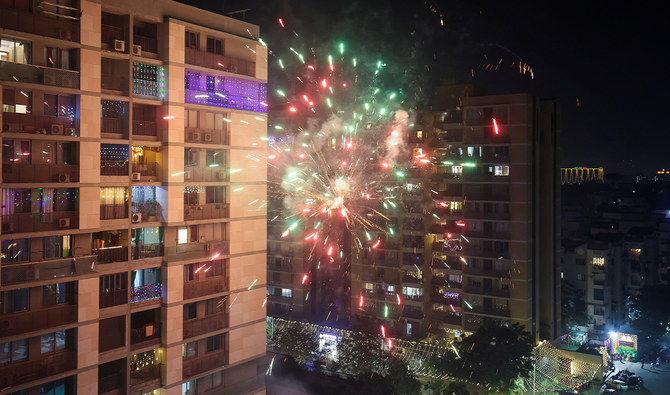
Fireworks explode in front of a residential building to celebrate Diwali, the Hindu festival of lights, in Ahmedabad, India, on November 12, 2023. (REUTERS)
Short Url
Updated 13 November 2023
Follow

Smoky skies in Indian capital on Diwali as revellers defy firecracker ban

  • Air Quality Index across 40 monitoring stations in capital averaged 219, indicating “poor” conditions
  • Globally, air pollution was worst in eastern Indian city of Kolkata while Delhi was the fifth-most polluted

NEW DELHI: A toxic haze began to circulate in New Delhi on Sunday as people in the city of 20 million, which has struggled with heavy pollution recently, defied a ban on firecrackers on the night of Diwali, the annual Hindu festival of light.

Smoke plumes were visible across the sky as revellers let off firecrackers in the evening to mark the country’s biggest festival.

Every year government authorities or India’s Supreme Court impose bans on firecrackers — but only rarely do those bans appear to be enforced.

The Air Quality Index (AQI) across all 40 monitoring stations in the capital averaged 219 on a scale of 500, according to the federal pollution control board data, indicating “poor” conditions that can affect most people on prolonged exposure.

The AQI data also showed that the concentration of “PM2.5” poisonous particulate matter in a cubic meter of air was around 100 micrograms per cubic meter — 20 times higher than the World Health Organization’s (WHO) recommended maximum.

Globally, air pollution was the worst in India’s eastern city of Kolkata, while Delhi was the fifth-most polluted, according to Swiss group IQAir.

Doctors say the air quality is likely to worsen on Monday as smoke from firecrackers lingers in the air, potentially causing itchy eyes and irritation in the throat.

“I can see my patients are getting distressed. As a society we have not understood the value of clean air,” said Desh Deepak, a senior consultant at Delhi’s Dr. Ram Manohar Lohia Hospital.

Some Hindus resent the Diwali firecracker bans, which they see as an attempt to interfere with them observing their religious festivals.

Earlier in the day, Delhi’s Environment Minister Gopal Rai had urged citizens to steer clear of firecrackers to prevent citizens from having breathing problems later.

Just before the weekend, a spell of rain had brought some relief to the city, where the AQI dipped below 160 after hovering around the 400-500 level over the past week.

The world’s most polluted capital typically experiences heavy smog in the winter months as particulate matter gets trapped in the cold air, leading to spikes in cases of respiratory distress.


Grand jury declines to indict man in shooting that killed teen at Kentucky State University

Updated 8 sec ago
Follow

Grand jury declines to indict man in shooting that killed teen at Kentucky State University

  • After the grand jury decision, Kentucky State officials said they “will cooperate with law enforcement and investigators as appropriate” and are focused on student safety and well-being

FRANKFORT, Kentucky: A grand jury has declined to indict the father of two Kentucky State University students who was charged with murder in an on-campus shooting that killed one student and critically injured another.
In a social media post after the Tuesday hearing, defense attorney Scott Danks said grand jurors decided not to indict his client, Jacob Lee Bard, for the Dec. 9 shooting and he is out of jail. Bard’s attorneys have said that 20 to 30 people had gathered to attack his son and family, and that he was justified in shooting two people who were beating his son.
After the grand jury decision, Kentucky State officials said they “will cooperate with law enforcement and investigators as appropriate” and are focused on student safety and well-being.
Bard’s attorneys say the family was moving their younger son out, with two armed campus police officers present, after withdrawing both sons from school because of “multiple armed, violent” incidents against them and other students in the days leading up to Dec. 9, some captured on security cameras.
When the family and an officer reached the dormitory entrance on the move-out day, the group of people in masks and hoods rushed out and began violently assaulting the family and others, including beating the son’s head against the pavement, the attorneys said.
In October, the younger son reported a burglary in his dorm room to campus police and received threats of violence afterward, the attorneys said.
Because of continued death threats, the sons are now staying in an undisclosed location, the attorneys added.
“Jacob’s actions were absolutely justified under the law, and were the only measure that prevented his son’s death or serious injury,” the attorneys wrote.
Investigators have said the shooting was isolated, but they have not publicly shared details of the circumstances or a possible motive. The shooting killed 19-year-old De’Jon Fox of Indianapolis.
In a message to the campus community, Kentucky State said the grand jury decision “does not lessen the pain our community continues to feel, nor does it change our priorities.”
“Our commitment remains centered on supporting our students and ensuring Kentucky State University is a safe place to learn, live, and work,” it said.
The shooting was the second in four months near the residence hall. Someone fired multiple shots from a vehicle on Aug. 17, striking two people who the university said weren’t students. Frankfort police said one victim was treated for minor injuries and the second sustained serious injuries. The dorm and at least one vehicle were damaged by gunfire.
Police have said Bard, 48, is from Evansville, Indiana, which is about 150 miles (240 kilometers) west of Frankfort.
Kentucky State is a public historically Black university with about 2,200 students. Lawmakers authorized the school’s creation in 1886.