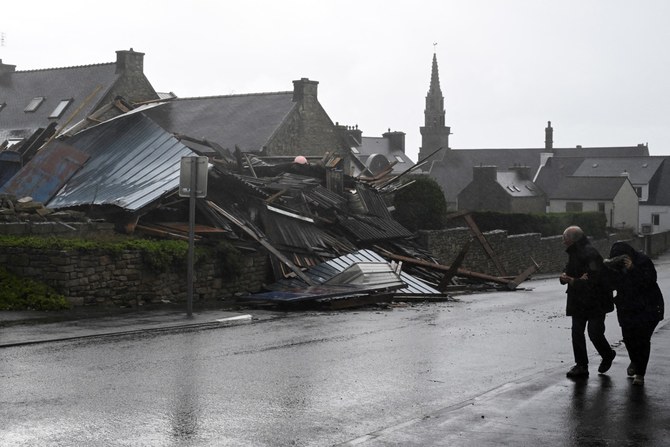
Brussels: At least 10 people were killed as Storm Ciaran battered Western Europe with record winds of up to 200 kilometers per hour, causing travel mayhem with closed ports and flight and rail disruptions.
Three people died in Tuscany, Italian authorities announced on Friday, reporting record rainfall and the declaration of a state of emergency.
Tuscany governor Eugenio Giani said the three dead included an 85-year-old man who was found drowned in his house.
“What happened tonight in Tuscany has a name: climate change,” he wrote on X, formerly known as Twitter.
Florence mayor Dario Nardella said the “situation is critical” in the city.
Trees felled by gale-force winds caused most of the deaths in Europe. In the Belgian city of Ghent, a five-year-old Ukrainian boy and a 64-year-old woman were killed by falling branches.
Falling trees had earlier killed a lorry driver in his vehicle in northern France’s Aisne region, and French authorities also reported the death of a man who fell from his balcony in the port city of Le Havre.
A man in the Dutch town of Venray, a woman in central Madrid and a person in Germany also died.
Some 1.2 million French homes lost electricity as the storm lashed the northwest coast. Almost 700,000 remained without power on Thursday evening, according to network manager Enedis.
French President Emmanuel Macron was due to visit the storm-battered region of Brittany on Friday, the Elysee presidential palace said.
The storm interrupted rail, air and maritime traffic in Belgium where the port of Antwerp was closed and flights from Brussels were disrupted.
The wind gusts in the western Brittany region were “exceptional” and “many absolute records have been broken,” national weather service Meteo-France said on X.
The prefect for the local department said gusts as high as 207 km/h (129 mph) were recorded at Pointe du Raz on the tip of the northwest coast, while the port city of Brest saw winds hit 156 km/h.
In southern England, hundreds of schools were closed as large waves powered by winds of 135 km/h crashed along the coastline.
On the Channel Island of Jersey, residents had to be evacuated to hotels overnight as gusts of up to 164 km/h damaged homes, according to local media.
More than 200 flights were canceled at Amsterdam’s Schiphol Airport, a major European hub.
Air, rail and ferry services saw cancelations and long delays across several countries.
The effects of the storm were felt as far south as Spain and Portugal, with Spanish authorities warning of waves as high as nine meters (29 feet) along the Atlantic coast.
In Spain, more than 80 flights were canceled at 11 airports.
There was disappointment for the hardy athletes of the annual Dutch “headwind cycle championships” race.
They only hold their race along the Oosterscheldekering storm surge barrier in the western Netherlands if the wind is above a gale seven on the Beaufort Scale (up to 61 km/h).
But they finally met their match with Storm Ciaran and had to postpone it.
There were “many disappointed faces,” organizer Robrecht Stoekenbroek told local agency ANP, vowing to go ahead when the storm passed.
The French weather service said storms would continue into Friday, notably in the southwest of the country and on the island of Corsica.
Rail services in western parts of the country would remain disrupted on Friday, said Transport Minister Clement Beaune.


Ten dead as Storm Ciaran batters Western Europe
https://arab.news/9dh83
Ten dead as Storm Ciaran batters Western Europe

- Florence mayor Dario Nardella said the “situation is critical” in the city
- In Spain, more than 80 flights were canceled at 11 airports


EU leaders to reassess US ties despite Trump U-turn on Greenland
- Diplomats stressed that, although Thursday’s emergency EU talks in Brussels would now lose some of their urgency, the longer-term issue of how to handle the relationship with the US remained
BRUSSELS: EU leaders will rethink their ties with the US at an emergency summit on Thursday after Donald Trump’s threat of tariffs and even military action to acquire Greenland badly shook confidence in the transatlantic relationship, diplomats said.
Trump abruptly stepped back on Wednesday from his threat of tariffs on eight European nations, ruled out using force to take Greenland, a semi-autonomous territory of NATO ally Denmark, and suggested a deal was in sight to end the dispute.
German Chancellor Friedrich Merz, welcoming Trump’s U-turn on Greenland, urged Europeans not to be too quick to write off the transatlantic partnership.
But EU governments remain wary of another change of mind by a mercurial president who is increasingly seen as a bully that Europe will have to stand up to, and they are focused on coming up with a longer-term plan on how to deal with the United States under this administration and possibly its successors too.
“Trump crossed the Rubicon. He might do it again. There is no going back to what it was. And leaders will discuss it,” one EU diplomat said, adding that the bloc needed to move away from its heavy reliance on the US in many areas.
“We need to try to keep him (Trump) close while working on becoming more independent from the US It is a process, probably a long one,” the diplomat said.
EU RELIANCE ON US
After decades of relying on the United States for defense within the NATO alliance, the EU lacks the needed intelligence, transport, missile defense and production capabilities to defend itself against a possible Russian attack. This gives the US substantial leverage.
The US is also Europe’s biggest trading partner, making the EU vulnerable to Trump’s policies of imposing tariffs to reduce Washington’s trade deficit in goods, and, as in the case of Greenland, to achieve other goals.
“We need to discuss where the red lines are, how we deal with this bully across the Atlantic, where our strengths are,” a second EU diplomat said.
“Trump says no tariffs today, but does that mean also no tariffs tomorrow, or will he again quickly change his mind? We need to discuss what to do then,” the second diplomat said.
The EU had been considering a package of retaliatory tariffs on 93 billion euros ($108.74 billion) on US imports or anti-coercive measures if Trump had gone ahead with his own tariffs, while knowing such a step would harm Europe’s economy as well as the United States.
WHAT’S THE GREENLAND DEAL?
Several diplomats noted there were still few details of the new plan for Greenland, agreed between Trump and NATO Secretary General Mark Rutte late on Wednesday on the sidelines of the World Economic Forum in Davos, Switzerland.
“Nothing much changed. We still need to see details of the Greenland deal. We are a bit fed up with all the bullying. And we need to act on a few things: more resiliency, unity, get our things together on internal market, competitiveness. And no more accepting tariff bullying,” a third diplomat said.
Rutte told Reuters in an interview in Davos on Thursday that under the framework deal he reached with Trump the Western allies would have to step up their presence in the Arctic.
He also said talks would continue between Denmark, Greenland and the US on specific issues.
Diplomats stressed that, although Thursday’s emergency EU talks in Brussels would now lose some of their urgency, the longer-term issue of how to handle the relationship with the US remained.
“The approach of a united front in solidarity with Denmark and Greenland while focusing on de-escalation and finding an off-ramp has worked,” a fourth EU diplomat said.
“At the same time it would be good to reflect on the state of the relationship and how we want to shape this going forward, given the experiences of the past week (and year),” he said.


