

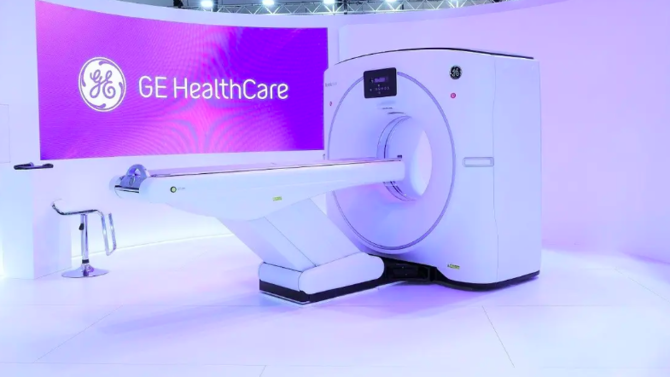
GE HealthCare to relocate regional headquarters to Riyadh

The firm has outlined its commitment to the Kingdom’s healthcare sector. Supplied.
Short Url
Updated 31 October 2023
Follow

GE HealthCare to relocate regional headquarters to Riyadh

RIYADH: GE HealthCare has announced its new regional headquarters in Riyadh amid Saudi Arabia’s push to attract international businesses to relocate their base to the Kingdom.

The announcement was made during the Global Health Exhibition in the Saudi capital, where the medical tech firm outlined its commitment to the Kingdom’s healthcare sector.

This comes on the heels of other major players joining the relocation trend. Jones Lang LaSalle, a global real estate services firm, and the consulting giant Deloitte had already declared their intent to shift their regional headquarters to Saudi Arabia earlier this month.  

First announced in February 2021, the initiative mandates that international firms seeking government contracts in the Kingdom must establish their regional headquarters in Riyadh by no later than Jan. 1, 2024.

The goal is twofold, aiming to stimulate local job creation in line with economic diversification plans and to stay competitive in the face of growing regional competition.

The health sector transformation program within the Kingdom’s Vision 2030 doctrine focuses on improving access to healthcare, modernizing facilities and equipment, and enhancing the role of private sector investment. 

“If you go back a few years, by memory, we will realize the effectiveness of using digital healthcare. During the pandemic, Saudi was ranked second in managing the pandemic. Digital health or e-health contributed heavily,” Saudi Health Minister Fahad Al-Jalajel said earlier this month.

“Nowadays in Saudi, any individual can access quality healthcare regardless of their physical location. This is actually done by leveraging digital health,” he added.

As the Kingdom aims to digitalize 70 percent of patient activities by 2030, health tech sector growth has become imperative to meet these goals.

The company’s innovative approaches, spanning from precision care, reimagined patient treatment and advanced imaging, will address the evolving healthcare demands in the Kingdom and the broader region.

Saudia Arabia aims to restructure the sector by enhancing its capabilities as an effective, integrated, value-based ecosystem focused on the patient’s well-being.

The Kingdom has committed to investing in the health technology sector, with the 2023 budget allocating over SR180 billion ($50.3 billion) to healthcare and social development, reflecting the government’s commitment to this initiative.

Much of this budget is focused on digital health to enhance accessibility, efficiency, and transparency within the sector.


Oman’s trade surplus narrows to $12bn as exports decline 

Updated 6 sec ago
Follow

Oman’s trade surplus narrows to $12bn as exports decline 

RIYADH: Oman’s trade surplus narrowed to 4.69 billion rials ($11.9 billion) by the end of October as weaker oil and gas shipments weighed on exports, even as imports rose, according to official data.

The surplus compares with 7.31 billion rials in the same period of 2024, the Oman News Agency reported, citing preliminary figures from the National Centre for Statistics and Information. Total merchandise exports fell 8 percent year on year to 19.3 billion rials, while imports increased 6.8 percent to 14.6 billion rials.

This comes as Fitch Ratings last month upgraded Oman to investment-grade status, raising its long-term foreign-currency rating from BB+ to BBB-, citing stronger public finances, an improved external position, and a continued commitment to prudent fiscal management. 

The agency noted that Oman has successfully strengthened fiscal discipline, reducing government debt to around 36 percent of gross domestic product in 2025, down from about 68 percent in 2020.   

“The decline in the value of Oman’s merchandise exports is primarily attributed to a decrease in the value of oil and gas exports, which reached 12.1 billion rials by the end of October 2025, a 16.3 percent decrease compared to 14.4 billion rials at the end of October 2024,” the ONA report stated.   

It added: “Conversely, the value of Oman’s non-oil merchandise exports increased by 9.9 percent, reaching 5.61 billion rials by the end of October 2025, compared to 5.1 billion rials during the same period in 2024.”  

The value of re-exports also increased, reaching 1.6 billion rials by the end of October, up 11.6 percent year on year. 

The UAE was the leading destination for Oman’s non-oil exports, with shipments valued at 1.07 billion rials, marking a 27.6 percent increase compared to the same period in 2024. 

The UAE also topped the list for re-exports, at 532 million rials, and for exports to Oman, at 3.49 billion rials. 

Saudi Arabia ranked second among destinations for Oman’s non-oil exports, with a value of 920 million rials, followed by India at 597 million rials. 

In re-exports, Iran ranked second with 324 million rials, followed by the UK with 179 million rials. 

On the import side, China ranked second, with imports valued at 1.55 billion rials, followed by Kuwait at 1.25 billion rials.