

Pakistan organizes second phase of Hajj training for 2026 pilgrims in Islamabad

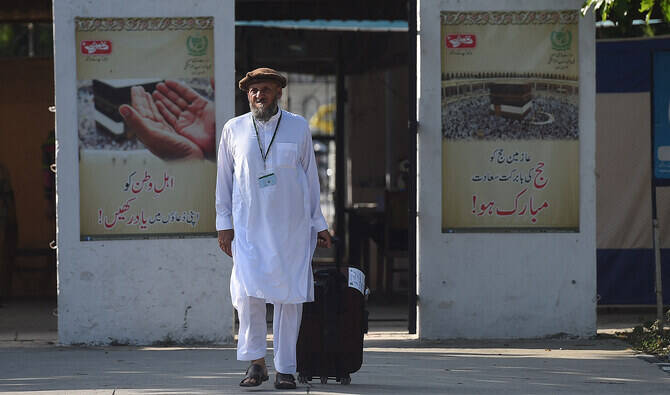
A Pakistani Hajj pilgrim arrives at The Hajj Complex in Islamabad on August 23, 2016, before leaving for the annual Hajj pilgrimage to the Islamic holy cities of Makkah and Madinah in Saudi Arabia. (AFP/File)
Short Url
Updated 11 January 2026
Follow

Pakistan organizes second phase of Hajj training for 2026 pilgrims in Islamabad

  • Training sessions held to inform pilgrims of various stages of Hajj, precautionary measures, obligatory acts, says state media 
  • Pilgrims told to improve their physical fitness, keep essential travel documents and vaccination cards ready ahead of Hajj 2026

ISLAMABAD: Pakistan’s Ministry of Religious Affairs organized the second phase of Hajj training for 2026 pilgrims in Islamabad today, Sunday, state media reported. 

Pakistan’s religion ministry kicked off the first phase of the mandatory Hajj trainings last Sunday in Islamabad and other cities. The ministry said the trainings were made mandatory to ensure that intending pilgrims are fully aware of Hajj rituals and administrative procedures. 

“Ministry of Religious Affairs and Interfaith Harmony organized second phase of Hajj training session for pilgrims in Islamabad today,” state broadcaster Radio Pakistan reported. 

It said the primary objective of the program was to provide awareness about the various stages of the pilgrimage, necessary precautionary measures and the obligatory acts of both Hajj and Umrah.

“Pilgrims were advised to improve their physical fitness by walking 2 to 3 kilometers daily and keep essential travel documents including original passport, CNIC, flight ticket, visa copies and vaccination cards ready,” the state media said. 

Intending pilgrims were strictly warned against carrying prohibited items such as narcotics, naswar (smokeless tobacco), cigarettes and unverified medicines.

Saudi Arabia has allocated Pakistan a quota of 179,210 pilgrims for Hajj 2026, of which around 118,000 seats have been reserved under the government scheme while the remainder will be allocated to private tour operators.

Under Pakistan’s Hajj scheme, the estimated cost of the government package ranges from Rs1,150,000 to Rs1,250,000 ($4,049.93 to $4,236), subject to final agreements with service providers.


Pakistan eyes ‘heavy’ Chinese investments in 10 key sectors at Islamabad agriculture summit

Updated 4 sec ago
Follow

Pakistan eyes ‘heavy’ Chinese investments in 10 key sectors at Islamabad agriculture summit

  • More than 300 Chinese and Pakistani firms attended the event focusing on fertilizers, seeds, smart farming and irrigation techniques
  • Islamabad expects the conference to lead to investments in agriculture, food processing, livestock, farm machinery and renewable energy

KARACHI: Pakistan is expecting “heavy” Chinese investments across 10 key sectors, including agriculture, renewable energy and technology, the Pakistani food security minister said on Monday, as officials and business leaders from both countries gathered for a major agriculture investment summit in Islamabad.
The Pakistan-China Agriculture Investment Conference was billed by Pakistan as a platform for deepening bilateral agricultural ties and supporting broader economic engagement between the two countries.
Around 120 Chinese companies and over 190 Pakistani firms participated in the event that focused on fertilizers, seed varieties, machinery, precision farming and smart irrigation systems, according to the organizers.
Speaking at the event, National Food Security Minister Rana Tanveer Hussain said the conference’s objective was to project Pakistan as a place where Chinese enterprises could grow, innovate and succeed alongside Pakistani partners.
“Heavy investments worth millions of dollars are expected, with multiple MoUs [memorandums of understanding] likely to be finalized by the end of the day across 10 key sectors, including agriculture, food processing, livestock, fisheries, agri-inputs, farm machinery, renewable energy, logistics, technology and value-added exports,” Hussain said on Monday evening.
Pakistan’s exports to China reached approximately $2.38 billion in Fiscal Year 2024–25 that ended in June, while imports stood at $16.3 billion, reflecting growing demand on both sides despite global economic headwinds, according to the minister.
This performance demonstrated resilience and expanding opportunities under the China–Pakistan Free Trade Agreement (CPFTA) framework.
Hussain said Islamabad was committed to supporting Chinese investors from regulatory processes to seamless coordination with all government departments and institutions.
“Together, Pakistan and China can push the boundaries of innovation, transform agri-technology, strengthen food security and reshape the economic landscape of the region,” he said.
The completion of the China-Pakistan Economic Corridor (CPEC) Phase I and the launch of CPEC Phase II marked a decisive shift toward industrialization, technology transfer, renewable energy and people-centric development, according to Hussain.
Both sides had signed over 40 MoUs in Sept. 2025, covering modern farming, livestock, fisheries, farm mechanization and advanced technology transfer.
“These initiatives are not just projects; they are lifelines of growth, confidence and mutual trust,” he said, adding that they aim to enhance productivity, expand exports, strengthen food security and ensure sustainable and inclusive economic growth.
Pakistan and China have been expanding cooperation in agriculture under the CPEC framework. Officials say stronger agricultural ties could help Pakistan boost exports, ensure food security and create jobs, while offering Chinese companies access to a large farming market and new investment opportunities.
Addressing the conference, Prime Minister Shehbaz Sharif urged Pakistani and Chinese agriculturists and experts to strengthen their existing partnership, saying that their sustained hard work and productivity gains could turn Pakistan into a surplus agricultural economy.
“Chinese experts are there to assist us and support us all the way to achieve this wonderful target [of becoming a surplus agricultural economy],” he said. “Now it’s up to us to generate this trade surplus through higher yields, comparative cost and, of course, highest quality.”
The prime minister noted that Pakistan’s policy rate was down to 10.5 percent down from 22 percent two years ago, exports were gradually increasing and macroeconomic indicators were stable.
“Now we have to move toward growth,” he said. “But then it requires solid, hard work, untiring efforts, blood and sweat. Without that, you will not be able to achieve your targets.”