Oman’s MSX sees largest growth among GCC equity markets in 2025: Kamco Invest 

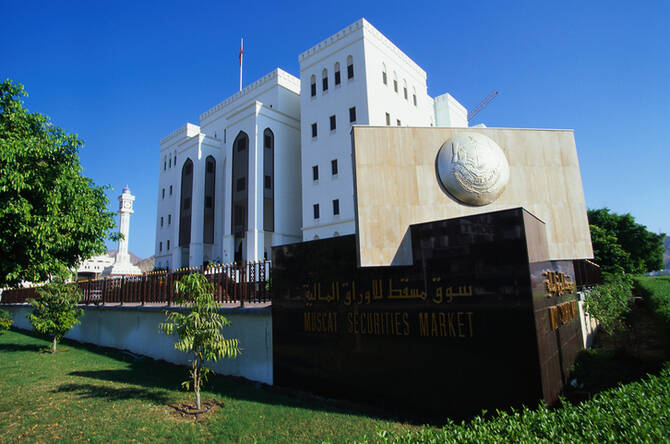
The MSX 30 Index reached a peak of 5,985.66 points in mid-December. Getty
Short Url
Updated 05 January 2026
Follow

Oman’s MSX sees largest growth among GCC equity markets in 2025: Kamco Invest 

RIYADH: Oman’s Muscat Securities Market emerged as the best-performing index in the Gulf Cooperation Council region in 2025, rising 28.2 percent year on year, according to an analysis by Kamco Invest. 

In its latest report, the financial firm said the MSX 30 Index closed the year at 5,866.8 points, marking one of the strongest annual performances among GCC markets. 

According to the analysis, the index reached its annual peak at 5,985.66 points in mid-December, while its lowest level was 4,223.83 points in early April, reflecting a 38.9 percent recovery from the year’s trough. 

Developing a robust capital market ecosystem remains crucial for GCC countries as they pursue economic diversification efforts to reduce dependence on oil revenues. 

“The aggregate MSCI GCC index reported a gain of 1.6 percent during the year despite largely positive performance at the country level. At the exchange level, Oman witnessed the biggest gains during the year with a double-digit surge of 28.2 percent,” said Kamco Invest.

The report added that Boursa Kuwait ranked as the second-best-performing market in the GCC, posting gains of 21.2 percent during the year. 

The Abu Dhabi Securities Exchange advanced 6.1 percent, while the Dubai Financial Market climbed 17.2 percent, supported by selective strength in real estate and services stocks. 

The Qatar Exchange recorded a marginal increase of 1.8 percent, while the Bahrain Bourse rose 4.1 percent in 2025. 

Despite a 12.8 percent decline, Saudi Arabia dominated regional listings activity during 2025. 

The Kingdom saw 13 companies debut on the Tadawul All Share Index, along with two transfers from the parallel Nomu market to the main market. In addition, 28 companies were listed on the Nomu market. 

Flynas was Saudi Arabia’s largest initial public offering in 2025, raising SR4.1 billion ($1.1 billion) in one of the region’s biggest aviation listings. 

Other notable IPOs during the year included Umm Al Qura for Development & Construction Co., Specialized Medical Co., Derayah Financial Co., and Dar Al Majed Real Estate Co. 

“At the sector level, the yearly performance (in the region) was skewed toward decliners with over 30 percent fall in Utilities, Insurance and Consumer Durable indices. On the gainers side, Telecom, Banks and Diversified Financials indices showed double gains that offset the overall weakness,” added Kamco Invest. 


IMF raises Saudi Arabia’s 2026 growth forecast to 4.5% 

Updated 4 sec ago
Follow

IMF raises Saudi Arabia’s 2026 growth forecast to 4.5% 

RIYADH: The International Monetary Fund raised its 2026 growth forecast for Saudi Arabia to 4.5 percent, citing higher oil output, resilient domestic demand, and continued economic reforms across the region. 

The revised projection marks a 0.5 percentage point upgrade from the IMF’s October report, according to the fund’s latest World Economic Outlook Update. Saudi Arabia’s economy is expected to have grown 4.3 percent in 2025, with expansion set to ease to 3.6 percent in 2027. 

This comes as the World Bank said earlier this month that Saudi Arabia’s gross domestic product is expected to grow by 4.3 percent in 2026 and 4.4 percent in 2027, up from an estimated 3.8 percent in 2025. 

The IMF expects growth momentum to build across the broader Middle East and North Africa and the Gulf Cooperation Council region. 

In its latest report, the IMF stated: “In the Middle East and Central Asia, growth is projected to accelerate from 3.7 percent in 2025 to 3.9 percent in 2026 and to 4.0 percent in 2027, supported by higher oil output, resilient local demand, and ongoing reforms.” 

Similarly, the Middle East and North Africa region is forecast to see growth rise from 3.4 percent in 2025 to 3.9 percent in 2026 and 4 percent in 2027. 

The broader report underscores a global economy holding steady at 3.3 percent growth in 2026, but noted this stability rests on a “narrow base of drivers,” primarily technology investment and fiscal support, making growth vulnerable.

Key risks include a potential reevaluation of artificial intelligence productivity gains, escalating trade tensions, and geopolitical flare-ups. 

“Headwinds from shifting trade policies are offset by tailwinds from surging investment related to technology, including artificial intelligence, more so in North America and Asia than in other regions, as well as fiscal and monetary support, broadly accommodative financial conditions, and adaptability of the private sector,” the IMF stated in its report. 

For energy commodities, a factor critical to regional revenues, the IMF expects prices to fall about 7 percent in 2026 due to “tepid global demand growth and strong supply growth,” but noted a soft floor is provided by higher-cost producers and strategic stockpiling. 

On inflation, the IMF projects a continued decline worldwide. Global headline inflation is expected to fall from an estimated 4.1 percent in 2025 to 3.8 percent in 2026 and further to 3.4 percent in 2027. The report stated that “overarching trends of softening demand and lower energy prices” are expected to remain intact. 

The IMF also provided updated growth forecasts for other major economies. Among advanced economies, the US is projected to grow by 2.4 percent in 2026, while the euro area is expected to expand by 1.3 percent. Japan’s growth is forecast to moderate to 0.7 percent.

For key emerging markets, China’s growth is projected at 4.5 percent in 2026, and India is expected to grow by 6.4 percent. 

The IMF’s policy advice emphasized rebuilding fiscal buffers, maintaining central bank independence, and reducing policy uncertainty to foster sustainable medium-term growth, advice particularly relevant for commodity-exporting regions navigating energy transition and diversification.