RAFAH: Gaza’s Hamas-run health ministry said Monday more than 5,000 people have been killed in the battered Palestinian enclave since Israel launched its withering bombing campaign just over two weeks ago.
Alarm has surged about the spiralling humanitarian crisis in Gaza as Israel struck back following the October 7 Hamas attacks which Israeli officials say killed more than 1,400 people who were shot, stabbed or burnt by the Islamist militants.
Israel also says the militants seized 222 hostages in the worst attack in the nation’s 75-year history.
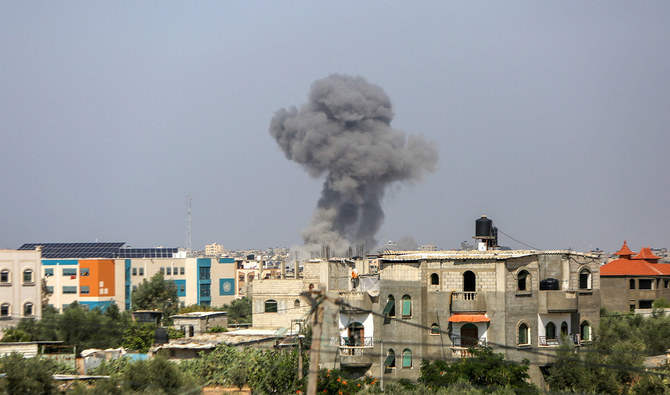
With the military saying it had conducted more than 300 new strikes within 24 hours, Gaza’s health ministry said the death toll had surged over 5,000, including more than 2,000 children, in figures AFP has not been able to independently verify.
Thousands of buildings have been levelled and more than a million people displaced in the besieged territory that has been largely deprived of water, food and other basic supplies.
Twenty trucks carrying desperately needed aid arrived in Gaza through the Rafah crossing with Egypt on Monday, the UN humanitarian agency said, the third convoy in as many days.
Washington vowed a “continued flow” of relief goods into Gaza, which the UN says is facing “catastrophic” conditions and needs to receive 100 trucks of aid per day.
Overnight, Gaza’s Hamas-controlled government said “more than 60” people died in Israeli bombardments, including 17 in a single strike on a house in Gaza’s north and another 10 in the morning.
And with thousands more wounded, Gaza’s health ministry called on citizens “to immediately go to hospitals and blood banks to donate blood.”
The Israeli military said it had hit “over 320 military targets” including “tunnels containing Hamas terrorists, dozens of operational command centers” and other militant outposts.
It also said it thwarted a cross-border Hamas drone attack on Monday, shooting down two UAVs that were crossing at the Nir Oz and Ein HaBesor communities near southern Gaza.
In a post on social media, Hamas confirmed the drones had sought to attack Israeli military positions.
Overnight, the army said a 19-year-old Israeli soldier had been killed and three others wounded during an operation on the outskirts of Gaza “to dismantle terror infrastructure... and locate missing persons and bodies.”
Meanwhile in southern Gaza, children killed in an Israeli air strike on the town of Khan Yunis were laid to rest in a makeshift grave on Monday as anguished family members looked on.
And at a packed UN school in the town, where thousands of displaced Palestinians were seeking shelter, staffers tried to distract traumatized youngsters by organizing games, including one with a colorful silk parachute.
Figures from the Hamas government say more than 181,000 housing units have been damaged, of which 20,000 had been totally destroyed or rendered uninhabitable.
Around the world, Israel’s friends and foes alike have warned against the Gaza war spilling over into a full-scale regional conflagration, with fears focused on its northern border where there have been increasing cross-border incidents with Lebanon’s Hezbollah.
Netanyahu on Sunday issued a stark warning to Hezbollah against opening a second front in the north, while Washington also fired a warning shot across the bows of any actors looking to inflame the conflict, saying it wouldn’t hesitate to act in the event of any “escalation.”
But the pace of evacuations has increased on both sides of the border, with the UN saying nearly 20,000 people had fled villages in south Lebanon due to the ongoing unrest.
At least 41 people have been killed in Lebanon, according to an AFP tally — mostly combatants but also at least four civilians, including a Reuters journalist. And four people have been killed in Israel, including three soldiers and a civilian.
Israel has also ordered the evacuation of thousands of people from a string of communities near its northern border but not everyone has left, with some refusing to go such as 62-year-old peach farmer Moshe Dadoush.
“I’d be lying if I said I wasn’t afraid. But I have to stay here and take care of my trees. If I don’t, there will be no fruit this year,” he told AFP.
“I wouldn’t leave for one simple reason: it’s here where I grew up. I have nowhere else to go but this country.”
At the weekend, Israel said it was stepping up its raids on Gaza and has massed tens of thousands of troops along the border ahead of a widely-expected ground invasion.
It has said its aim is to destroy Hamas, but has offered little detail about what would follow.
“One thing is clear: the Gaza Strip will not be ruled by Hamas once this war is over,” Israeli government spokesman Eylon Levy told AFP.
But Palestinian prime minister Mohammed Shtayyeh on Monday accused Western nations of giving Israel a “license to kill,” saying Israeli plans for a ground invasion would mean “more crimes, atrocities and forced displacement.”
“We condemn the statements that constitute a license to kill and give Israel political cover to commit massacres and spread destruction in Gaza,” he said.
US President Joe Biden and other leaders including Britain’s Rishi Sunak and Germany’s Olaf Scholz have visited Israel in recent days and affirmed its “right to defend” itself while urging it to keep within international humanitarian law.
Sunak on Monday said Britain was sending an additional £20 million ($24 million) of aid to help Gaza civilians affected by the war, and France’s Emmanuel Macron was due in Tel Aviv on Tuesday for talks with Netanyahu.


![]()

Hamas says more than 5,000 killed in Israeli strikes on Gaza
Short Url
https://arab.news/rdhbc
Hamas says more than 5,000 killed in Israeli strikes on Gaza
- Between 200 and 300 people have been killed each day in the besieged territory
- Thousands of buildings have been levelled and more than a million displaced
Latest updates


© 2026 SAUDI RESEARCH & PUBLISHING COMPANY, All Rights Reserved And subject to Terms of Use Agreement.