

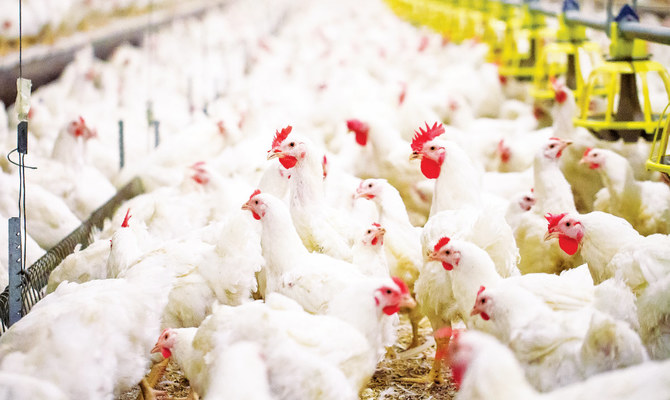

RIYADH: Saudi Arabia aims to reach 80 percent food security in poultry supplies by 2025, which is leading to an increased need for hatching eggs, according to a leading industry figure.
Ahmed Osilan, managing director and executive board member at Tanmiah Food Co., told Arab News that agricultural and scientific developments mean the Kingdom can now export products it previously needed to import.
He made it clear that Saudi Arabia is also on the cusp of achieving breakthroughs in the production of vital crops which could open up new trade markets for the Kingdom.
Osilan revealed Saudi Arabia has reached above 100 percent food security in the supply of dairy and table eggs, which is why he believes the Kingdom can achieve the same in fresh poultry and hatching eggs.
“We have realized that Saudi cannot have sustainable food security if we continue importing hatching eggs from outside of the country,” he said, adding: “Growing corn and soya in Saudi Arabia is now our only challenge left to achieve 100 percent food security in Saudi Arabia.”
In 2018, Saudi Arabia had a self-sufficiency rate of 45 percent in poultry production. This has now hit 67 percent, Osilan said.
The shareholder agreement signed by Desert Hills Veterinary Services Co. — a fully owned subsidiary of Tanmiah Food Co, — with MHP SE, a food and aggrotech group, to invest more than SR200 million ($53.33 million) in agricultural activities in the Kingdom. This investment is expected to significantly increase hatching eggs’ contribution to food security and self-sufficiency.
This included a state-of-the-art hatchery, feed mill, broiler farms with a capacity of more than 1 million parent stock projected to produce around 175 million hatching eggs yearly.
The partnership is expected to provide Tanmiah with an extensive and comprehensive insight into the process, and the company plans to collaborate closely with their partners in research and development and knowledge transfer.
Osilan explained: “We will work with them on the R&D side to understand how the research work happens and we will also work with them on the knowledge transfer by incubating this whole investment in the Kingdom of Saudi Arabia.”
He continued: “Ultimately we are genetically making sure that the supply of hatching eggs in the Kingdom becomes local and that will solve the bigger issue of food security.”
The development is a welcome move for a nation that has traditionally relied on imports to fulfill the demand for various stages of poultry production.
Corn and soybeans are two of the main foodstuffs, so Tanmiah launched a global Omnipreneurship Challenge. The challenge seeks to find solutions to grow these poultry feed within Saudi Arabia using innovative and advanced agricultural methods, offering a grand prize of one million dollars.
The executive believes it might be possible to cultivate these crops successfully in Saudi Arabia, and said: “We’re one step away from achieving the highest level of food security.”
This achievement would not only benefit the Kingdom but also have positive implications for other Arab countries, including Lebanon, Algeria, and Morocco, which currently rely entirely, or to a significant extent, on food imports.
Importantly, Saudi Arabia is striving to achieve these goals independently, by “developing all of this in-house,” said Osilan.
“Saudi Arabia taking the lead and being able to develop all of this in-house will then (show) … that Saudi Arabia is now not only concerned about food security for the Kingdom, but also concerned for food security for the entire Arab region, in fact, for the entire globe,” he added.
Osilan also stated that Saudi Arabia has a high per capita consumption of chicken, the largest in the Middle East.
This robust demand for poultry protein is continuously rising, due to its perceived health benefits, and there are no indications that it will decrease in the near future.


