

Saudi Arabia’s libraries showcase book restoration at Riyadh fair

1 / 7
This year, King Fahd National Library is introducing people to methods to restore old books. (Abdulrahman Shulhub)
2 / 7
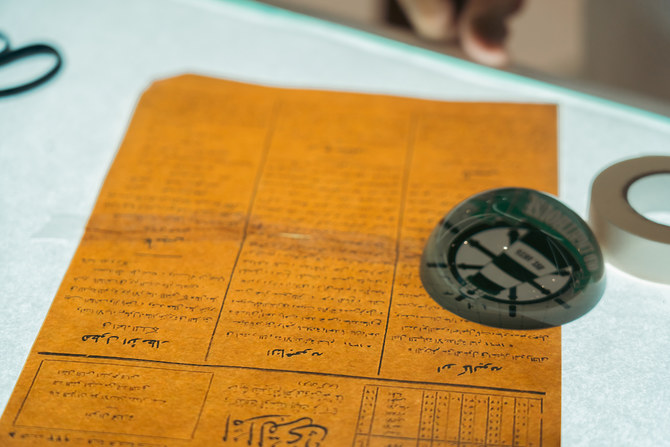
The time spent to restore a manuscript depends on the age of the manuscript itself. (Abdulrahman Shulhub)
3 / 7
This year, King Fahd National Library is introducing people to methods to restore old books. (Abdulrahman Shulhub)
4 / 7
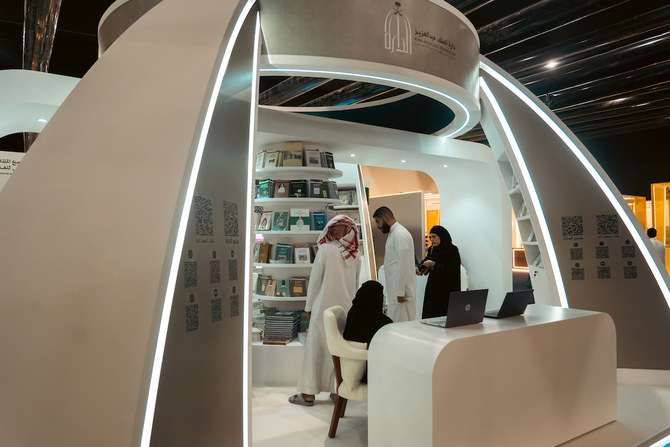
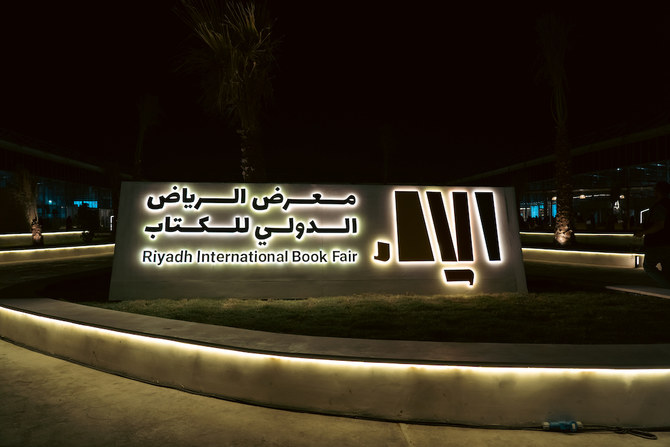
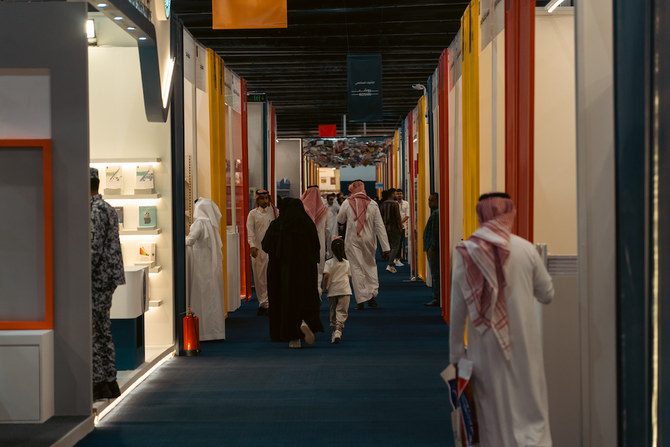
The 10-day book fair — which opened on Sept. 28 and will continue until Oct. 7 — is being held at King Saud University under the slogan “An Inspiring Destination.” (Abdulrahman Shulhub)
5 / 7
The 10-day book fair — which opened on Sept. 28 and will continue until Oct. 7 — is being held at King Saud University under the slogan “An Inspiring Destination.” (Abdulrahman Shulhub)
6 / 7
The 10-day book fair — which opened on Sept. 28 and will continue until Oct. 7 — is being held at King Saud University under the slogan “An Inspiring Destination.” (Abdulrahman Shulhub)
7 / 7
The 10-day book fair — which opened on Sept. 28 and will continue until Oct. 7 — is being held at King Saud University under the slogan “An Inspiring Destination.” (Abdulrahman Shulhub)
Short Url
Updated 01 October 2023
Follow

Saudi Arabia’s libraries showcase book restoration at Riyadh fair

RIYADH: Two national libraries are showing visitors how to restore decades and centuries-old books and manuscripts at Riyadh International Book Fair 2023.

The 10-day book fair — which opened on Sept. 28 and will continue until Oct. 7 — is being held at King Saud University under the slogan “An Inspiring Destination.” Hundreds of publishing companies and libraries from around the world are showcasing their expansive collections of books of all genres.

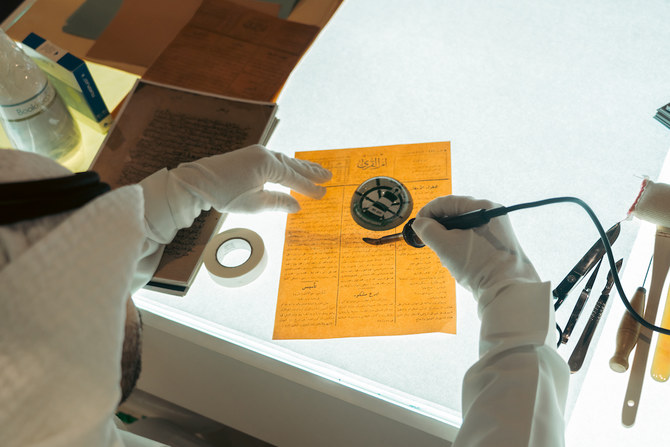
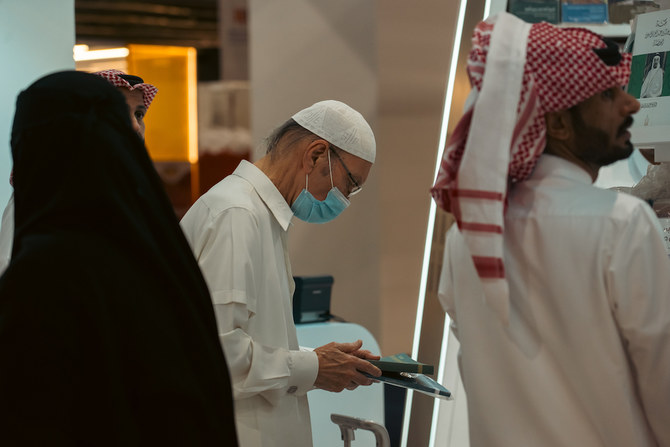
This year, King Fahd National Library is introducing people to methods to restore old books. Some of the books they have worked on are centuries old.

“Over the years, some manuscripts are subject to poor preservation and storage, as they are exposed to high temperature, acidity, or insect corrosion. When we pick up manuscripts, there are always insects or fungi on them,” said Tahani Al-Saghami, deputy director of the restoration and sterilization laboratory department at King Fahd National Library.

She explained to Arab News how the process of restoring old books is carried out until the desired results are achieved.

She said: “First, we put it in the sterilizer, where it is sterilized for 18 to 24 hours. Then, the restorer receives it. We try to clean the manuscript and treat it chemically so that we neutralize the acidity and stabilize the ink before handing it over to the restorer so that he can carry out the manual restoration process efficiently … the process of covering and removing the cracks and breaks in the manuscript without distortion.”

Al-Saghami also said that natural fibers that are close to the nature of the manuscript’s paper to repair damaged parts of manuscripts are used.

Another national library that is showing visitors how the preservation of manuscripts is done is the King Abdulaziz Foundation for Research and Archives.

“There is mechanical restoration and manual restoration, and the process goes through stages, the first of which is sterilizing documents and manuscripts with ozone gas, which kills bacteria and insects present in the manuscript,” said Anas Al-Shamlan, document restorer at King Abdulaziz Foundation for Research and Archives.

He added: “After that the papers are treated with alkaline and restored manually … the final stage is mechanical restoration.”

He also stressed the importance of preserving manuscripts in suitable environments after the restoration process.

Al-Shamlan said: “The place must be prepared to store manuscripts so that the humidity rate is between 25 and 30 C, in addition to placing them above the ground, away from leaks, sunlight, and air conditioner.”

Al-Shamlan has repaired several manuscripts, some as much as 250 years old. The time spent to restore a manuscript depends on the age of the manuscript itself, he says, but generally speaking, it may take from six months to a year to complete one item.

Riyadh International Book Fair is one of the most prominent exhibitions in Saudi Arabia. Around 1 million people attended the book fair last year, and organizers are hoping to reach a similar total in 2023.


Japanese researchers hope to restore coral from Saudi-made structures

Updated 10 sec ago
Follow

Japanese researchers hope to restore coral from Saudi-made structures

  • Coral skeletons made for Saudi Pavilion at Japan expo last year
  • Results of Japanese study to be revealed at Riyadh Expo 2030

TOKYO: Japanese universities are seeking to restore coral reefs and marine ecosystems after receiving artificial structures that Saudi Arabia made and showcased at last year’s Osaka-Kansai Expo.

The coral skeletons were donated to the University of the Ryukyus in Okinawa and Kansai University in Osaka Prefecture, Kyodo News reported at the weekend.

The structures are made from calcium carbonate, a material on which corals are believed to grow more easily compared to artificial alternatives such as concrete or metal.

The skeletal structures were created using 3-D printers, with one piece produced a day during the expo, and displayed across an entire wall in the Saudi Arabia Pavilion, which had an area focusing on sustainable marine environments.

Coral reefs serve as habitats for much marine life, but over 40 percent of the world’s 892 species face possible extinction, according to the International Union for Conservation of Nature.

The University of the Ryukyus, which received about 150 of the artificial coral skeletons, will place them in waters off the eastern coast of Okinawa’s main island and then examine their impact on the ecosystem.

Kansai University has placed theirs in the sea around Kagoshima Prefecture’s Yoron Island to observe their growth after transplanting coral polyps onto the structures.

The results of the research are expected to be revealed at the Riyadh Expo in 2030.

“I had never imagined that Japan and Saudi Arabia would cooperate on coral research,” said Masato Ueda, a professor specializing in regenerative medicine at Kansai University.

Ueda said he wants to demonstrate to children that “humanity is attempting to restore the environment.”