

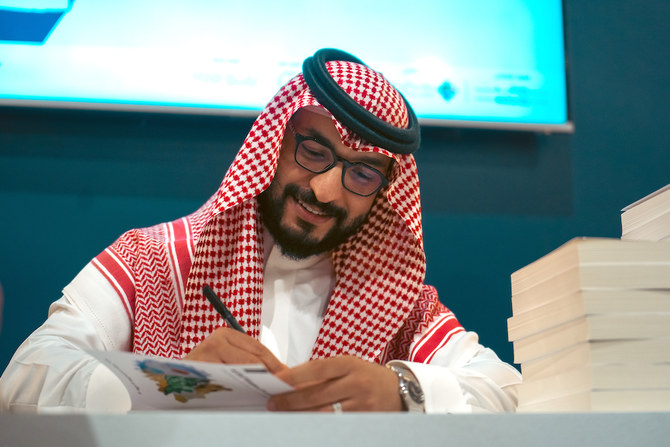


RIYADH: The history of Saudi-Japan relations can be traced back to the early 20th century, but it was not well documented, and the few books written on the subject were available only in Japanese and English.
This prompted Khalid Alrashoud, who pursued a Ph.D. in transformation management and development engineering in Japan, to write a book on the growing relationship between the two countries — the first publication to appear in Arabic.
While signing copies of his book, “Saudi Japanese Relations,” at the Riyadh International Book Fair, Alrashoud spoke exclusively to Arab News, sharing the story of his connection to Japan, and what readers can expect from the publication.
Iwai Fumio, Japanese ambassador to Saudi Arabia, also attended the book signing on Friday.
“It’s all about the Saudi-Japanese diplomatic relations. The book covers the relations between Japan and Saudi Arabia from the beginning, even before the establishment of the modern Kingdom in 1932, from 1920 all the way to 2022,” Alrashoud said.
“The first chapter touches on the early connections between Japanese and Muslims, which took place in China, and how this relationship developed over time to where it is today.
“What’s really special about this book is that it covers not only the political and diplomatic aspects, but also all the prominent engagements, whether social, cultural or trade relations,” he added.
Alrashoud began writing the book during his stay in Japan. He lived there for 13 years while completing an undergraduate program, and pursuing a master’s and Ph.D. He also has the highest-level qualification in Japanese language proficiency, the Japanese-Language Proficiency Test, which covers language knowledge, and reading and listening ability.
“This helped me dig deep in literature written in Japanese,” he said.
“When I first started writing about the subject, I was shocked at how little was available. When it comes to looking for literature on bilateral relations, it was available only in English or Japanese, and wasn’t quite accurate. So, I took on this mission to write the book in Arabic, the first and only book in Arabic documenting Saudi-Japan relations. It took me about three years,” Alrashoud told Arab News.
Referring to his connection with Japan, Alrashoud said: “I worked there as a university professor and as a consultant in international relations. I also worked there for a number of years as a project manager for a Japanese company that is basically focusing on development partnerships with Middle Eastern countries.”
On what readers can expect from the book, especially on Saudi-Japan relations, he said: “If you are looking for a well-documented and well-written book that provides all the resources, whether in Arabic, Japanese or English, this is the book to read. And all the names mentioned are in Japanese and in English for researchers who want to take a step further and search even more on this topic.
“I worked very hard to make it easily understandable for anyone who is reading this book to be enlightened about the numbers and data. I remember when I first reached out to the Ministry of Economy and Planning in Saudi Arabia and asked for the data on bilateral trade. All this information they had was from around the 1980s. Then I reached out to the Japanese government and they had information documented from the 1970 and 1960s.
“So, I combined the two and I made graphs. In this book you will find information that you will not find in another book.”
Alrashoud also bought rare historic photos of Japanese officials who visited Saudi Arabia in the 1950s and earlier, and incorporated these in the book.
The book also deals with Saudi students studying in Japan.
“Yes, I was one of them. I was honored to be a part of the King Abdullah Foreign Scholarship Program, and that’s where I completed my bachelor’s, master’s and Ph.D. It covers the numbers of students studying in Japan, and how the numbers increase and decrease.”
Alrashoud completed his Ph.D. in transformation management and development engineering at the Tokyo Institute of Technology (Tokyo Tech).


