

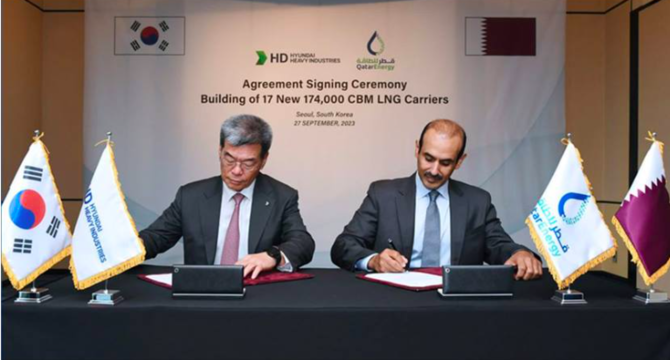
QatarEnergy inks $3.9bn deal with Hyundai for 17 LNG carriers 

This agreement will raise the total number of new LNG carriers to be delivered to QatarEnergy and its subsidiaries to 77. QNA.
Short Url
Updated 28 September 2023
Follow

QatarEnergy inks $3.9bn deal with Hyundai for 17 LNG carriers 

RIYADH: QatarEnergy has signed a contract with South Korea’s Hyundai Heavy Industries to construct 17 new liquefied natural gas carriers, marking the beginning of the second phase of the energy firm’s maritime fleet expansion program. 

Valued at 14.2 billion Qatari riyals ($3.9 billion), this deal, according to Qatar News Agency, aims to support increased LNG production from the North Field Expansion and Golden Pass projects while addressing long-term fleet modernization needs. 

In addition to the 60 carriers contracted during the first phase of the program, which were constructed in Korean and Chinese shipyards, this agreement will raise the total number of new LNG carriers to be delivered to QatarEnergy and its subsidiaries to 77. 

Furthermore, there are plans for additional carriers in the future, as reported by QNA. 

The agreement was signed by Saad bin Sherida Al-Kaabi, the minister of state for energy affairs and the CEO of QatarEnergy, and Sam Hyun Ka, vice chairman at Korea Shipbuilding & Offshore Engineering Co. Ltd. 

Al-Kaabi stated that the agreement represents another milestone in the relationship with Hyundai Heavy Industries and the Korean shipbuilding industry.

He added: “Hyundai Heavy Industries will construct these 17 LNG carriers to the highest technical, environmental, and quality standards, ensuring optimal fuel efficiency and significant reductions in carbon emissions. This underscores our ongoing commitment to leadership in sustainability, innovation, and growth in the LNG industry.” 

Hyun Ka said: “We take pride in our partnership with Qatar and participation in one of the world's largest LNG projects. We have strong faith that this opportunity will enhance the long-term cooperation between our two companies and our nations.” 

QatarEnergy’s LNG carrier fleet expansion program plays a crucial role in meeting future shipping demands as the country expands its production capacity from the North Field.


Saudi POS spending jumps 28% in final week of Jan: SAMA

Updated 06 February 2026
Follow

Saudi POS spending jumps 28% in final week of Jan: SAMA

RIYADH: Saudi Arabia’s point-of-sale spending climbed sharply in the final week of January, rising nearly 28 percent from the previous week as consumer outlays increased across almost all sectors. 

POS transactions reached SR16 billion ($4.27 billion) in the week ending Jan. 31, up 27.8 percent week on week, according to the Saudi Central Bank. Transaction volumes rose 16.5 percent to 248.8 million, reflecting stronger retail and service activity. 

Spending on jewelry saw the biggest uptick at 55.5 percent to SR613.69 million, followed by laundry services which saw a 44.4 percent increase to SR62.83 million. 

Expenditure on personal care rose 29.1 percent, while outlays on books and stationery increased 5.1 percent. Hotel spending climbed 7.4 percent to SR377.1 million. 

Further gains were recorded across other categories. Spending in pharmacies and medical supplies rose 33.4 percent to SR259.19 million, while medical services increased 13.7 percent to SR515.44 million. 

Food and beverage spending surged 38.6 percent to SR2.6 billion, accounting for the largest share of total POS value. Restaurants and cafes followed with a 20.4 percent increase to SR1.81 billion. Apparel and clothing spending rose 35.4 percent to SR1.33 billion, representing the third-largest share during the week. 

The Kingdom’s key urban centers mirrored the national surge. Riyadh, which accounted for the largest share of total POS spending, saw a 22 percent rise to SR5.44 billion from SR4.46 billion the previous week. The number of transactions in the capital reached 78.6 million, up 13.8 percent week on week. 

In Jeddah, transaction values increased 23.7 percent to SR2.16 billion, while Dammam reported a 22.2 percent rise to SR783.06 million. 

POS data, tracked weekly by SAMA, provides an indicator of consumer spending trends and the ongoing growth of digital payments in Saudi Arabia.  

The data also highlights the expanding reach of POS infrastructure, extending beyond major retail hubs to smaller cities and service sectors, supporting broader digital inclusion initiatives.  

The growth of digital payment technologies aligns with Saudi Arabia’s Vision 2030 objectives, promoting electronic transactions and contributing to the Kingdom’s broader digital economy.