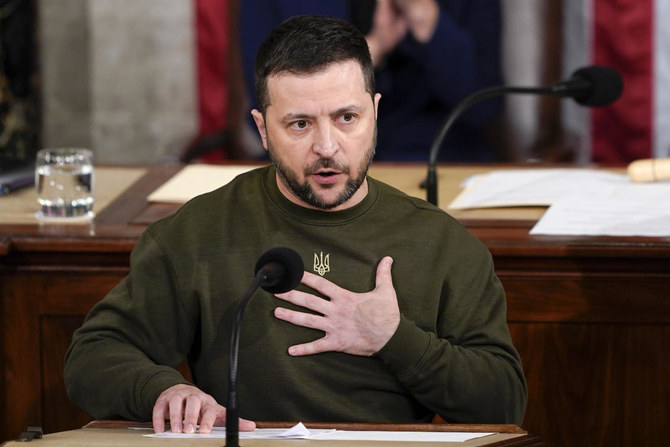
WASHINGTON: Ukrainian President Volodymyr Zelensky returned to Washington on Thursday for a whirlwind one-day visit, this time to face the Republicans now questioning the flow of American dollars that for 19 months has kept his troops in the fight against Russian forces.
Zelensky will meet with President Joe Biden at the White House, speak with US military leaders at the Pentagon and stop at Capitol Hill to talk privately with Republican and Democratic leaders of the House and Senate as the world is watching Western support for Kyiv.
It is Zelensky’s second visit to Washington since Russia invaded Ukraine in February 2022 and comes as Biden’s request to Congress for an additional $24 billion for Ukraine’s military and humanitarian needs is hanging in the balance.
National Security Council spokesman John Kirby called the Ukrainian president “our best messenger” in persuading US lawmakers to keep vital US money and weapons coming.
“It’s really important for members of Congress to be able to hear directly from the president about what he’s facing in this counteroffensive,” Kirby told reporters Wednesday, “and how he’s achieving his goals, and what he needs to continue to achieve those goals.”
Biden has called on world leaders to stand strong with Ukraine, even as he faces domestic political divisions at home. A hard-right flank of Republicans, led by former President Donald Trump, Biden’s chief rival in the 2024 race for the White House, is increasingly opposed to sending more money overseas.
As the White House worked to shore up support for Ukraine before Zelensky’s visit, Secretary of State Antony Blinken and top intelligence officials briefed senior lawmakers behind closed doors Wednesday to argue the case.
But some Senate Republicans walked out of the briefing no more convinced than before about the necessity of spending more on Ukraine. “It’s not close to the end,” Sen. Josh Hawley, a Missouri Republican, said. “What we’re basically told is, ‘Buckle up and get out your checkbook.”’
Since the start of the war, most members of Congress supported approving four rounds of aid to Ukraine, totaling about $113 billion, viewing defense of the country and its democracy as an imperative, especially when it comes to containing Russian President Vladimir Putin. Some of that money went toward replenishing US military equipment sent to the frontlines.
Democratic Sen. Mark Kelly of Arizona, who traveled to Kyiv this week, said cutting off US aid during the Ukrainians’ counteroffensive would be “catastrophic” to their efforts.
“That would clearly be the opening that Putin is looking for,” Kelly said Wednesday. “They cannot be successful without our support.”
The political environment has shifted markedly since Zelensky addressed Congress last December on his first trip out of Ukraine since the war began. He was met with rapturous applause for his country’s bravery and surprisingly strong showing in the war.
His meeting with senators on Thursday will take place behind closed doors in the Old Senate Chamber, a historical and intimate place of importance at the US Capitol, signifying the respect the Senate is showing the foreign leader.
But on the other side of the Capitol, Republican House Speaker Kevin McCarthy, who faces more opposition within his Trump-aligned ranks to supporting Ukraine, is planning a separate meeting with Zelensky, with a smaller bipartisan group of lawmakers and committee chairmen.
“I will have questions for President Zelensky,” McCarthy told reporters before the visit.
The House speaker said he wanted more accountability for the money the US has already approved for Ukraine before moving ahead with more.
And, McCarthy said, he wants to know, “What is the plan for victory?”
In the Senate, however, Ukraine has a strong ally in Republican leader Mitch McConnell, who is out front in pushing his party, and the president, to continue robust support for Kyiv.
McConnell urged Biden before Wednesday’s closed-door briefing to senators to make sure the administration’s top brass puts forward a more forceful case in support of Ukraine so Congress can send Zelensky what’s needed to win the war.
“I sometimes get the sense that I speak more about Ukraine matters than the president does,” McConnell said in a speech Wednesday.


![]()

Zelensky returns to Washington to face growing dissent among Republicans to US spending for Ukraine
Short Url
https://arab.news/mch72
Zelensky returns to Washington to face growing dissent among Republicans to US spending for Ukraine
- Zelensky will meet with President Joe Biden at the White House
- National Security Council spokesman John Kirby called the Ukrainian president “our best messenger” in persuading US lawmakers to keep vital US money and weapons coming


Latest updates


© 2026 SAUDI RESEARCH & PUBLISHING COMPANY, All Rights Reserved And subject to Terms of Use Agreement.