

Powerful earthquakes rock Indonesia’s Bali and Java islands, no casualties reported

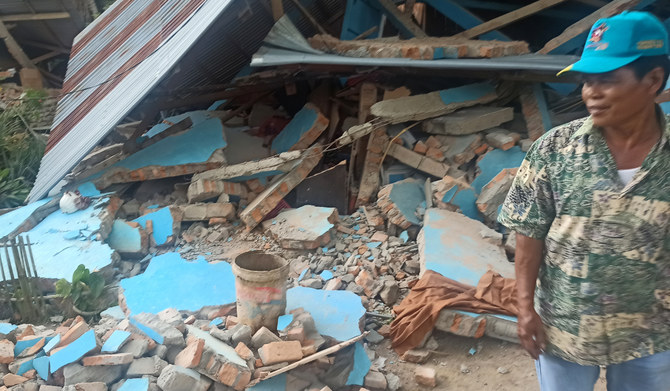
A man stands near a damaged house following an earthquake in Pasaman, West Sumatra, Indonesia, Friday, Feb. 25, 2022. (AP)
Short Url
Updated 29 August 2023
Follow

Powerful earthquakes rock Indonesia’s Bali and Java islands, no casualties reported

  • The US Tsunami Warning System said there were no threats of a tsunami as a result of the earthquake that struck deep under the seabed

DENPASAR, Indonesia: A powerful earthquake and an aftershock rocked Indonesia’s resort island of Bali and other parts of the country on Tuesday, causing panic but no immediate reports of damage or casualties.
The US Geological Survey said the magnitude 7.1 earthquake was centered 181 kilometers (112 miles) northeast of Gili Air, a tiny island near the coast of Lombok Island, next to Bali, at a depth of 513.5 kilometers (319 miles).
Indonesia’s Meteorology, Climatology and Geophysical Agency said there was no danger of a tsunami but warned of possible aftershocks. The agency put a preliminary magnitude at 7.4. Variations in early measurements are common.
A 5.4 magnitude aftershock hit the same area a few minutes later just before dawn.
Many residents and tourists rushed out of their homes and hotels toward higher ground after reporting powerful shockwaves, but the situation returned to normal after they received text messages saying the quake had no potential to trigger a tsunami.
“I thought the walls were going to come down on the hotel,” an Australian tourist said on social media.
People in neighboring provinces of East Java, Central Java, West Nusa Tenggara and East Nusa Tenggara provinces also felt the tremors and panicked as houses and buildings swayed for several seconds.
Indonesia, a vast archipelago of 270 million people, is frequently struck by earthquakes, volcanic eruptions and tsunamis because of its location on the “Ring of Fire,” an arc of volcanoes and fault lines that arcs the Pacific.
An earthquake in the hilly Karangasem in 2021 triggered landslides and cut off at least three villages, killing at least three people.
A magnitude 5.6 earthquake on Nov. 21 killed at least 331 people and injured nearly 600 in West Java’s Cianjur city. It was the deadliest in Indonesia since a 2018 quake and tsunami in Sulawesi killed about 4,340 people.
In 2004, an extremely powerful Indian Ocean quake set off a tsunami that killed more than 230,000 people in a dozen countries, most of them in Indonesia’s Aceh province.


171 bodies found in mass graves in eastern Congo, an official says

Updated 4 sec ago
Follow

171 bodies found in mass graves in eastern Congo, an official says

  • Authorities found two mass graves with at least 171 dead bodies in the Kiromoni and Kavimvira
  • M23’s spokesperson did not immediately respond to a request for comment

KINSHASA: Congolese authorities and a civil society group said Thursday that mass graves were found in part of eastern Congo that the M23 rebel group has recently withdrawn from, as fighting in the region escalates despite a US-mediated peace deal.
The governor of South-Kivu province, Jacques Purusi, said authorities found two mass graves with at least 171 dead bodies in the Kiromoni and Kavimvira neighborhoods on the outskirts of the eastern city of Uvira.
“At this stage, we have identified two sites: one mass grave containing approximately 30 bodies in Kiromoni, not far from the Burundian border on the Congolese side, and another in Kavimvira where 141 bodies were found,” Purusi told The Associated Press over the phone.
The Associated Press could not independently verify the claim. M23’s spokesperson did not immediately respond to a request for comment.
The Executive Secretariat of the Local Network for the Protection of Civilians, a civil society group in the region, said Thursday it wanted to visit the mass graves but was prevented from doing so by the Congolese military.
Information gathered so far indicates that the victims were killed by M23 rebels, said Yves Ramadhani, the group’s vice president.
The governor and the civil society group alleged that the rebels killed the individuals because they suspected them of belonging to the Congolese army or a pro-government militia.
Both the Congolese military and M23 have been accused of extrajudicial killings and abuses by rights groups.