

China cuts key interest rate to support economy 

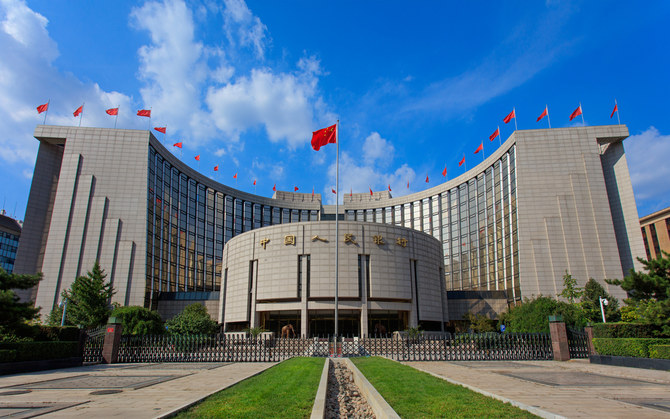
The People’s Bank of China said on Monday cut the one-year loan prime rate, which serves as a benchmark for corporate loans, from 3.55 percent to 3.45 percent.  (Shutterstock)
Short Url
Updated 21 August 2023
Follow

China cuts key interest rate to support economy 

BEIJING: China’s central bank on Monday cut a key interest rate in an attempt to counter the post-Covid growth slowdown in the world’s second-largest economy. 

Activity has been dragged down recently by uncertainty in the labor market and global economic sluggishness, weakening demand for Chinese goods. 

Financial troubles in the real estate sector, with several leading developers on the verge of bankruptcy and struggling to complete projects, also pose a major obstacle to growth. 

The People’s Bank of China said on Monday cut the one-year loan prime rate, which serves as a benchmark for corporate loans, from 3.55 percent to 3.45 percent. 

However, the five-year LPR, which is used to price mortgages, was held at 4.2 percent. 

Closely followed by the markets, the two rates are now at historic lows, after previous reductions in June. 

The decision is intended to encourage commercial banks to grant more loans and at more advantageous rates. 

Monday’s measures — which run counter to rising interest rates around the world as other major economies work to curb inflation — aim to indirectly support economic activity as growth flags. 

The long-awaited post-Covid recovery following the lifting of health restrictions at the end of 2022 has run out of steam in recent months.  

In another sign that the recovery is faltering, loans to households fell last month to their lowest level since 2009. 

To reinvigorate the economy, the central bank reduced the rate for its medium-term lending facility to financial institutions last Tuesday. 

And financial regulators agreed Friday on the need for “financial support,” while avoiding “risks and hidden dangers,” state media reported. 

Analysts polled by Bloomberg expected a bigger cut to the LPR following the Friday meeting. 

In a note following the Monday announcement, Goldman Sachs economist Maggie Wei described the LPR cut as “disappointing,” adding that it “would not help with building confidence” as Chinese authorities pursue an economic recovery. 

The move “can even backfire if market participants interpret these easing measures as policymakers' unwillingness to deliver even moderate policy stimulus,” wrote Wei. 

Traders appeared unimpressed with the move, with Hong Kong stocks down 1.4 percent and Shanghai off 0.6 percent. 

The central bank’s decision comes as a crisis at property giant Country Garden, long deemed financially sound and now ultra-indebted, raises fears of a bankruptcy that could have dire consequences for the domestic financial system. 

Country Garden’s problems are building just two years after a crisis erupted at major rival Evergrande, which is struggling with huge debt. 

In addition to the real estate woes, growth is also hampered by sluggish consumption amid uncertainty in the labor market and a global economic slowdown. 

That is weighing on demand for Chinese goods, slowing the activity of thousands of factories. 

China suspended the monthly publication of its detailed youth unemployment figures last Tuesday, after it hit a record high of 21.3 percent in June, according to official data. 

The unemployment rate is calculated for urban areas and therefore provides only a partial picture of the situation. 

The series of gloomy figures in recent weeks has ramped up pressure on officials to introduce a vast economic recovery plan, but debt-averse policymakers in Beijing are reluctant. 

Authorities have instead announced various steps to boost the private sector, which was hit particularly hard during the pandemic, and consumption, though they have yet to take effect. 

The economic slowdown threatens a growth target set by authorities at around five percent for this year. 

If achieved, that would already be one of China’s lowest annual growth rates in decades, outside of the Covid period. 

Beijing last Wednesday acknowledged economic “difficulties” but castigated the pessimism of Western commentators who doubt its continued ability to support global growth. 

“Eventually, they will for sure be proven wrong,” said Wang Wenbin, a spokesman for the Chinese Ministry of Foreign Affairs. 


How AI and financial literacy are redefining the Saudi workforce

Updated 26 December 2025
Follow

How AI and financial literacy are redefining the Saudi workforce

  • Preparing people capable of navigating money and machines with confidence

ALKHOBAR: Saudi Arabia’s workforce is entering a transformative phase where digital fluency meets financial empowerment. 

As Vision 2030 drives economic diversification, experts emphasize that the Kingdom’s most valuable asset is not just technology—but people capable of navigating both money and machines with confidence.

For Shereen Tawfiq, co-founder and CEO of Balinca, financial literacy is far from a soft skill. It is a cornerstone of national growth. Her company trains individuals and organizations through gamified simulations that teach financial logic, risk assessment, and strategic decision-making—skills she calls “the true language of empowerment.”

An AI-driven interface showing advanced data insights, highlighting the increasing demand for leaders who can navigate both technology and strategy. (creativecommons.org)

“Our projection builds on the untapped potential of Saudi women as entrepreneurs and investors,” she said. “If even 10–15 percent of women-led SMEs evolve into growth ventures over the next five years, this could inject $50–$70 billion into GDP through new job creation, capital flows, and innovation.”

Tawfiq, one of the first Saudi women to work in banking and later an adviser to the Ministry of Economy and Planning on private sector development, helped design early frameworks for the Kingdom’s venture-capital ecosystem—a transformation she describes as “a national case study in ambition.”

“Back in 2015, I proposed a 15-year roadmap to build the PE and VC market,” she recalled. “The minister told me, ‘you’re not ambitious enough, make it happen in five.’” Within years, Saudi Arabia had a thriving investment ecosystem supporting startups and non-oil growth.

Opinion

This section contains relevant reference points, placed in (Opinion field)

At Balinca, Tawfiq replaces theory with immersion. Participants make business decisions in interactive simulations and immediately see their financial impact.

“Balinca teaches finance by hacking the brain, not just feeding information,” she said. “Our simulations create what we call a ‘business gut feeling’—an intuitive grasp of finance that traditional training or even AI platforms can’t replicate.”

While AI can personalize lessons, she believes behavioral learning still requires human experience.

Saudi women take part in a financial skills workshop, reflecting the growing role of financial literacy in shaping the Kingdom’s emerging leadership landscape. (AN File)

“AI can democratize access,” she said, “but judgment, ethics, and financial reasoning still depend on people. We train learners to use AI as a co-pilot, not a crutch.”

Her work aligns with a broader national agenda. The Financial Sector Development Program and Al Tamayyuz Academy are part of Vision 2030’s effort to elevate financial acumen across industries. “In Saudi Arabia, financial literacy is a national project,” she said. “When every sector thinks like a business, the nation gains stability.”

Jonathan Holmes, managing director for Korn Ferry Middle East, sees Saudi Arabia’s digital transformation producing a new generation of leaders—agile, data-literate, and unafraid of disruption.

“What we’re seeing in the Saudi market is that AI is tied directly to the nation’s economic growth story,” Holmes told Arab News. “Unlike in many Western markets where AI is viewed as a threat, here it’s seen as a catalyst for progress.”

Saudi Arabia's Vision 2030 and the national AI strategy are producing “younger, more dynamic, and more tech-fluent” executives who lead with speed and adaptability. (SPA photo)

Holmes noted that Vision 2030 and the national AI strategy are producing “younger, more dynamic, and more tech-fluent” executives who lead with speed and adaptability. Korn Ferry’s CEO Tracker Report highlighted a notable rise in first-time CEO appointments in Saudi Arabia’s listed firms, signaling deliberate generational renewal.

Korn Ferry research identifies six traits for AI-ready leadership: sustaining vision, decisive action, scaling for impact, continuous learning, addressing fear, and pushing beyond early success.

“Leading in an AI-driven world is ultimately about leading people,” Holmes said. “The most effective leaders create clarity amid ambiguity and show that AI’s true power lies in partnership, not replacement.”

He believes Saudi Arabia’s young workforce is uniquely positioned to model that balance. “The organizations that succeed are those that anchor AI initiatives to business outcomes, invest in upskiling, and move quickly from pilots to enterprise-wide adoption,” he added.

DID YOU KNOW?

• Saudi women-led SMEs could add $50–$70 billion to GDP over five years if 10–15% evolve into growth ventures.

• AI in Saudi Arabia is seen as a catalyst for progress, unlike in many Western markets where it is often viewed as a threat.

• Saudi Arabia is adopting skills-based models, matching employees to projects rather than fixed roles, making flexibility the new currency of success.

The convergence of Tawfiq’s financial empowerment approach and Holmes’s AI leadership vision points to one central truth: the Kingdom’s greatest strategic advantage lies in human capital that can think analytically and act ethically.

“Financial literacy builds confidence and credibility,” Tawfiq said. “It transforms participants from operators into leaders.” Holmes echoes this sentiment: “Technical skills matter, but the ability to learn, unlearn, and scale impact is what defines true readiness.”

Saudi women in the transportation sector represent the expanding presence of female talent across high-impact industries under Vision 2030. (AN File)

As organizations adopt skills-based models that match employees to projects rather than fixed job titles, flexibility is becoming the new currency of success. Saudi Arabia’s workforce revolution is as much cultural as it is technological, proving that progress moves fastest when inclusion and innovation advance together.

Holmes sees this as the Kingdom’s defining opportunity. “Saudi Arabia can lead global workforce transformation by showing how technology and people thrive together,” he said.

Tawfiq applies the same principle to finance. “Financial confidence grows from dialogue,” she said. “The more women talk about money, valuations, and investment, the more they’ll see themselves as decision-makers shaping the economy.”

Together, their visions outline a future where leaders are inclusive, data-literate, and AI-confident—a model that may soon define the global standard for workforce transformation under Vision 2030.