

How AI and financial literacy are redefining the Saudi workforce

Short Url
Updated 26 December 2025
Follow

How AI and financial literacy are redefining the Saudi workforce

  • Preparing people capable of navigating money and machines with confidence

ALKHOBAR: Saudi Arabia’s workforce is entering a transformative phase where digital fluency meets financial empowerment. 

As Vision 2030 drives economic diversification, experts emphasize that the Kingdom’s most valuable asset is not just technology—but people capable of navigating both money and machines with confidence.

For Shereen Tawfiq, co-founder and CEO of Balinca, financial literacy is far from a soft skill. It is a cornerstone of national growth. Her company trains individuals and organizations through gamified simulations that teach financial logic, risk assessment, and strategic decision-making—skills she calls “the true language of empowerment.”


An AI-driven interface showing advanced data insights, highlighting the increasing demand for leaders who can navigate both technology and strategy. (creativecommons.org)

“Our projection builds on the untapped potential of Saudi women as entrepreneurs and investors,” she said. “If even 10–15 percent of women-led SMEs evolve into growth ventures over the next five years, this could inject $50–$70 billion into GDP through new job creation, capital flows, and innovation.”

Tawfiq, one of the first Saudi women to work in banking and later an adviser to the Ministry of Economy and Planning on private sector development, helped design early frameworks for the Kingdom’s venture-capital ecosystem—a transformation she describes as “a national case study in ambition.”

“Back in 2015, I proposed a 15-year roadmap to build the PE and VC market,” she recalled. “The minister told me, ‘you’re not ambitious enough, make it happen in five.’” Within years, Saudi Arabia had a thriving investment ecosystem supporting startups and non-oil growth.

Opinion

This section contains relevant reference points, placed in (Opinion field)

At Balinca, Tawfiq replaces theory with immersion. Participants make business decisions in interactive simulations and immediately see their financial impact.

“Balinca teaches finance by hacking the brain, not just feeding information,” she said. “Our simulations create what we call a ‘business gut feeling’—an intuitive grasp of finance that traditional training or even AI platforms can’t replicate.”

While AI can personalize lessons, she believes behavioral learning still requires human experience.


Saudi women take part in a financial skills workshop, reflecting the growing role of financial literacy in shaping the Kingdom’s emerging leadership landscape. (AN File)

“AI can democratize access,” she said, “but judgment, ethics, and financial reasoning still depend on people. We train learners to use AI as a co-pilot, not a crutch.”

Her work aligns with a broader national agenda. The Financial Sector Development Program and Al Tamayyuz Academy are part of Vision 2030’s effort to elevate financial acumen across industries. “In Saudi Arabia, financial literacy is a national project,” she said. “When every sector thinks like a business, the nation gains stability.”

Jonathan Holmes, managing director for Korn Ferry Middle East, sees Saudi Arabia’s digital transformation producing a new generation of leaders—agile, data-literate, and unafraid of disruption.

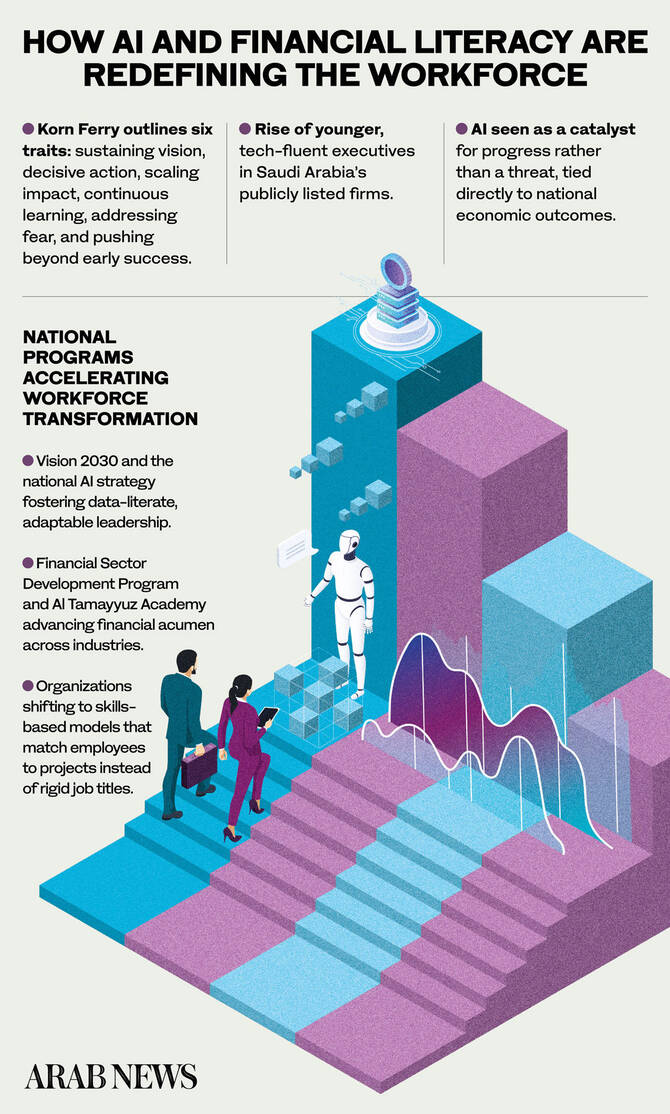
“What we’re seeing in the Saudi market is that AI is tied directly to the nation’s economic growth story,” Holmes told Arab News. “Unlike in many Western markets where AI is viewed as a threat, here it’s seen as a catalyst for progress.”


Saudi Arabia's Vision 2030 and the national AI strategy are producing “younger, more dynamic, and more tech-fluent” executives who lead with speed and adaptability. (SPA photo)

Holmes noted that Vision 2030 and the national AI strategy are producing “younger, more dynamic, and more tech-fluent” executives who lead with speed and adaptability. Korn Ferry’s CEO Tracker Report highlighted a notable rise in first-time CEO appointments in Saudi Arabia’s listed firms, signaling deliberate generational renewal.

Korn Ferry research identifies six traits for AI-ready leadership: sustaining vision, decisive action, scaling for impact, continuous learning, addressing fear, and pushing beyond early success.

“Leading in an AI-driven world is ultimately about leading people,” Holmes said. “The most effective leaders create clarity amid ambiguity and show that AI’s true power lies in partnership, not replacement.”

He believes Saudi Arabia’s young workforce is uniquely positioned to model that balance. “The organizations that succeed are those that anchor AI initiatives to business outcomes, invest in upskiling, and move quickly from pilots to enterprise-wide adoption,” he added.

DID YOU KNOW?

• Saudi women-led SMEs could add $50–$70 billion to GDP over five years if 10–15% evolve into growth ventures.

• AI in Saudi Arabia is seen as a catalyst for progress, unlike in many Western markets where it is often viewed as a threat.

• Saudi Arabia is adopting skills-based models, matching employees to projects rather than fixed roles, making flexibility the new currency of success.

The convergence of Tawfiq’s financial empowerment approach and Holmes’s AI leadership vision points to one central truth: the Kingdom’s greatest strategic advantage lies in human capital that can think analytically and act ethically.

“Financial literacy builds confidence and credibility,” Tawfiq said. “It transforms participants from operators into leaders.” Holmes echoes this sentiment: “Technical skills matter, but the ability to learn, unlearn, and scale impact is what defines true readiness.”


Saudi women in the transportation sector represent the expanding presence of female talent across high-impact industries under Vision 2030. (AN File)

As organizations adopt skills-based models that match employees to projects rather than fixed job titles, flexibility is becoming the new currency of success. Saudi Arabia’s workforce revolution is as much cultural as it is technological, proving that progress moves fastest when inclusion and innovation advance together.

Holmes sees this as the Kingdom’s defining opportunity. “Saudi Arabia can lead global workforce transformation by showing how technology and people thrive together,” he said.

Tawfiq applies the same principle to finance. “Financial confidence grows from dialogue,” she said. “The more women talk about money, valuations, and investment, the more they’ll see themselves as decision-makers shaping the economy.”

Together, their visions outline a future where leaders are inclusive, data-literate, and AI-confident—a model that may soon define the global standard for workforce transformation under Vision 2030.


AI’s shift toward proactive healthcare

Updated 05 February 2026
Follow

AI’s shift toward proactive healthcare

  • Experts reveal how AI is reducing burnout and streamlining workflows

JEDDAH: Artificial intelligence is increasingly moving from the margins of healthcare innovation into its operational core. Rather than replacing clinicians, AI is being deployed to address persistent challenges across health systems, from administrative overload and staff burnout to fragmented data and inefficient patient flow.

Speaking to Arab News, Abbes Seqqat, chief executive officer of Rain Stella Technologies, and Eric Turkington, chief product officer, discussed how AI is already transforming healthcare delivery — and why its impact is most meaningful when embedded directly into clinical workflows rather than treated as a standalone tool.

Seqqat describes AI’s role as accelerating a structural shift in healthcare delivery. “AI is accelerating the shift in healthcare from reactive to proactive care, because AI fundamentally helps detect, analyze and predict,” he said, noting that many health systems lack the resources to perform these tasks at scale.

Abbes Seqqat, chief executive officer of Rain Stella Technologies. (RST photo)

While AI use cases in healthcare are broad, Seqqat emphasized that the most effective applications today focus on operational and clinical fundamentals, including reducing administrative burden, identifying patient risks earlier, and capturing clinical data more reliably and in real time.

RST’s portfolio reflects this approach, spanning surgical data capture and workflow automation, cloud-based electronic medical records, and health information exchange. Across these systems, the common goal is improving data quality and usability so clinicians can spend less time managing information and more time delivering care.

According to Turkington, RST’s systems rely on a mix of established and emerging AI technologies.

RST's Equinox offers a streamlined workflow, minimizing redundant data entry, and also allows for seamless integration with other systems. (RST images)

“Across the portfolio, we are using a wide range of AI and predictive technologies, from voice technology to reliably capture clinician inputs, to large language models that analyze and act on collected data,” he said.

A key focus has been adapting AI to regional and clinical realities. Voice models, for example, have been trained on UAE and GCC accents and grounded in medical terminology to improve accuracy in real-world settings. RST also uses retrieval-augmented generation and multi-agent AI architectures, allowing different AI components to perform specialized tasks such as classifying surgical notes, identifying unusual events, or assisting with billing and coding, Turkington explained.

DID YOU KNOW?

• AI can detect, analyze, and predict patient risks faster than traditional methods.

• Systems like Equinox use voice input and predictive analytics to actively support clinical decisions.

• AI assistants provide real-time updates, automate documentation, and improve coordination in operating theaters.

One of the central concerns around AI adoption is whether it adds complexity to already demanding clinical roles. Seqqat argues the opposite should be the goal.
“For nurses and frontline staff, AI’s greatest contribution is removing the invisible administrative friction that leads to burnout,” Seqqat said.

In operating theaters, AI systems can replace manual coordination methods such as phone calls and whiteboards by providing real-time situational awareness. By automating updates, anticipating delays, and serving as an on-demand clinical notepad, AI reduces cognitive load and allows staff to remain focused on patient care, he explained.

RST’s voice-enabled assistant, Orva, is designed specifically for perioperative environments.

Orva captures live updates through voice input, enabling it to surface delays, flag bottlenecks, and prompt coordination between departments. (RST photo)

Turkington said it enables hands-free documentation and coordination, helping surgical teams manage schedules and resources more effectively.

By capturing live updates through voice input, Orva can surface delays, flag bottlenecks, and prompt coordination between departments. It also assists with documentation and coding, reducing errors and supporting more accurate reimbursement— an area where incomplete records often create downstream challenges.

Electronic medical records remain central to healthcare delivery, but Turkington noted that AI can move them beyond passive data repositories.

Eric Turkington, chief product officer of Rain Stella Technologies. (RST photo)

“We designed Equinox as an EMR that enables you to spend less time with the software and more time with patients,” Turkington said.

Through voice input, automated documentation from visual annotations, and AI-generated pre-visit summaries, the system can actively support clinicians rather than slow them down. Predictive analytics, such as identifying no-show risks or highlighting care gaps, further shift EMRs toward decision-support tools rather than administrative obligations.

Both executives stressed that AI’s effectiveness depends heavily on data access and quality. Seqqat pointed to interoperability as a prerequisite rather than an afterthought.
“AI is only as powerful as the data it can access,” he said, adding that fragmented records limit both clinical insight and system-wide learning.

Health information exchanges, such as RST’s Constellation platform, enable patient data to be viewed longitudinally across providers. AI can then assist with patient identity matching and population-level analysis, allowing trends and risks to be identified across large datasets.

Turkington shared an example from an operating theatre where AI helped prevent cascading delays. When a surgical case ran late, a nurse verbally updated Orva that the patient was ready to exit. The system alerted the recovery unit, analyzed schedule conflicts, and prompted management to reassign staff before delays affected subsequent procedures.

Opinion

This section contains relevant reference points, placed in (Opinion field)

By tagging the cause of the delay and feeding that data into predictive models, the system helped prevent similar issues in the future — without additional manual coordination.

According to Seqqat, the primary returns from AI adoption come from combining efficiency with financial accuracy. Streamlined workflows allow providers to treat more patients without compromising care, while improved documentation reduces revenue leakage.

Looking ahead, Seqqat sees AI becoming central to Saudi Arabia’s healthcare transformation. He described its role as advancing smart hospitals, predictive patient flow, and precision medicine aligned with Vision 2030 goals.
“The role of AI in Saudi Arabia’s healthcare sector is evolving from a supporting technology to a foundational pillar of the Kingdom’s Vision 2030 transformation. Over the next few years, we expect to see AI move into the realm of smart hospitals, where predictive analytics optimize patient flow and AI-driven precision medicine leverages the Saudi Genome Program to provide hyper-personalized care. By unifying national health data and automating complex administrative workflows, AI will enable a more proactive, value-based healthcare model that improves patient outcomes and operational efficiency across the country.”