Cat cafe brings pawsitivity to war-scarred Gaza

1 / 3
Owner Nehma Maabad holds a feline at her newly inaugurated Cat Cafe in Gaza City. (AFP)
2 / 3
Boys hold felines at the newly inaugurated Cat Cafe in Gaza City. (AFP)
3 / 3
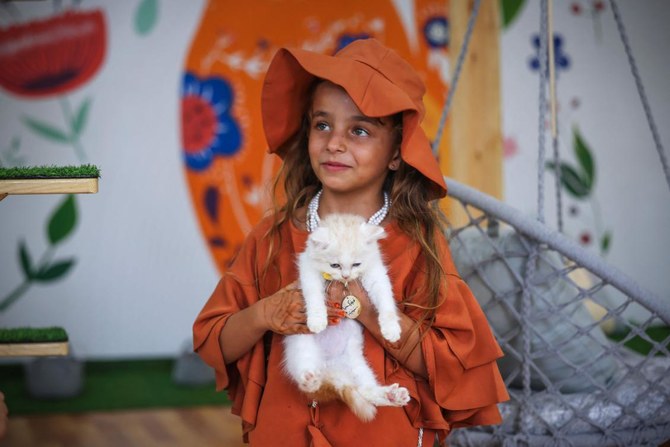
A girl holds a feline at the newly inaugurated Cat Cafe in Gaza City. (AFP)
Short Url
Updated 18 August 2023
Follow

Cat cafe brings pawsitivity to war-scarred Gaza

  • Meow is part of a growing global trend of cat cafes, but circumstances in Gaza are unique

GAZA CITY: A cat cafe in the Gaza Strip aims to “cheer up” Palestinian residents and offer them a respite from the trials of daily life in the blockaded territory, its owner said.
At the Meow Cat Cafe which opened this week in Gaza City, owner Nehma Maabad set out food for a clowder of kittens.
“Cats, for me, are a refuge that relieves me of psychological stress. So I thought of creating a project that combines serving people with something to cheer them up,” said the 50-year-old.
Part of the space is kitted out with wooden platforms covered in astroturf for the cats to clamber onto, while feline murals and portraits adorn the walls.
Meow is part of a growing global trend of cat cafes, but the circumstances in Gaza are unique.
The territory has been under a crippling Israeli blockade since 2007 and scars of repeated wars fought between Palestinian militants and Israel are visible across the city.
Customers pay nearly 10 shekels ($2.65) per hour to play with the cats, which Maabad said covers their food as well as costly vet bills.
Visiting the cafe, Manar Abu Samra said it was reasonably priced and she had told her friends and sisters about the new venture.
“The quality of cats here is beautiful and sweet, so it’s a wonderful idea — despite its strangeness to society — and when I heard about it I felt happy,” she said.
Pets are rare in Gaza although cats are ever-present, particularly around the port or fishmongers as they try to paw away some scraps.
Maabad said she had cats at home to bring to Meow, while others came from friends.
“The idea of the cafe was to have something nice with a cup of coffee,” she said.
“A cat that you play with and it makes you smile and forget the pressures of life.”


Archeologists discover world’s oldest artwork in Indonesia’s Sulawesi 

Updated 22 January 2026
Follow

Archeologists discover world’s oldest artwork in Indonesia’s Sulawesi 

  • Newly dated artworks are believed to have been created by ancestors of indigenous Australians
  • Discovery shows Sulawesi as one of world’s oldest centers of artistic culture, researcher says 

JAKARTA: Hand stencils found in a cave in Indonesia’s Sulawesi are the world’s oldest known artworks, Indonesian and Australian archeologists have said in a new study that dates the drawings back to at least 67,800 years ago.

Sulawesi hosts some of the world’s earliest cave art, including the oldest known example of visual storytelling — a cave painting depicting human-like figures interacting with a wild pig. Found in 2019, it dates back at least 51,200 years. 

On Muna, an island off the province’s southeast, researchers have discovered new artworks which are faint and partially obscured by a more recent motif on the wall. They used a new dating technique to determine their age. 

The cave art is of two faded hand stencils, one at least 60,900 years old and another dating back at least 67,800 years. This makes it the oldest art to be found on cave walls, authors of the study, which was published this week, said in the journal Nature. 

Adhi Agus Oktaviana, a researcher at the National Research and Innovation Agency, or BRIN, and co-author, said this hand stencil was 16,600 years older than the rock art previously documented in the Maros-Pangkep caves in Sulawesi, and about 1,100 years older than stencils found in Spain believed to have been drawn by Neanderthals.

The discovery “places Indonesia as one of the most important centers in the early history of symbolic art and modern human seafaring. This discovery is the oldest reliably dated rock art and provides direct evidence that humans have been intentionally crossing the ocean since almost 70,000 years ago,” Oktaviana said on Wednesday.

The stencils are located in Liang Metanduno, a limestone cave on Muna that has been a tourist destination known for cave paintings that are about 4,000 years old. 

“This discovery demonstrates that Sulawesi is one of the oldest and most continuous centers of artistic culture in the world, with roots dating back to the earliest phases of human habitation in the region,” said Prof. Maxime Aubert of Australia, another of the study’s co-authors.

To figure out the stencils’ ages, researchers used a technique called laser-ablation uranium-series dating, which allows for the accurate dating of ocher-based rock art. The method uses a laser to collect and analyze a tiny amount of mineral crusts that had formed on top of the art. 

The study also explored how and when Australia first became settled, with the researchers saying the stencil was most likely created by the ancestors of indigenous Australians.