

Archeologists discover world’s oldest artwork in Indonesia’s Sulawesi 

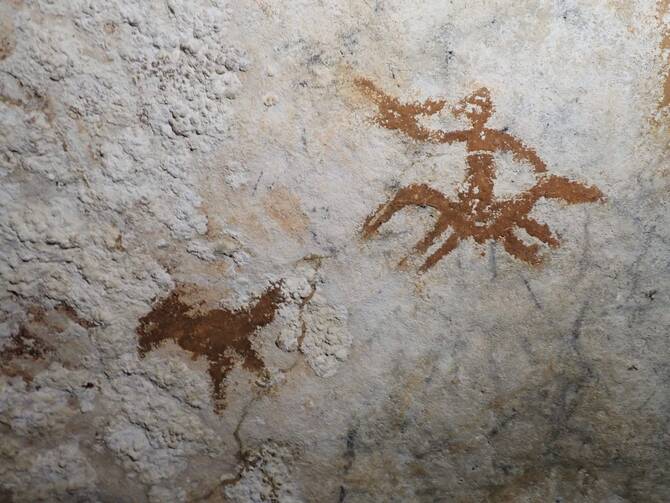
This handout photograph released on Jan. 21, 2026, shows a view of prehistoric cave paintings in the Sulawesi island of Indonesia, which includes faded hand stencils dated to at least 67,800 years ago. (AFP Photo/Maxime Aubert/Griffith University)
Short Url
Updated 22 January 2026
Follow

Archeologists discover world’s oldest artwork in Indonesia’s Sulawesi 

  • Newly dated artworks are believed to have been created by ancestors of indigenous Australians
  • Discovery shows Sulawesi as one of world’s oldest centers of artistic culture, researcher says 

JAKARTA: Hand stencils found in a cave in Indonesia’s Sulawesi are the world’s oldest known artworks, Indonesian and Australian archeologists have said in a new study that dates the drawings back to at least 67,800 years ago.

Sulawesi hosts some of the world’s earliest cave art, including the oldest known example of visual storytelling — a cave painting depicting human-like figures interacting with a wild pig. Found in 2019, it dates back at least 51,200 years. 

On Muna, an island off the province’s southeast, researchers have discovered new artworks which are faint and partially obscured by a more recent motif on the wall. They used a new dating technique to determine their age. 

The cave art is of two faded hand stencils, one at least 60,900 years old and another dating back at least 67,800 years. This makes it the oldest art to be found on cave walls, authors of the study, which was published this week, said in the journal Nature. 

Adhi Agus Oktaviana, a researcher at the National Research and Innovation Agency, or BRIN, and co-author, said this hand stencil was 16,600 years older than the rock art previously documented in the Maros-Pangkep caves in Sulawesi, and about 1,100 years older than stencils found in Spain believed to have been drawn by Neanderthals.

The discovery “places Indonesia as one of the most important centers in the early history of symbolic art and modern human seafaring. This discovery is the oldest reliably dated rock art and provides direct evidence that humans have been intentionally crossing the ocean since almost 70,000 years ago,” Oktaviana said on Wednesday.

The stencils are located in Liang Metanduno, a limestone cave on Muna that has been a tourist destination known for cave paintings that are about 4,000 years old. 

“This discovery demonstrates that Sulawesi is one of the oldest and most continuous centers of artistic culture in the world, with roots dating back to the earliest phases of human habitation in the region,” said Prof. Maxime Aubert of Australia, another of the study’s co-authors.

To figure out the stencils’ ages, researchers used a technique called laser-ablation uranium-series dating, which allows for the accurate dating of ocher-based rock art. The method uses a laser to collect and analyze a tiny amount of mineral crusts that had formed on top of the art. 

The study also explored how and when Australia first became settled, with the researchers saying the stencil was most likely created by the ancestors of indigenous Australians.


Cambodia takes back looted historic artifacts handled by British art dealer

Updated 28 February 2026
Follow

Cambodia takes back looted historic artifacts handled by British art dealer

  • The objects were returned under a 2020 agreement between the Ministry of Culture and Fine Arts and the family of the late Douglas Latchford, a British art collector and dealer who allegedly had the items smuggled out of Cambodia

PHNOM PENH, Cambodia: Cambodian officials on Friday received more than six dozen historic artifacts described as part of the country’s cultural heritage that had been looted during decades of war and instability.
At a ceremony attended by Deputy Prime Minister Hun Many, the 74 items were unveiled at the National Museum in Phnom Penh after their repatriation from the United Kingdom.
The objects were returned under a 2020 agreement between the Ministry of Culture and Fine Arts and the family of the late Douglas Latchford, a British art collector and dealer who allegedly had the items smuggled out of Cambodia.
“This substantial restitution represents one of the most important returns of Khmer cultural heritage in recent years, following major repatriations in 2021 and 2023 from the same collection,” the Culture Ministry said in a statement. “It marks a significant step forward in Cambodia’s continued efforts to recover, preserve, and restore its ancestral legacy for future generations.”
The artifacts were described as dating from the pre-Angkorian period through the height of the Angkor Empire, including “monumental sandstone sculptures, refined bronze works, and significant ritual objects.” The Angkor Empire, which extended from the ninth to the 15th century, is best known for the Angkor Wat archaeological site, the nation’s biggest tourist attraction.
Latchford was a prominent antiquities dealer who allegedly orchestrated an operation to sell looted Cambodian sculptures on the international market.
From 1970 to the 1980s, during Cambodia’s civil wars and the communist Khmer Rouge ‘s brutal reign, organized looting networks sent artifacts to Latchford, who then sold them to Western collectors, dealers, and institutions. These pieces were often physically damaged, having been pried off temple walls or other structures by the looters.
Latchford was indicted in a New York federal court in 2019 on charges including wire fraud and conspiracy. He died in 2020, aged 88, before he could be extradited to face charges.
Cambodia, like neighboring Thailand, has benefited from a trend in recent decades involving the repatriation of art and archaeological treasures. These include ancient Asian artworks as well as pieces lost or stolen during turmoil in places such as Syria, Iraq and Nazi-occupied Europe. New York’s Metropolitan Museum of Art is one of the prominent institutions that has been returning illegally smuggled art, including to Cambodia.
“The ancient artifacts created and preserved by our ancestors are now being returned to Cambodia, bringing warmth and joy, following the country’s return to peace,” said Hun Many, who is the younger brother of Prime Minister Hun Manet.