

Rise of the machines: AI spells danger for Hollywood stunt workers

1 / 3
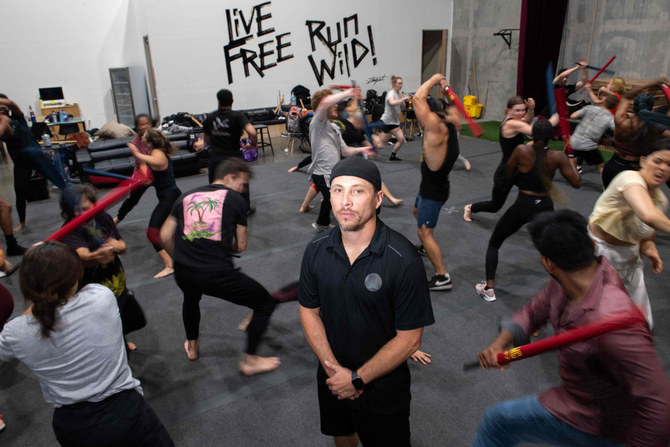
Stunts Master Class students attend a training session at the Tempest Academy, in Chatsworth, California, on August 10, 2023. (AFP)
2 / 3
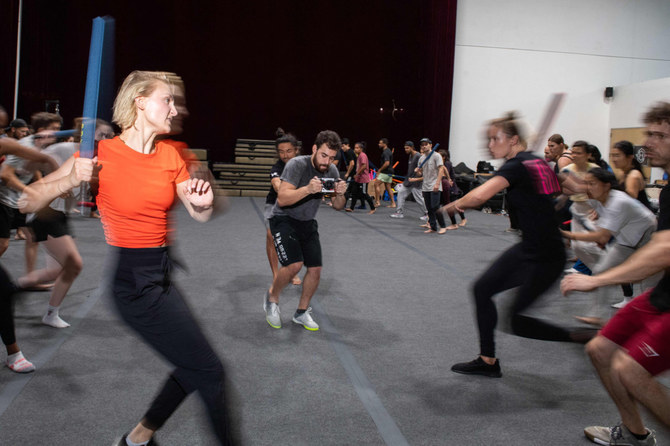
The Stunts Master Class students practice how to work in front of a camera during a training session at the Tempest Academy, in Chatsworth, California, on August 10, 2023. (AFP)
3 / 3
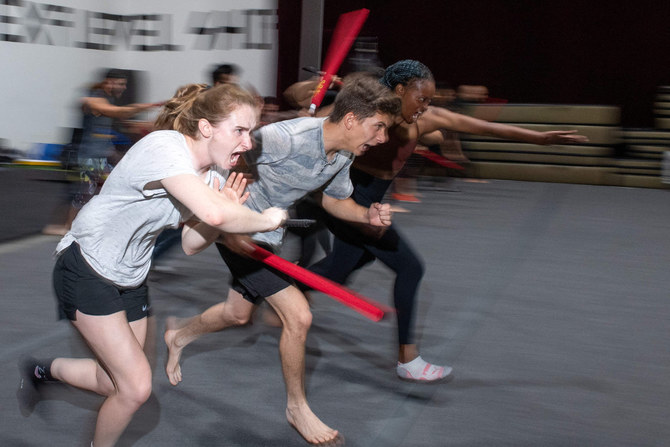
Stunts Master Class students attend a training session at the Tempest Academy, in Chatsworth, California, on August 10, 2023. (AFP)
Short Url
Updated 12 August 2023
Follow

Rise of the machines: AI spells danger for Hollywood stunt workers

  • The rise of AI means cheaper and more powerful techniques are being explored to create highly elaborate action sequences such as car chases and shootouts — without those pesky (and expensive) humans

LOS ANGELES: Hollywood’s striking actors fear that artificial intelligence is coming for their jobs — but for many stunt performers, that dystopian danger is already a reality.
From “Game of Thrones” to the latest Marvel superhero movies, cost-slashing studios have long used computer-generated background figures to reduce the number of actors needed for battle scenes.
Now, the rise of AI means cheaper and more powerful techniques are being explored to create highly elaborate action sequences such as car chases and shootouts — without those pesky (and expensive) humans.
Stunt work, a time-honored Hollywood tradition that has spanned from silent epics through to Tom Cruise’s latest “Mission Impossible,” is at risk of rapidly shrinking.
“The technology is exponentially getting faster and better,” said Freddy Bouciegues, stunt coordinator for movies like “Free Guy” and “Terminator: Dark Fate.”
“It’s really a scary time right now.”
Studios are already requiring stunt and background performers to take part in high-tech 3D “body scans” on set, often without explaining how or when the images will be used.
Advancements in AI mean these likenesses could be used to create detailed, eerily realistic “digital replicas,” which can perform any action or speak any dialogue its creators wish.
Bouciegues fears producers could use these virtual avatars to replace “nondescript” stunt performers — such as those playing pedestrians leaping out of the way of a car chase.
“There could be a world where they said, ‘No, we don’t want to bring these 10 guys in... we’ll just add them in later via effects and AI. Now those guys are out of the job.”
But according to director Neill Blomkamp, whose new film “Gran Turismo” hits theaters August 25, even that scenario only scratches the surface.
The role AI will soon play in generating images from scratch is “hard to compute,” he told AFP.
“Gran Turismo” primarily uses stunt performers driving real cars on actual racetracks, with some computer-generated effects added on top for one particularly complex and dangerous scene.
But Blomkamp predicts that, in as soon as six or 12 months, AI will reach a point where it can generate photo-realistic footage like high-speed crashes based on a director’s instructions alone.
At that point, “you take all of your CG (computer graphics) and VFX (visual effects) computers and throw them out the window, and you get rid of stunts, and you get rid of cameras, and you don’t go to the racetrack,” he told AFP.
“It’s that different.”

The lack of guarantees over the future use of AI is one of the major factors at stake in the ongoing strike by the Screen Actors Guild (SAG-AFTRA) and Hollywood’s writers, who have been on the picket lines 100 days.
SAG-AFTRA last month warned that studios intend to create realistic digital replicas of performers, to use “for the rest of eternity, in any project they want” — all for the payment of one day’s work.
The studios dispute this, and say they have offered rules including informed consent and compensation.
But as well as the potential implications for thousands of lost jobs, Bouciegues warns that no matter how good the technology has become, “the audience can still tell” when the wool is being pulled over their eyes by computer-generated VFX.
Even if AI can perfectly replicate a battle, explosion or crash, it cannot supplant the human element that is vital to any successful action film, he said, pointing to Cruise’s recent “Top Gun” and “Mission Impossible” sequels.
“He uses real stunt people, and he does real stunts, and you can see it on the screen. For me, I feel like it subconsciously affects the viewer,” said Bouciegues.
Current AI technology still gives “slightly unpredictable results,” agreed Blomkamp, who began his career in VFX, and directed Oscar-nominated “District 9.”
“But it’s coming... It’s going to fundamentally change society, let alone Hollywood. The world is going to be different.”
For stunt workers like Bouciegues, the best outcome now is to blend the use of human performers with VFX and AI to pull off sequences that would be too dangerous with old-fashioned techniques alone.
“I don’t think this job will ever just cease to be,” said Bouciegues, of stunt work. “It just definitely is going to get smaller and more precise.”
But even that is a sobering reality for stunt performers who are currently standing on picket lines outside Hollywood studios.
“Every stunt guy is the alpha male type, and everybody wants to say, ‘Oh, we’re good,’” said Bouciegues.
“But I personally have spoken to a lot of people that are freaked out and nervous.”


Global gems go under the hammer 

Updated 16 January 2026
Follow

Global gems go under the hammer 

  • International highlights from Sotheby’s ‘Origins II’ auction, which takes place Jan. 31 in Diriyah 

Andy Warhol 

‘Muhammad Ali’ 

Arguably the most famous name in pop art meets arguably the most famous sportsman of the 20th century in this set of four screen prints from 1978, created at the behest of US investment banker Richard Weisman. “I felt putting the series together was natural, in that two of the most popular leisure activities at the time were sports and art, yet to my knowledge they had no direct connection,” Weisman said in 2007. “Therefore I thought that having Andy do the series would inspire people who loved sport to come into galleries, maybe for the first time, and people who liked art would take their first look at a sports superstar.” Warhol travelled to Ali’s training camp to take Polaroids for his research, and was “arrested by the serene focus underlying Ali’s power — his contemplative stillness, his inward discipline,” the auction catalogue states. 

Jean-Michel Basquiat 

‘Untitled’ 

Basquiat “emerged from New York’s downtown scene to become one of the most influential artists of the late 20th century,” Sotheby’s says. The largely self-taught artist’s 1985 work, seen here, “stands as a vivid testament to (his) singular ability to transform drawing into a site of intellectual inquiry, cultural memory, and visceral self-expression.” Basquiat, who was of Caribbean and Puerto Rican heritage, “developed a visual language of extraordinary immediacy and intelligence, in which image and text collide with raw urgency,” the catalogue continues. 

Camille Pissarro 

‘Vue de Zevekote, Knokke’ 

The “Knokke” of the title is Knokke-sur-Mer, a Belgian seaside village, where the hugely influential French-Danish Impressionist stayed in the summer of 1894 and produced 14 paintings, including this one. The village, Sotheby’s says, appealed to Pissarro’s “enduring interest in provincial life.” In this work, “staccato brushstrokes, reminiscent of Pissarro’s paintings of the 1880s, coalesce with the earthy color palette of his later work. The resulting landscape, bathed in a sunlit glow, celebrates the quaint rural environments for which (he) is best known.” 

David Hockney 

‘5 May’ 

This iPad drawing comes from the celebrated English artist’s 2011 series “Arrival of Spring in Woldgate, East Yorkshire in 2011,” which Sotheby’s describes as “one of the artist’s most vibrant and ambitious explorations of landscape, perception, and technological possibility.” Each image in the series documents “subtle shifts in color, light and atmosphere” on the same stretch of the Woldgate, “showing the landscape as something experienced over time rather than frozen in an instant.” The catalogue notes that spring has long been an inspiration for European artists, but says that “no artist has ever observed it so closely, with such fascinated and loving attention, nor recorded it in such detail as an evolving process.” 

Zarina  

‘Morning’ 

Sotheby’s describes Indian artist Zarina Hashmi — known by her first name — as “one of the most compelling figures in post-war international art — an artist whose spare, meditative works distilled the tumult of a peripatetic life into visual form.” She was born in Aligarh, British India, and “the tragedy of the 1947 Partition (shaped) a lifelong meditation on the nature of home as both physical place and spiritual concept.” This piece comes from a series of 36 woodcuts Zarina produced under the title “Home is a Foreign Place.” 

George Condo 

‘Untitled’ 

This 2016 oil-on-linen painting is the perfect example of what the US artist has called “psychological cubism,” which Sotheby’s defines as “a radical reconfiguration of the human figure that fractures identity into simultaneous emotional and perceptual states.” It’s a piece that “distills decades of inquiry into the mechanics of portraiture, drawing upon art-historical precedent while decisively asserting a contemporary idiom that is at once incisive and darkly humorous,” the catalogue notes, adding that the work is “searing with psychological tension and painterly bravura.”