

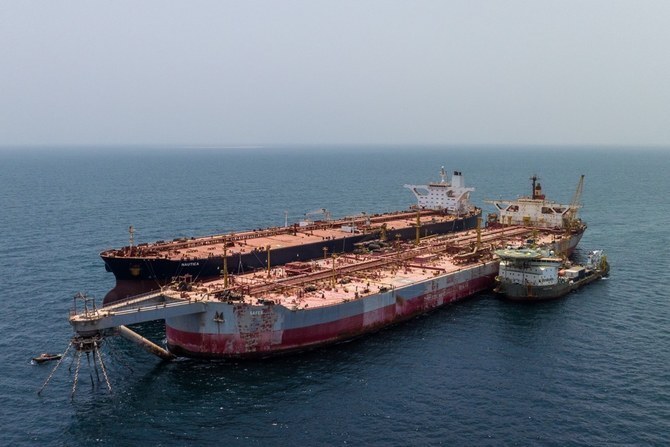

NEW YORK CITY: The UN on Friday said the imminent threat of a massive oil spill in the Red Sea had been averted, after more than a million barrels of oil were successfully transferred to a salvage ship from the Safer, a decaying storage vessel moored off the coast of Yemen for years that had been described as a “ticking time bomb.”
UN Secretary-General Antonio Guterres welcomed the successful completion of this phase of the operation, saying that it had “avoided what could have been a monumental environmental and humanitarian catastrophe.”
Achim Steiner, head of the UN’s Development Program, described it as “one of the most significant preventative actions taken in recent years.”
He added: “Some of you have written and called the FSO (floating storage and offloading vessel) Safer a ticking time bomb. I think it is fair to say that as of today, that ticking is no longer an immediate threat.”
Although the bulk of the oil has been removed, the operation is not yet complete, officials said, as there is still a small amount of viscous oil on board and the vessel could still break apart.
“The residual oil on the Safer is mixed with sediment and can’t be pumped out at this point,” said David Gressly, the UN’s resident coordinator in Yemen. “It will be removed during the final cleaning of the Safer.”
The second and final phase of the operation, which will involve stripping and cleaning the Safer and preparing it for towing and scrapping, is expected to take between a week and 10 days to complete, he added.
The vessel has been moored in the Red Sea off the coast of Yemen, near the port of Hodeidah, for more than eight years, since start of the war in the country. During that time it had little or no maintenance and its condition had deteriorated to a point where there were growing fears of a catastrophic oil spill.
According to the UN, it contained more than 1.14 million barrels of oil, which is four times as much as was spilled during the 1989 Exxon Valdez disaster off the coast of Alaska, one of the world’s worst ecological catastrophes.
Donations to fund the Safer salvage operation from 23 UN member states, the EU, the private sector and the public have surpassed $121 million but a further $20 million is still needed to complete the operation.
“We should recognize the cooperation the United Nations received from the authorities in Sanaa, particularly through the Safer Technical Committee, currently based in Hodeidah, which ensured the access, security and technical support required to carry this out,” Gressly said.
He added that the UN had also “received important political and technical support from the government of Yemen. That cannot be underestimated. They made a $5 million contribution to the global environmental facility, making (them) one of the top 10 donors to the project.”
Gressly also highlighted the fact that the two captains working on the operation on board the Safer were invited to travel from Aden to take part in the project, which he described as “an indication of the importance of going beyond the day-to-day concerns that exist in the civil war that continues here.”
The accomplishment has sparked hope not only in the international community but also among the people of Yemen, according to Gressly, who expressed hope that the ability of adversaries to work together to address this one critical problem might lay the groundwork for broader cooperation and peace negotiations.
The success of the salvage operation serves as a testament to the power of diplomacy, patience and transparency in efforts to foster collaboration in even the most challenging of situations, he added.
“It's a good Friday,” Gressly told Arab News. “We feel good about what we’ve seen today. It’s nice to see something advancing as it did here. In terms of the larger political dialogue, of course it won’t contribute directly to that. But I have to say (it) does create a bit of hope for people that there is a way forward.
“And then, while the parties are adversaries, they did find a way to set aside those differences long enough to deal with this particular problem. And that can create, I think, conditions more conducive for negotiations.
“And also, I think the fact that the (memorandum of understanding) that was signed back in March last year, that so far has been adhered to by Sanaa. is a good sign that you can have a successful negotiation in this context.
“That does not guarantee it but it does create a sense of, I think, hope that may not have been there before. And I hope those that are in a position to do so can take advantage of whatever momentum this is creating to go forth.”
Steiner similarly said that in the broader context of the situation in Yemen, a country grappling with one of the most catastrophic humanitarian crises the world has ever seen, the success of the Safer operation offers as “a glimpse of hope,” especially amid wider shifts in the dynamics of the region and within Yemen itself.
He told Arab News: “UNDP, which works in virtually all parts of the country, has estimated that Yemen over the last eight years has lost some 20 to 22 years of its development. So I think the context within which this operation had to be mounted was quite unique.
“But I think one can at least speculate that the ability of two sides to this conflict — who lack trust in each other, who are even very skeptical toward international community — to find it within themselves, and ultimately with a very strong sense of support from the public, that this was an operation that was of benefit to every citizen, and therefore required exceptional and unusual measures.
“And the story of how we got here might actually give some hope to those who believe that there is more that can be achieved in the next few months.”


