Rescue mission for Yemen’s deteriorating SFO Safer tanker nears completion

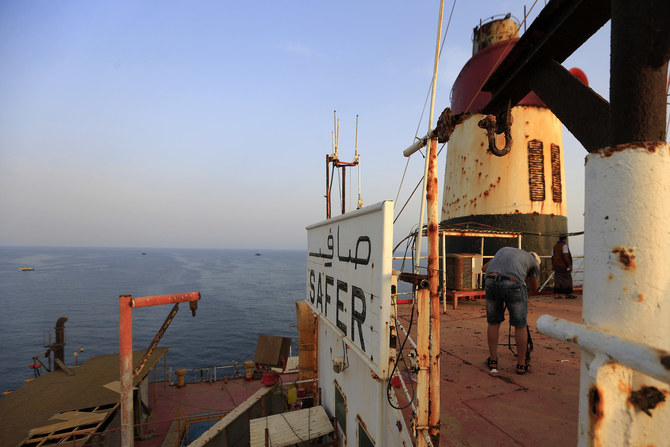
The long-awaited operation to resolve the issue of the ageing tanker SFO Safer, currently decaying off the coast of Yemen, is set to end in the coming days, the Yemeni government said on Wednesday. (AFP/File)
Short Url
Updated 09 August 2023
Follow

Rescue mission for Yemen’s deteriorating SFO Safer tanker nears completion

  • The UN announced on July 25 the start of the operation to pump more than 1.1 million barrels of oil from the Safer to head off a major environmental disaster in the Red Sea
  • Moored off the western Yemeni city of Hodeidah, the four-decade-old tanker has attracted international attention over the past few years

AL-MUKALLA: The long-awaited operation to resolve the issue of the ageing tanker SFO Safer, currently decaying off the coast of Yemen, is set to end in the coming days, with over 96 percent of the ship’s oil cargo transferred to a replacement tanker, the Yemeni government said on Wednesday.
Capt. Yeslem Mubarak, vice executive chairman of the Maritime Affairs Authority and acting head of the Safer National Committee, told Arab News that as of 9 a.m. on Wednesday, 1.105 million barrels of oil had been siphoned from the Safer, with the current phase of the operation to conclude over the weekend. The Yemeni official said the pumping process slowed as oil levels reduced.
The UN announced on July 25 the start of the operation to pump more than 1.1 million barrels of oil from the Safer to head off a major environmental disaster in the Red Sea.
Moored off the western Yemeni city of Hodeidah, the four-decade-old tanker has attracted international attention over the past few years after images revealed water seeping into the vessel as corrosion ate away at its hull.
Russell Geekie, communications advisor to UN Humanitarian Coordinator David Gressly, recently told Arab News that the UN still requires $28 million in additional funding to complete the second phase of the operation, which includes removing the deteriorating tanker itself and safely recycling it, as well as attaching a catenary anchor leg mooring buoy to the replacement tanker.
Critics, including some Yemeni government officials, argue that the UN is effectively setting another time bomb in the Red Sea by allowing the newly loaded oil tanker to moor in the area next to the deteriorating Safer until the government and the Houthis agree on who will receive the proceeds of the oil sales.
Officials say that the Houthis may use the new tanker as leverage to extract concessions from the Yemeni government and international community, as they did previously with the Safer.
“We hope that efforts will result in a solution to the problem of selling oil so that the disaster can be completely averted before the condition of the alternative tanker deteriorates, as the Houthis’ failure and inability to provide funds for its maintenance will again turn it into a ticking time bomb, as was the case with the Safer,” Mubarak said.


Clashes in Syria’s Aleppo deepen rift between government, Kurdish forces

Updated 10 sec ago
Follow

Clashes in Syria’s Aleppo deepen rift between government, Kurdish forces

ALEPPO: Fierce fighting in Syria’s northern city of Aleppo between government forces and Kurdish fighters drove thousands of civilians from ​their homes on Wednesday, with Washington reported to be mediating a de-escalation. The violence, and statements trading blame over who started it, signaled that a stalemate between Damascus and Kurdish authorities that have resisted integrating into the central government was deepening and growing deadlier. Deadly clashes broke out on Tuesday between Syrian government troops and the Kurdish-led Syrian Democratic Forces (SDF).
After relative calm overnight, shelling resumed on Wednesday and intensified in the afternoon, Reuters reporters in the city said.
A spokesperson for Aleppo’s health directorate told Reuters that four civilians had been killed on Tuesday and more than two dozen wounded on Tuesday and Wednesday. Security ‌sources separately told Reuters ‌that two fighters had also been killed.
The health directorate said ‌there ⁠were ​no ‌civilian fatalities on Wednesday, and that it was not authorized to comment on deaths among fighters.
By Wednesday evening, fighting had subsided, the Reuters reporters said. Ilham Ahmed, who heads the foreign affairs department of the Kurdish administration, told Reuters that international mediation efforts were underway to de-escalate. A source familiar with the matter told Reuters the US was mediating.

THOUSANDS OF CIVILIANS FLEE
The directorate for social affairs said on Wednesday night that more than 45,000 people had been displaced from Aleppo city, most of them heading northwest toward the enclave of Afrin.
The Syrian ⁠army announced that military positions in the Kurdish-held neighborhoods of Sheikh Maqsoud and Ashrafiyah were “legitimate military targets.” Two Syrian security officials told Reuters ‌that they expected a significant military operation in the city.
The government ‍opened humanitarian corridors for civilians to flee flashpoint ‍neighborhoods, ferrying them out on city buses.
“We move them safely to the places they want to ‍go to according to their desire or to displaced shelters,” said Faisal Mohammad Ali, operations chief of the civil defense force in Aleppo.
The latest fighting has disrupted civilian life in what is a leading Syrian city, closing the airport and a highway to Turkiye, halting operations at factories in an industrial zone and paralysing major roads into ​the city center.
The Damascus government said its forces were responding to rocket fire, drone attacks and shelling from Kurdish-held neighborhoods. Kurdish forces said they held Damascus “fully and directly responsible ⁠for ... the dangerous escalation that threatens the lives of thousands of civilians and undermines stability in the city.” During Syria’s 14-year civil war, Kurdish authorities began running a semi-autonomous zone in northeast Syria, as well as in parts of Aleppo city.
They have been reluctant to give up those zones and integrate fully into the Islamist-led government that took over after ex-President Bashar Assad’s ousting in late 2024.
Last year, the Damascus government reached a deal with the SDF that envisaged a full integration by the end of 2025, but the two sides have made little progress, each accusing the other of stalling or acting in bad faith.
The US has stepped in as a mediator, holding meetings as recently as Sunday to try to nudge the process forward. Sunday’s meetings ended with no tangible progress.
Failure to integrate the SDF into Syria’s army risks further violence ‌and could potentially draw in Turkiye, which has threatened an incursion against Kurdish fighters it views as terrorists.