Local fighters control three towns in tense Ethiopian region

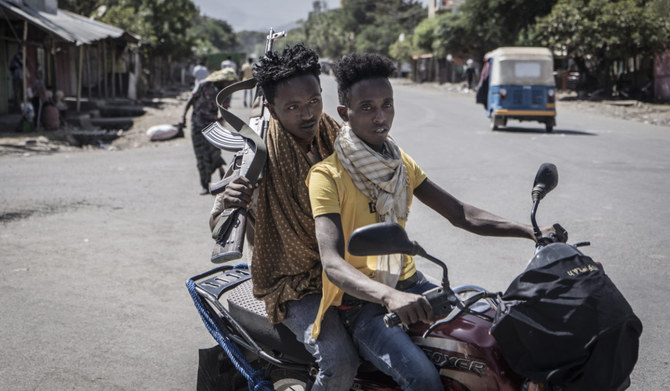
Members from Amhara militia are seen in Shewa Robit, Ethiopia. (AFP file photo)
Short Url
Updated 05 August 2023
Follow

Local fighters control three towns in tense Ethiopian region

  • According to residents of Lalibela, a UNESCO World Heritage site famous for its 12th and 13th-century rock-cut churches, the local militia Fano took control of the town and its airport earlier this week

NAIROBI: Local fighters were in control of three towns in Ethiopia’s Amhara region on Saturday, residents said, after clashes with the national army prompted the federal government to impose a “state of emergency.”
The fresh unrest in Africa’s second-most populous country comes just nine months after the end of a devastating two-year war in the neighboring region of Tigray which also drew in fighters from Amhara.
The government said Friday that the restrictions would cover Amhara “for six months” but could be imposed “nationwide in relation to any situation or movement that aggravates the security problem.”
Tensions have been rising since April when the federal government announced it was dismantling regional forces across Ethiopia, triggering protests by Amhara nationalists who said the move would weaken the northern region.
Clashes in Amhara have escalated in recent weeks, prompting travel warnings from foreign governments and the grounding of flights, with Prime Minister Abiy Ahmed’s office on Friday saying emergency measures were needed “to control this unacceptable movement.”
According to residents of Lalibela, a UNESCO World Heritage site famous for its 12th and 13th-century rock-cut churches, the local militia Fano took control of the town and its airport earlier this week.
Shops were open on Saturday but streets were largely deserted, Lalibela resident Aneley said.
“Lalibela is calm, no fighting ... (but) people’s movement isn’t like it used to be before,” he said, adding that the town was suffering from intermittent power and internet outages.
The mood was similarly tense in the cities of Gondar and Dessie, locals said.
“Things look calm but there is no activity ... almost all shops, cafes are closed,” said Simachew, a rickshaw driver in Gondar, which witnessed fighting on Thursday before federal troops retreated to its outskirts.
“People are indoors in their homes,” he said, with Fano fighters blocking routes in and out of the city.
Amir, a businessman from Dessie, said there was “no fighting here,” with Fano members in control of the city.
“Markets and shops are open but people here are ... on alert.”
The Ethiopian Human Rights Commission on Friday said civilians had been attacked, with damage reported to property, while transport services and internet had been suspended in some areas of Amhara.
Web security firm Cloudflare said they “saw (internet) traffic in Amhara drop on Wednesday.”
National carrier Ethiopian Airlines has canceled flights to Dessie, Lalibela and Gondar.
The US has “expressed concern” about the violence, while Britain and Spain have both warned their citizens against traveling to parts of Amhara.


Trump says Australia will grant asylum to Iran women footballers

Team Iran listens to the national anthem before the AFC Women’s Asian Cup Australia 2026 football match.
Updated 09 March 2026
Follow

Trump says Australia will grant asylum to Iran women footballers

  • Presenter on Iranian state TV had branded the players “wartime traitors” after they stood motionless during the anthem

MIAMI: US President Donald Trump said Monday that Australia had agreed to grant asylum to some of Iran’s visiting women’s football team, amid fears they could face retaliation back home for not singing the national anthem before a match.
The gesture ahead of the team’s Asian Cup match against South Korea last week was seen by many as an act of defiance against the Islamic republic just two days after the United States and Israel attacked it.
“I just spoke to Prime Minister Anthony Albanese, of Australia, concerning the Iranian National Women’s Soccer Team. He’s on it! Five have already been taken care of,” Trump said Monday on his Truth Social network, less than two hours after an initial post urging Australia to take them in.
Trump added that “some, however, feel they must go back because they are worried about the safety of their families, including threats to those family members if they don’t return.”
There was no immediate comment from the Australian government, which has so far declined to say whether it could offer the players asylum.
Asked about their case on Sunday, Foreign Minister Penny Wong said Australia “stands in solidarity” with the people of Iran.
The son of Iran’s late shah, US-based Reza Pahlavi, warned on Monday that the refusal to sing the anthem could have “dire consequences,” and urged Australia to offer the team protection.
Trump then weighed in, pressing Albanese to “give ASYLUM” to the team and adding: “The US will take them if you won’t.”
“Australia is making a terrible humanitarian mistake by allowing the Iran National Woman’s Soccer team to be forced back to Iran, where they will most likely be killed,” the US leader said on Truth Social.
Pahlavi, who has not returned to Iran since before the 1979 Islamic revolution that ousted the monarchy, has billed himself as the man to lead a democratic transition to a secular Iran as the theocratic regime fights to survive.
Politicians, human rights activists and even “Harry Potter” author J.K. Rowling have also called for the team to be offered official protection.
“Please, protect these young women,” Rowling said in a post on social media.

‘Save our girls’ 

A presenter on Iranian state TV had branded the players “wartime traitors” after they stood motionless during the anthem before their match against South Korea.
In subsequent games, the players saluted and sang.
Crowds gathered outside the Gold Coast stadium where the side played their last match over the weekend, banging drums and shouting “regime change for Iran.”
They then surrounded the Iranian team bus, chanting “let them go” and “save our girls.”
On Monday, an AFP journalist saw members of the team speaking on phones from their balcony of their hotel.
Asked about the possibility of granted asylum, a spokesperson for Australia’s Home Affairs department told AFP earlier it “cannot comment on the circumstances of individuals.”
Amnesty International campaigner Zaki Haidari said they faced persecution, or worse, if they were sent home.
“Some of these team members probably have had their families already threatened,” Haidari told AFP.
“Them going back... who knows what sort of punishment they will receive?“
Despite being heavily monitored, the side would have a “small window of opportunity” to seek asylum at the airport, he said.
Iran’s embassy in Australia did not respond to a request for comment.